Tag Archives: Stern

MBA Concentration Acceptance Rate Analysis

With the current semester just about over, next years application essay questions will be posted in the coming weeks for many schools. Round one applicants should start figuring out their story and crafting their essays. The most important essay for most schools is the question: Why get an MBA and why is [insert school name here] the right choice for you? In order to answer this question you need to have a plan for how an MBA is going to help you achieve your goals. The vast majority of MBA students are looking to switch careers. Why else pay $120,000 in tuition and give up two years of salary? If you wanted to stay in the same industry, you would probably just go for a promotion or switch companies.

I was curious if the industry an applicant is trying to transition into impacts their MBA acceptance rate. My theory was that there are a lot of people trying to transition into consulting, banking and technology, so there may be oversupply for those concentrations. Perhaps a candidate would stick out if they are pursuing a more unique career. I took the business school admissions data from GMAT Club and looked at the acceptance rate by stated concentration. First I decided to look at the top 20 schools in aggregate, to ensure the results were statistically significant. I was surprised by how much the acceptance rate varied depending on MBA concentration.

MBA Acceptance Rate by Concentration
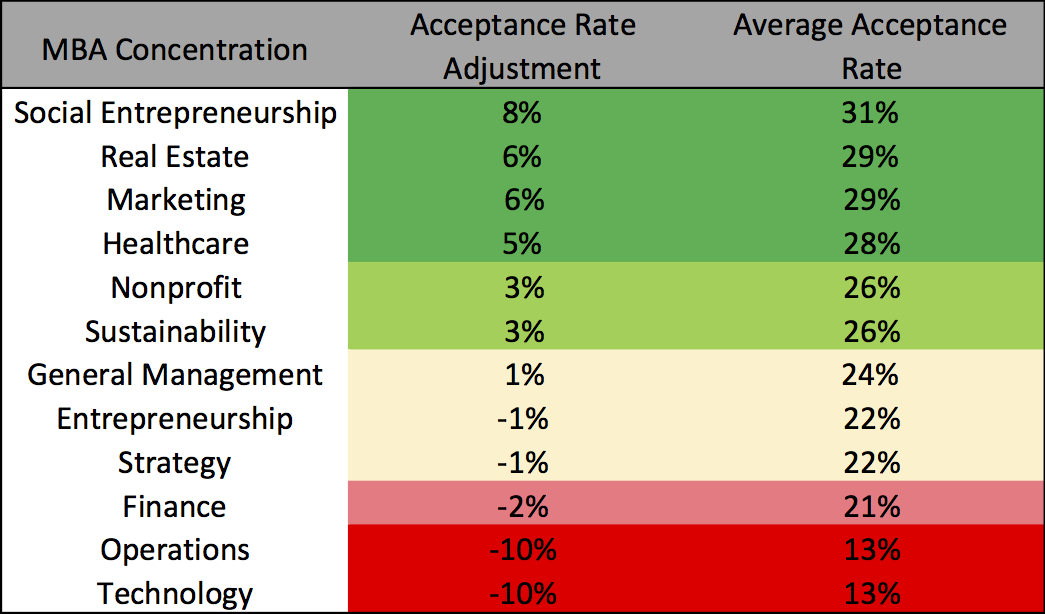
MBA Concentration Acceptance Rate Business SchoolThe average acceptance rate for top 20 schools is 23%. Many of the concentrations towards the top are fairly small with the exception of Marketing. As you can see, there is a huge range in the acceptance rates based on industry focus. With Social Entrepreneurship applicants 2.5 times more likely to be admitted than applicants interested in Technology or Operations. Most of the results don’t surprise me, business schools seem to be trying to help the world right now, so it is no shock that Social Entrepreneurship, Nonprofit and Sustainability are all in the top half. With the crisis in the Healthcare industry, the high acceptance rate for Healthcare applicants is also logical I am a little surprised that Real Estate is so high and Technology is so low. There is not a lot of focus on Real Estate that I have seen in business school, so I didn’t expect it to be the concentration with the second highest acceptance rate. On the other hand, Technology is very hot right now, so it is shocking the admissions rate is so low.

Since this data does not have gender included, it is possible that the acceptance rates are skewed by gender concentrations. More women tend to focus on Nonprofit, Social Entrepreneurship, Marketing and Healthcare, which could have bumped up the acceptance rate. Many schools are trying to increase their female enrollment, so women tend to have higher acceptance rates. At the other end of the spectrum, industries such as Operations and Technology are more dominated by men, which likely led to the low acceptance rates in those concentrations.

In the end, I wouldn’t recommend outright gaming the system. Don’t say you want to pursue Social Entrepreneurship rather than Technology if Tech is really what you are passionate about. It will likely show in your application. However if you are unsure of what you want to focus on, it would make sense to chose the concentration you are interested in that has the highest acceptance rate. There was a lot of variance by school. The chart below shows some of the highest and lowest acceptance rate concentrations by school. Take these findings with a grain of salt because the sample size is pretty small.

School Increase Acceptance Rate Lower Acceptance Rate
Stanford Social Entrepreneurship Finance, Entrepreneurship
Harvard Entrepreneurship Finance*
Wharton Healthcare* Finance, Entrepreneurship, Marketing
Booth Healthcare*, Marketing* Entrepreneurship, Finance, Operations*
Sloan Marketing, Social Entrepreneurship* Technology*, Operations*
Kellogg Entrepreneurship, Marketing, Social Entrepreneurship Operations*, Technology*
Haas Entrepreneurship, Healthcare Operations*, Technology*
Columbia Social Entrepreneurship Entrepreneurship, Marketing, Healthcare
Tuck Healthcare, Marketing Finance, Technology*
Darden Marketing Entrepreneurship, Finance
NYU Entrepreneurship, Finance, Marketing*
Ross Entrepreneurship, Marketing, Healthcare*, Social Entrepreneurship* Finance, Operations*, Technology*
Duke Healthcare, Marketing, Social Entrepreneurship* Finance, Operations*, Technology*
Yale Marketing*, Social Entrepreneurship* Entrepreneurship
Anderson Finance, Marketing Entrepreneurship, Technology
Cornell Finance Entrepreneurship, Operations
McCombs Entrepreneurship, Marketing Finance
Kenan-Flagler Finance, Healthcare*, Marketing*
Tepper Entrepreneurship, Operations, Marketing* Finance
Emory Marketing Finance

*This concentration had a very large increase or decrease.

MBA Waitlist Acceptance Rate Rank

A more up-to-date analysis of MBA waitlist acceptance rate has been completed which include admissions data for the class of 2019.

At this point in the year many applicants have been placed on the waitlist for the school of their dreams. It is a frustrating experience that I personally have experienced. This articles shows the MBA waitlist acceptance rates for the top US MBA programs. The data for this analysis comes from GMATClub. These acceptance rates are meant to give a rough idea of the waitlist acceptance rate and should be taken with a grain of salt. The sample sizes vary by school; Olin, Emory and Stanford have the lowest sample sizes.

MBA Waitlist Acceptance Rate by School Rank

US News Rank School Waitlist Acceptance Rate
1 Stanford 9%
2 Harvard 2%
3 Wharton 6%
4 Booth 15%
5 Sloan 8%
6 Kellogg 6%
7 Haas 4%
8 Columbia 6%
9 Tuck 10%
10 Darden 16%
11 NYU 3%
11 Ross 11%
13 Duke 4%
13 Yale 3%
15 Anderson 18%
16 Cornell 11%
17 McCombs 8%
18 Kenan-Flagler 46%
19 Olin 30%
20 Tepper 13%
21 Emory 4%

MBA waitlist acceptance rates ranges widely from 46% to 2% depending on the school. It tends to vary quite a bit from year to year, so these acceptance rates should only be used as a guide. For example Dartmouth’s average waitlist acceptance rate is 10%, however for the class of 2016 it was only 2%. The top ten schools on average have a slightly lower waitlist acceptance rate coming in at 8% while the next ten schools average a noticeably higher acceptance rate of 14%.

MBA Waitlist Acceptance Rate Rank

Acceptance Rank School Waitlist Acceptance Rate
1 Kenan-Flagler 46%
2 Olin 30%
3 Anderson 18%
4 Darden 16%
5 Booth 15%
6 Tepper 13%
7 Ross 11%
8 Cornell 11%
9 Tuck 10%
10 Stanford 9%
11 Sloan 8%
12 McCombs 8%
13 Kellogg 6%
14 Wharton 6%
15 Columbia 6%
16 Emory 4%
17 Duke 4%
18 Haas 4%
19 Yale 3%
20 NYU 3%
21 Harvard 2%

The schools with the highest MBA waitlist acceptance rates are Kenan-Flagler, Olin, and Anderson. At the other end are Harvard, NYU and Yale with the lowest waitlist acceptance rates. Although NYU has the highest interview acceptance rate, it rarely accepts anyone off the waitlist.

MBA Acceptance Rate by Application Round

An updated MBA acceptance rate by round analysis article can be found here which includes application data from the class 2017 and 2018.

Some business schools have roughly the same acceptance rate during all rounds while others see a significant drop off in later rounds. With applications for round 3 due in the next month or two, this analysis may help you decide which schools to focus on and which to avoid. Here is a list of the top 20 schools’ MBA acceptance rates by application round. The data for this analysis came from GMAT Club, which may be a biased sample. People on GMAT Club tend to have higher GMAT scores than the general applicant pool, so the acceptance rate can be significantly higher for some schools. The acceptance rates are meant to give you an idea of the relationship between rounds, not the absolute acceptance rate. These numbers are raw and not adjusted for other variables such as GMAT and GPA.

MBA Acceptance Rate by Round

The first table is MBA acceptance rates by round ordered by school ranking. The acceptance rates that have a star next to them means that the sample size is very small and might not be very accurate.

US News Rank School Round 1 Round 2 Round 3 Round 4
1 Stanford 8% 5% 2%
1 Wharton 19% 16% 0%*
1 Harvard 12% 6% 4%
4 Booth 29% 25% 15%
5 MIT 16% 11%
6 Kellogg 26% 23% 20%*
7 Haas 17% 17% 6%
8 Columbia 23% 20%
9 Tuck 28% 29% 22% 9%
10 NYU 29% 27% 21%
11 Ross 41% 42% 38%*
11 Darden 32% 33% 16%
13 Yale 24% 27% 9%
14 Duke 31% 33% 21%
15 McCombs 38% 36% 28%
16 Anderson 26% 34% 9%
17 Johnson 39% 36% 37%
18 Tepper 24% 38% 43%
19 Kenan-Flagler 36% 40% 60%
20 Emory 26% 40% 37%

Schools with Significantly Lower Round 3 Acceptance Rate

Many of the top 20 MBA programs have significantly lower acceptance rates in round 3 to the point where it is better to wait until next year to apply. Harvard, Stanford and Wharton, the number one ranked schools, have a large decrease in acceptance rate for round 3. Only 2% to 3% of applications for these schools are in round 3 because everyone knows that acceptance rates are so low. Haas, Yale, Duke, UVA and UCLA also see a significant drops in round 3 admissions compared to earlier rounds. Dartmouth has a respectable round 3 acceptance rate of 22%, but a very low 9% chance of admission for round 4.

Schools with Similar or Higher Round 3 Acceptance Rate

While many schools have a lower acceptance rate for round 3, there are several schools that don’t have a drop off in response. Ross, Cornell, and Emory all have similar admission odds for the third round, while Tepper and UNC actually have a higher acceptance rate for round 3.

Round 3 MBA Acceptance Rate Ranking

This is the the same table as the first one but ranked by round 3 acceptance rate from highest to lowest. Some schools have a round 4 that I did not include, because the sample size was too small. I combined round 4 applications with round 3 except for Tuck because Dartmouth actually had a large number of round 4 applicants.

Round 3 Rank School Round 1 Round 2 Round 3 Round 4
1 Kenan-Flagler 36% 40% 60%
2 Tepper 24% 38% 43%
3 Ross 41% 42% 38%*
4 Johnson 39% 36% 37%
4 Emory 26% 40% 37%
6 McCombs 38% 36% 28%
7 Tuck 28% 29% 22% 9%
8 NYU 29% 27% 21%
8 Duke 31% 33% 21%
10 Kellogg 26% 23% 20%*
11 Darden 32% 33% 16%
12 Booth 29% 25% 15%
13 Yale 24% 27% 9%
13 Anderson 26% 34% 9%
15 Haas 17% 17% 6%
16 Harvard 12% 6% 4%
17 Stanford 8% 5% 2%
18 Wharton 19% 16% 0%*
19 MIT 16% 11%
19 Columbia 23% 20%

The most surprising number is  UNC Kenan-Flagler’s round 3 acceptance rate of 60%, which is significantly higher than that of round 1 and 2. I looked at the GMAT and GPA for each round to see if they would explain the high admissions in round 3, however they were both slightly lower than other rounds. I can’t explain why UNC round 3 acceptance rate is so high, but it is a great school to apply to in the third round.

Kenan-Flagler UNC MBA Acceptance Rate by Round GMAT GPA Admissions Statistics

By request, below is the GMAT, GPA and age for Harvard and Booth by round. Round 3 data does not have a ton of data, so take this with a grain of salt.

School Variable R1 R2 R3
Booth GMAT 735 739 728
Booth GPA 3.61 3.62 3.58
Booth Age 27 28 29
Harvard GMAT 735 728 720
Harvard GPA 3.61 3.57 3.54
Harvard Age 27 27 27

* Sample size is 30 or fewer applications.

Stern Interview Preparation

NYU Stern Interview MBA Business SchoolStern Interviewed me back in December 2013. I am happy to say that I was accepted. I used Clear Admit to prepare, and it was very helpful. I felt ready and don’t remember being caught off guard by any questions. I have created a list of the most common questions you can expect during a Stern interview because I want to help all of my potential future classmates. Most Stern interviews are around 30 minutes and conducted by an admissions staff member who has read your full application. My first question was about a unique activity that I participate in that I mentioned in the application. When you arrive, you will receive a folder with information about clubs/programs you mentioned you would be interested in. You will also be given a Stern shirt so you can show your pride if you are admitted. My Stern interview was right before winter break so I didn’t hear back for almost 3 weeks, but often candidates get their decision in as little as a few days. Don’t forget to bring a copy of your transcripts, your application cannot proceed without them. I forgot mine and had to overnight them when I got back home.

The Most Common Stern Interview Questions

  1. (63%) Why do you want to attend Stern?
  2. (63%) How did you come to work for XYZ company? Or why did you transition for XYZ company to ABC company?
  3. (53%) What is your back up plan if you don’t get a job in your desired post-MBA role?
  4. (42%) What programs would you get involved with at Stern?
  5. (37%) Describe a conflict you had at work (or challenging situation or time you failed) and how you overcame it.
  6. (37%) What is your proudest professional achievement?
  7. (37%) What companies do you want to work at post MBA? (Have a list of 5 companies and reasons for each one)
  8. (37%) How is your post MBA goal different from your current role?
  9. (32%) Where would you like to intern between your first and second year?
  10. (26%) How would your (friends, manager or colleague) describe you?
  11. (21%) What is the weakest aspect of your resume?
  12. (21%) If you are admitted to all of the schools you applied to, how will you decide which school to attend?
  13. (21%) Why do you want to get an MBA?
  14. (16%) How do you plan to market yourself to your target industry?
  15. (16%) Tell me about yourself or walk me through your resume.
  16. (16%) If 25 years from now you were asked to return to Stern to speak, how would you want to be introduced?
  17. (11%) What is your role within a team?
  18. (11%) What will you contribute to the class?
  19. What other schools are you applying to?
  20. What other schools did you apply to? How would you decide where to attend?
  21. What frustrates me the most at my current role?
  22. What role would I prefer to take (if any) in a student organization?
  23. Tell me about what you’ve learned working at your current company?
  24. What’s the best constructive criticism your boss has given you?
  25. What do you hope to learn from your future classmates?
  26. How did you choose to attend ABC for undergrad? What is your best memory of your time there?
  27. How did you first hear about Stern and in what ways did you learn about the school?
  28. What most surprises you about Stern?
  29. Is international experience important to me in my business school experience? Why?
  30. Tell me what you like to do in your free time.
  31. What do you like about New York? What neighborhoods would you consider living in?
  32. What would you change/enhance on the Stern website?
  33. What makes Stern’s culture different from other schools?
  34. During the first few weeks at Stern, how will you distinguish yourself from the other students?
  35. Why do your MBA in New York City? (about the city.. not the school)
  36. What do you bring to the class?

Any question that doesn’t have a percentage next to it I only saw once in interview reports. The one Stern interview question that rubs me the wrong way is the question about  your back up plan. As a member of the class of 2016, I wonder is it so common that Stern students fail to get the job they want post MBA that Stern need to ask almost every student this question?

If you are invited for a Stern interview, please let me know if this guide was helpful for you. Also, check out my guide on how to prepare for an MBA interview.

Other interview preparation articles:

MIT / Sloan Interview Preparation

Upenn / Wharton Interview Preparation

Tuck Interview Preparation

HBS Interview Preparation

MBA Interview Acceptance Rate Rankings

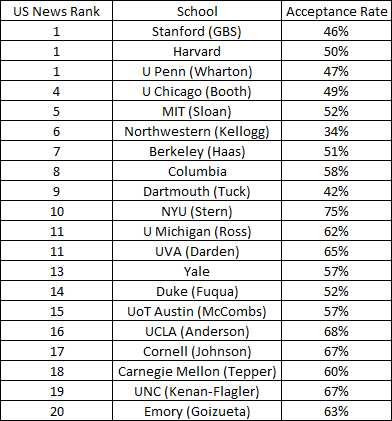
So you have just been invited to interview at the MBA school of your dreams. Obviously this raises your chance of getting in, but by how much? In general, top ten schools have lower MBA interview acceptance rates while schools ranked 11 to 20 have a higher acceptance rate for applicants who were interviewed.

MBA Interview Acceptance Rate by Rank

MBA Interview Acceptance Rate by Rank

Interview acceptance rate for Stanford, Harvard, Wharton, Booth, MIT, Kellogg, Hass, Columbia, Dartmouth, NYU, Ross, Darden, Yale, Duke, McCombs, Anderson, Cornell, Tepper, Kenan-Flagler, Emory

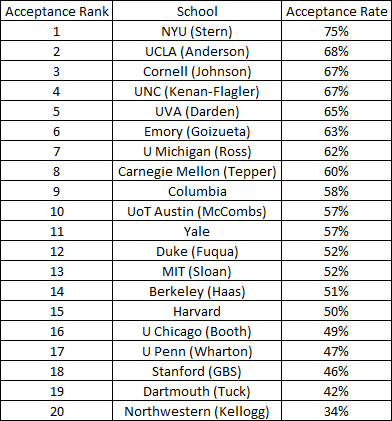
The acceptance rate ranges from 34% to 75% for schools in the top 20. The average MBA interview acceptance rate for the top 10 is 50% and it is 62% for schools ranked 11 to 20.

MBA Interview Acceptance Rate Rankings from Highest to Lowest

MBA Interview Acceptance Rate from Highest to LowestNYU jumps out as the highest acceptance rate by a wide margin. If you have been selected to interview at Stern then you can prepare to open a bottle of champagne because you are probably going to business school. No other school in the top 10 has an interview acceptance rate above 60%.

On the other end of the spectrum is Kellogg and Tuck with the lowest acceptance rates. These two schools will allow anyone who visits campus to interview, so it is not surprising that they admit significantly fewer applicants who are interviewed. Most of the top 10 schools have an acceptance rate clustered between 46% and 51%.

Duke has the lowest acceptance rate for a school not in the top 10 at 52%. The rest of the schools range from 57% to 68%,

Good luck and don’t forget to prepare for your MBA interviews!

Stern Interview Acceptance Rate Analysis

I know that the final decisions for applicants who were interviewed for New York University’s business school are expected soon. I decided to perform a Stern interview acceptance rate analysis to see if I could predict the chance of acceptance for applicants who were invited to interview. From my data sample 74% of applicants who were invited to interview were ultimately accepted.

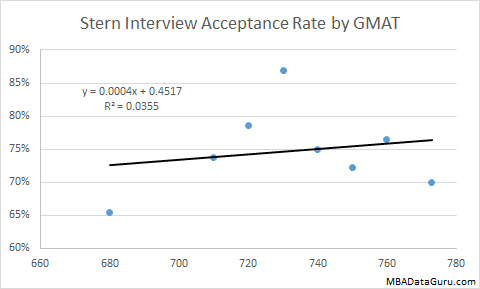
Stern Interview Acceptance Rate by GMAT

Stern Interview Acceptance Rate by GMAT NYU MBA School AdmissionsNot only is the slope of the regression line very flat, but also the the R-squared is only 3%. These two pieces of information suggest that once a candidate is invited to interview, their GMAT has no impact on acceptance rate.

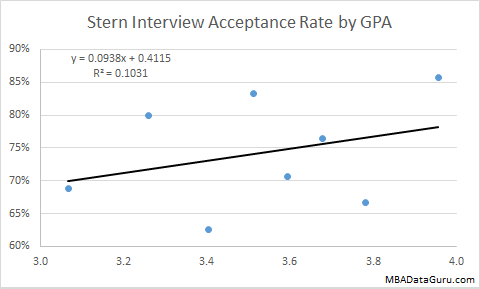
Stern Interview Acceptance Rate by GPA

Stern Interview Acceptance Rate by GPA NYU Business School AdmissionThe slope of the GPA graph is a little steeper than the GMAT graph slope. The R-squared is also higher, coming in at 10%. Once again, this indicates that GPA has a little more impact on your chance of admission after being invited to interview compared to GMAT.

The low R-squared of the GPA and GMAT compared to admissions for interviewed applicants suggest that NYU treats all applicants as equal once they are invited to interview. If interviewed you are on equal footing compared to all other candidates invited to interview. This is different compared to Ross, which has a much higher correlation between GMAT / GPA and acceptance rate. The GMAT & GPA acceptance rate R-squared ranged from 30% to 75% for Ross, which is much higher than the 3% to 10% for Stern.

The data used for this post comes from GMAT Club.

Stern Acceptance Rate Analysis

I just finished building the Stern acceptance rate prediction model. I will post the admissions calculator as soon as I have time to finish learning PHP and then build that portion of the website. I’ll probably have time to work on it over Christmas break, but right now I am too busy applying for interviews for summer internships. In the mean time I will share some of the insights I got from building the model.

Stern Acceptance Rate by GMAT

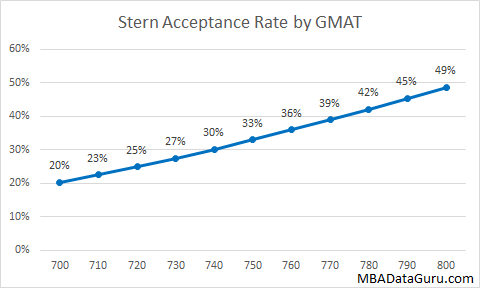
The first thing that jumped out at me was that the acceptance rates I came up with are noticeably higher than the published acceptance rate of 15%. I believe that this is because the average candidate who applies and posts their data on GMAT Club, where I get my data, is more competitive than the average candidate. The average GMAT Club applicant to Stern has a GPA or 3.45 and GMAT of 709, which is not too far from the scores listed on the class profile for Sterns class of 2016 of 3.52 and 721.

Stern Acceptance Rate by GMAT MBA Admissions Business School NYUIf you are applying to Stern, it is pretty obvious that having a higher GMAT is important and will significantly raise your chances of being admitted. To create the graph above, I used my model with the average GPA of 3.45.

Stern Acceptance Rate by GPA

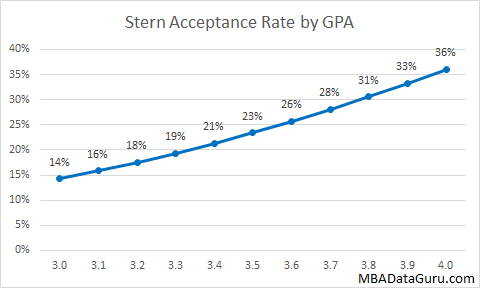
Next I looked at how GPA affects Stern acceptance rate. Once again there is a clear relationship between GPA and admission rate for NYU. In the graph below I used the average GPA score of 709 in my admissions model.Stern Acceptance Rate by GPA NYU Admissions Business School

Stern Acceptance Rate by Round

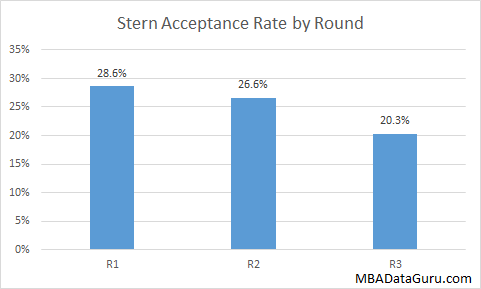
Many candidates want to know if it matters in which round you apply. I took a look at the raw acceptance rate by round for NYU. As you can see the acceptance rate for round 2 is slightly lower and for round 3 it is noticeably lower.

Stern Acceptance Rate by Round MBA NYU Admissions Business SchoolThe acceptance rates above are raw numbers, not the predicted values from my admissions model. Why you ask? Because when I took into account all of the other factors, the round you apply in is not statistically significant. The reason the acceptance rate is lower in round 2 and 3 is not because the schools are more selective but because on average lower quality candidates apply in those rounds. If you are a qualified candidate, do not worry about applying to Stern in round 3, you still have a good chance of getting in.

Stern Prefers GMAT over GPA

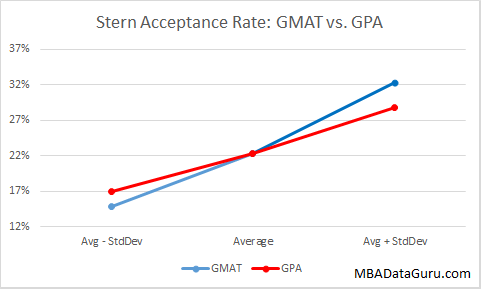
In the past I tried to figure out if Stern prefers a high GMAT or GPA and didn’t come up with anything conclusive. Now that I have built the Stern admissions model I can see how a similar change in GMAT or GPA impact acceptance rate at Stern. In the graph below I compare how much the admissions rate changes if I alter the GMAT or GPA by a standard deviation. If you are applying to business school then you should probably know what a standard deviation is, however if you don’t it is a standard measure of variance in a population or sample. Since I can’t compare an absolute variance because GMAT and GPA are on different scales, I compare how the shift of one standard deviation impacts the Stern acceptance rate.

Stern Acceptance Rate GPA vs GMAT MBA NYU Admissions Business SchoolIn the graph above, you can see that increasing the GPA by one standard deviation (.28) increase acceptance rate by 29%, but raising the GMAT score by one standard deviation (39) leads to a 45% higher chance of admissions. It is clear that Stern prefers candidates with high GMAT score over ones with a high GPA. This is good news for candidates with a low GPA because with enough hard work, you can increase your odds significantly by raising your GMAT.

Other NYU Admissions Insights

I also found that NYU prefers candidates with an average age of 27 to 28, the further you are from this average age, the lower your chance of getting in. Stern really likes candidates that come from consulting. Applicants from consulting had a acceptance rate of 42% vs. 21% for non-consultants. Having more work experience also increased your odds of admissions. Acceptance rate increased by about 2% for each year of work experience. However, once you pass 28, the age deviation factor is significantly stronger than the work experience factor so you shouldn’t wait until after 28 to apply.

I noticed that candidates that majored in business or engineering had a lower chance of admission. Business majors with average scores had a 8% chance of admission compared to 24% for non-business majors. Engineers had a 13% chance of getting in compared to a 26% chance for non-engineers. These differences are statistically significant even after taking into account all other factors. That being said, I majored in engineering and I got into Stern. I also know many other business and engineering majors who are currently attending Stern with me.

Stern: How Important is the GMAT vs. GPA

I posted an updated analysis of Stern Acceptance rate for GPA vs. GMAT on this page.

NYU is currently ranked 10th by US News and World Report for full-time MBA programs and is tied for the 3rd highest average GMAT score. I expected to see Stern prefer GMAT over GPA, but that is not what I found.

Stern NYU GMAT GPA Admissions MBA Business School

It turns out that Stern has by far the smallest slope of any of the other schools I have looked at so far. The .0043 slope means that Stern would view a candidate with a 800 GMAT and 3.00 GPA similarly to one with a 700 GMAT and 3.43 GPA.

Other Schools:

Sloan

Wharton

Tuck

Columbia Business School

Methodology: The scatterplot represents the 50% of applicants who are accepted with the lowest GMAT and GPA. It isn’t helpful to look at the top 50% of applicants because those are not the marginal candidates who barely got in. I occasionally will remove very low outliers because those candidates may have been admitted due to very strong connections that most applicants don’t have. I never remove more than 5% of the total accepted students as outliers. The slope of the scatterplot demonstrates the point at which the school is indifferent to GMAT vs. GPA.