Tag Archives: Owen

MBA Waitlist Acceptance Rate Analysis (with Class of 2019 data)

MBA Waitlist Acceptance Rate Analysis by GMATOne of the most frustrating parts of the MBA application process is waiting to hear back from the schools. First, applicants have to wait to hear if you will be interviewed. Next, an applicant must wait to hear if they have been admitted. Some unlucky souls will have to wait a third time on the waitlist, sometimes for up to 8 months if they are a round 1 applicant. I created this updated MBA waitlist acceptance rate analysis to provide some transparency to those who are on the waitlist.
Unlike the rather stable overall admission rate, the MBA waitlist acceptance rate fluctuates substantially. Some years it is very high for a school and other years it can be zero. The acceptance yield of the school in a given year drives the waitlist acceptance rate. In addition to providing the average acceptance rate from 2012 to 2017, I also included the lowest year and highest year during that period. Some of the smaller schools have a lot less data available, so the acceptance rates below are less reliable.

MBA Waitlist Acceptance Rate and Range

Rank
School
Low
Average
High
1
Harvard University (HBS)
0%
6%
14%
1
University of Pennsylvania (Wharton)
0%
5%
6%
3
University of Chicago (Booth)
3%
17%
35%
4
Stanford University (GSB)
0%
18%
50%
4
Northwestern University (Kellogg)
0%
5%
10%
4
Massachusetts Institute of Technology (Sloan)
2%
9%
17%
7
University of California—​Berkeley (Haas)
0%
7%
15%
8
Dartmouth College (Tuck)
0%
6%
15%
9
Columbia University (CBS)
5%
13%
24%
9
Yale University (YSOM)
0%
9%
21%
11
University of Michigan—​Ann Arbor (Ross)
6%
14%
20%
12
New York University (Stern)
0%
5%
13%
12
Duke University (Fuqua)
2%
5%
11%
14
University of Virginia (Darden)
0%
17%
27%
15
University of California—​Los Angeles (Anderson)
5%
17%
33%
16
Cornell University (Johnson)
0%
10%
19%
17
University of Texas—​Austin (McCombs)
4%
7%
20%
18
University of North Carolina—​Chapel Hill (Kenan-​Flagler)
6%
26%
55%
19
Carnegie Mellon University (Tepper)
0%
9%
22%
20
Emory University (Goizueta)
0%
8%
33%
21
Georgetown University (McDonough)
0%
8%
13%
21
Indiana University (Kelley)
0%
13%
18%
21
Washington University in St. Louis (Olin)
11%
26%
50%
24
University of Southern California (Marshall)
0%
20%
50%
25
Arizona State University (Carey)
0%
12%
20%
25
Vanderbilt University (Owen)
0%
19%
50%

I suspected that some schools would have a higher preference for waitlisted applicants with higher GMATs. I found that schools treated applicants very differently based on GMAT. Some schools have a preference for very high GMATs, while others have a preference average GMATs (for top MBAs). Strangely, some schools have no preference for GMAT while others appear to have a preference for lower GMATs. The data is a little thin, so take this with a grain of salt.

Waitlist acceptance rate for schools with preference for very higher GMATs

School
< 700
700 – 730
740+
Harvard University (HBS)
0%
0%
13%
Stanford University (GSB)
0%
0%
13%
University of Pennsylvania (Wharton)
0%
0%
5%
Columbia University (CBS)
0%
0%
16%

Waitlist acceptance rate for schools that have a preference for higher GMATs

School
< 700
700 – 730
740+
Northwestern University (Kellogg)
6%
2%
11%
Dartmouth College (Tuck)
0%
8%
6%
Duke University (Fuqua)
0%
6%
4%
University of Virginia (Darden)
20%
17%
27%
Georgetown University (McDonough)
0%
14%
20%

Waitlist acceptance rate for schools that have a preference for average GMATs

School
< 700
700 – 730
740+
University of California—​Berkeley (Haas)
0%
6%
3%
Yale University (YSOM)
0%
17%
4%
University of Michigan—​Ann Arbor (Ross)
10%
18%
11%

Waitlist acceptance rate for schools that have preference for lower GMATs

School
< 700
700 – 730
740+
University of California—​Los Angeles (Anderson)
27%
19%
6%
University of Texas—​Austin (McCombs)
8%
9%
6%
Carnegie Mellon University (Tepper)
9%
9%
3%

Waitlist acceptance rate for schools that have no preference for GMAT

School
< 700
700 – 730
740+
University of Chicago (Booth)
18%
15%
19%
Massachusetts Institute of Technology (Sloan)
14%
14%
8%
New York University (Stern)
8%
6%
7%
Cornell University (Johnson)
11%
11%
12%
University of North Carolina—​Chapel Hill (Kenan-​Flagler)
33%
21%
29%

Some schools had data that was too thin to analyze. Those schools are Carey, Emory, Kelley, Olin, Owen, and USC.

MBA Interview Probability for top schools by GMAT and GPA

With round 2 application deadlines rapidly approaching, many applicants may wonder what their chance of getting an MBA interview with their favorite schools is. I analyzed the MBA interview probability for the top 25 schools over the past 5 years by GMAT and GPA. Unsurprisingly, for most schools the MBA interview chance increased for high GMAT and high GPA candidates.

Some interesting insights I found:

  • At Booth, GPA has little to no impact on likelihood of getting and interview unless your GMAT is under 700
  • At Columbia, GMAT and GPA are very important for your interview chances
  • At Cornell, GMAT is far more important than GPA for getting an interview
  • At Duke, neither GPA nor GMAT seem to have much of an impact on interview odds
  • At Emory, strangely, if you have a GMAT of 700 or higher then low GPA applicants actually have a higher chance of getting an interview
  • At Georgetown, chance of getting an interview for 740+ applicants is no more than for those in the 700 to 730 range
  • At Stanford and Harvard, chance of interviewing is depressingly low, both GMAT and GPA are very important
  • At Ross, GPA doesn’t seem to matter if an applicant has a GMAT of 740 or higher
  • At NYU, having a very high GMAT dramatically increases your chance of getting an interview
  • At Wharton, having a high GMAT only appears to matter if the applicants GPA is over 3.40
  • At Yale, both GMAT and GPA have a huge impact on chance of getting an interview

University of Chicago (Booth) MBA Interview Probability

< 700
700 – 730
740+
< 3.40
33%
52%
68%
3.40 – 3.59
28%
53%
67%
3.60+
58%
59%
73%

Arizona State University (Carey) MBA Interview Probability

< 700
700 – 730
740+
< 3.40
56%
53%
75%
3.40 – 3.59
58%
33%
100%
3.60+
52%
62%
75%

Carnegie Mellon University (Tepper) MBA Interview Probability

< 700
700 – 730
740+
< 3.40
67%
61%
74%
3.40 – 3.59
48%
62%
80%
3.60+
53%
49%
77%

Columbia University MBA Interview Probability

< 700
700 – 730
740+
< 3.40
19%
25%
43%
3.40 – 3.59
17%
34%
54%
3.60+
28%
43%
55%

Cornell University (Johnson) MBA Interview Probability

< 700
700 – 730
740+
< 3.40
46%
62%
69%
3.40 – 3.59
48%
61%
68%
3.60+
54%
58%
72%

Duke University (Fuqua) MBA Interview Probability

< 700
700 – 730
740+
< 3.40
58%
64%
65%
3.40 – 3.59
57%
58%
62%
3.60+
76%
63%
66%

Emory University (Goizueta) MBA Interview Probability

< 700
700 – 730
740+
< 3.40
47%
55%
78%
3.40 – 3.59
44%
52%
57%
3.60+
52%
43%
62%

Georgetown University (McDonough) MBA Interview Probability

< 700
700 – 730
740+
< 3.40
65%
74%
72%
3.40 – 3.59
65%
88%
85%
3.60+
71%
85%
89%

Stanford University (GSB) MBA Interview Probability

< 700
700 – 730
740+
< 3.40
3%
3%
12%
3.40 – 3.59
6%
12%
18%
3.60+
13%
14%
22%

University of California—​Berkeley (Haas) MBA Interview Probability

< 700
700 – 730
740+
< 3.40
12%
27%
22%
3.40 – 3.59
28%
27%
44%
3.60+
27%
39%
50%

Harvard University (HBS) MBA Interview Probability

< 700
700 – 730
740+
< 3.40
5%
10%
13%
3.40 – 3.59
12%
15%
18%
3.60+
12%
24%
27%

Indiana University (Kelley) MBA Interview Probability

< 700
700 – 730
740+
< 3.40
44%
57%
75%
3.40 – 3.59
39%
70%
70%
3.60+
34%
76%
84%

Northwestern University (Kellogg) MBA Interview Probability

< 700
700 – 730
740+
< 3.40
67%
82%
80%
3.40 – 3.59
56%
77%
86%
3.60+
60%
76%
83%

University of Texas—​Austin (McCombs) MBA Interview Probability

< 700
700 – 730
740+
< 3.40
44%
68%
76%
3.40 – 3.59
51%
74%
81%
3.60+
60%
75%
82%

Washington University in St. Louis (Olin) MBA Interview Probability

< 700
700 – 730
740+
< 3.40
58%
76%
88%
3.40 – 3.59
62%
77%
91%
3.60+
74%
86%
80%

Vanderbilt University (Owen) MBA Interview Probability

< 700
700 – 730
740+
< 3.40
74%
80%
56%
3.40 – 3.59
66%
74%
83%
3.60+
94%
83%
92%

University of Michigan—​Ann Arbor (Ross) MBA Interview Probability

< 700
700 – 730
740+
< 3.40
50%
57%
72%
3.40 – 3.59
54%
65%
70%
3.60+
50%
68%
70%

Massachusetts Institute of Technology (Sloan) MBA Interview Probability

< 700
700 – 730
740+
< 3.40
14%
26%
24%
3.40 – 3.59
0%
24%
33%
3.60+
26%
39%
39%

New York University (Stern) MBA Interview Probability

< 700
700 – 730
740+
< 3.40
24%
28%
44%
3.40 – 3.59
35%
41%
58%
3.60+
13%
37%
56%

Dartmouth College (Tuck) MBA Interview Probability

< 700
700 – 730
740+
< 3.40
58%
66%
71%
3.40 – 3.59
38%
64%
82%
3.60+
65%
73%
74%

University of California—​Los Angeles (Anderson) MBA Interview Probability

< 700
700 – 730
740+
< 3.40
26%
40%
57%
3.40 – 3.59
23%
60%
70%
3.60+
24%
60%
69%

University of North Carolina—​Chapel Hill (Kenan-​Flagler) MBA Interview Probability

< 700
700 – 730
740+
< 3.40
72%
68%
89%
3.40 – 3.59
59%
71%
83%
3.60+
63%
73%
90%

University of Southern California (Marshall) MBA Interview Probability

< 700
700 – 730
740+
< 3.40
38%
74%
67%
3.40 – 3.59
52%
74%
75%
3.60+
28%
71%
85%

University of Virginia (Darden) MBA Interview Probability

< 700
700 – 730
740+
< 3.40
40%
41%
58%
3.40 – 3.59
36%
39%
73%
3.60+
50%
54%
60%

University of Pennsylvania (Wharton) MBA Interview Probability

< 700
700 – 730
740+
< 3.40
29%
35%
33%
3.40 – 3.59
26%
27%
46%
3.60+
29%
36%
55%

Yale University (YSOM) MBA Interview Probability

< 700
700 – 730
740+
< 3.40
15%
31%
42%
3.40 – 3.59
24%
41%
63%
3.60+
34%
53%
67%

Best Schools for Young MBA Applicants

Deciding when to start applying to business school can be a challenge. Salary increases dramatically after an MBA, but schools tend to prefer applicants with more work experience. I looked at the top 25 US MBA programs’ admission data to find the best schools for young MBA applicants in terms of chance of being admitted. I analyzed the MBA acceptance rate by age to see which schools had the smallest disadvantage for younger applicants relative to traditionally aged MBA applicants.

How Many MBA Applicants are Young?

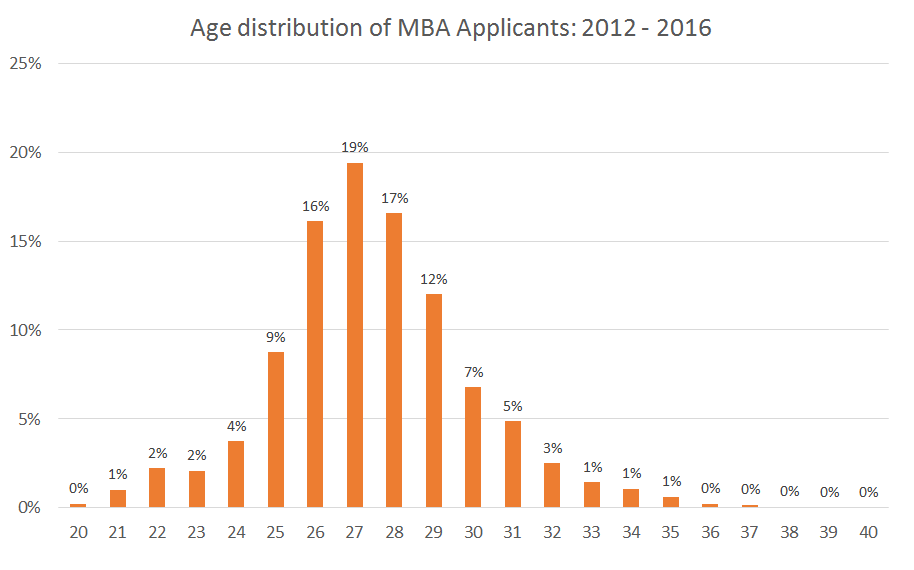
I defined an applicant as young if they are 25 or younger. I compared the young MBA applicants to those who are the more typical age range of 26 to 29. Over the past 5 years, the number of young applicants has increased significantly from 13% of the applicant pool to 21% over the past 5 years. Despite the increase in supply of young applicants, there has not been a drop in acceptance rate for younger candidates.

MBA Applicant Age Distribution

MBA Applicant Age Distribution

The rise in applications from younger applicants could be driven by some schools adopting programs specifically targeted at undergraduates. Harvard has the 2+2 program that allows undergraduates to apply to HBS while they are still in school. Those who are accepted must spend at least 2 years working full time before starting their MBA. NYU Stern also has a program targeted towards undergraduates called the Berkley Scholars. It is a very selective program where 5 to 6 undergraduates will get a full ride and a stipend for living expenses. Unlike Harvard’s 2+2 program, Berkley Scholars start their MBA immediately. The Berkley Scholars tend to do very well. From the class of 2016, two of the scholars joined McKinsey and one went to BCG.

Best Schools for Young MBA Applicants

Almost every school in the top 25 penalizes young applicants in admissions. On average young applicants have only 2.5 years of work experience which, is 2 years lower than traditionally aged applicants that are 26 to 29. Most of the best schools for young MBA applicants still moderately penalize younger applicants. Stanford is the only school that actually gives young applicants an advantage when they apply. My hypothesis is that it is related to their affinity for startups. If a young person has a great idea for a startup, will 2 more years working as a low level analyst really improve the odds of it working out? In the table below, the “Disadvantage for <25” column shows how much lower the odds are for a young applicant to be admitted. For example at MIT an applicant that is 26 to 29 has a 16% acceptance rate. The disadvantage factor is -10%, so the young MBA acceptance rate is 14.4%. I have included the average GMAT and GPA for reference.

School
Disadvantage
for <25
GMAT
(<25)
GMAT
(26 – 29)
GPA
(<25)
GPA
(26 – 29)
Stanford University (GSB)
52%
733
731
3.57
3.59
Washington University in St. Louis (Olin)
3%
719
712
3.52
3.46
Massachusetts Institute of Technology (Sloan)
-10%
720
729
3.56
3.52
Carnegie Mellon University (Tepper)
-16%
714
714
3.43
3.39
Georgetown University (McDonough)
-20%
699
699
3.43
3.35
University of North Carolina—​Chapel Hill (Kenan-​Flagler)
-26%
709
712
3.42
3.37
Cornell University (Johnson)
-28%
712
715
3.32
3.36
Columbia University (CBS)
-29%
722
726
3.55
3.49
Vanderbilt University (Owen)
-30%
698
692
3.49
3.34
University of Virginia (Darden)
-35%
723
718
3.44
3.39

Worst Schools for Young MBA Applicants

These schools are at the complete other end of the spectrum. These MBA programs severely penalize young applicants. It is interesting to see Berkeley, the other top California school, treats young applicants completely contrary to Stanford. Young applicants have a 72% lower chance of being admitted then applicants 26 to 29, despite the young applicants having higher GMAT and GPA. I was a little shocked to see Harvard featured so prominently on the list of worst schools for young MBA applicants given that they have the 2+2 program to attract young talent.

School
Dissadvantage for <25
GMAT
(<25)
GMAT
(26 – 29)
GPA
(<25)
GPA
(26 – 29)
University of California—​Berkeley (Haas)
-72%
722
721
3.56
3.51
University of Michigan—​Ann Arbor (Ross)
-64%
721
720
3.33
3.41
Harvard University (HBS)
-63%
731
732
3.59
3.58
Arizona State University (Carey)
-52%
690
687
3.46
3.41
University of Pennsylvania (Wharton)
-52%
734
731
3.56
3.55
Duke University (Fuqua)
-50%
716
717
3.46
3.42
University of Texas—​Austin (McCombs)
-49%
717
708
3.38
3.44
Dartmouth College (Tuck)
-48%
716
727
3.51
3.46
Indiana University (Kelley)
-47%
694
698
3.43
3.39
Yale University (YSOM)
-46%
713
724
3.49
3.47
University of California—​Los Angeles (Anderson)
-45%
720
718
3.48
3.47
University of Chicago (Booth)
-44%
726
731
3.56
3.52
Emory University (Goizueta)
-44%
714
705
3.46
3.37
Northwestern University (Kellogg)
-42%
730
724
3.5
3.49
New York University (Stern)
-41%
711
718
3.47
3.43
University of Southern California (Marshall)
-40%
703
707
3.52
3.42

MBA Acceptance Rate by Age Group

For reference, here are the raw MBA acceptance rates by age group for each school. I also looked at older applicants and plan to do a follow-up article focusing on applicants that are 30 years old and older.

Rank
School
<= 25
26 – 29
30+
1
Harvard University (HBS)
4%
12%
12%
1
University of Pennsylvania (Wharton)
10%
22%
15%
3
University of Chicago (Booth)
16%
28%
18%
4
Stanford University (GSB)
8%
5%
5%
4
Northwestern University (Kellogg)
14%
24%
26%
4
Massachusetts Institute of Technology (Sloan)
14%
16%
11%
7
University of California—​Berkeley (Haas)
4%
16%
8%
8
Dartmouth College (Tuck)
14%
27%
17%
9
Columbia University (CBS)
15%
21%
13%
9
Yale University (YSOM)
13%
24%
16%
11
University of Michigan—​Ann Arbor (Ross)
14%
40%
36%
12
New York University (Stern)
15%
26%
14%
12
Duke University (Fuqua)
13%
26%
24%
14
University of Virginia (Darden)
23%
36%
19%
15
University of California—​Los Angeles (Anderson)
14%
24%
22%
16
Cornell University (Johnson)
28%
40%
41%
17
University of Texas—​Austin (McCombs)
19%
37%
29%
18
University of North Carolina—​Chapel Hill (Kenan-​Flagler)
30%
41%
42%
19
Carnegie Mellon University (Tepper)
34%
40%
38%
20
Emory University (Goizueta)
22%
39%
42%
21
Georgetown University (McDonough)
39%
49%
46%
21
Indiana University (Kelley)
22%
42%
56%
21
Washington University in St. Louis (Olin)
34%
33%
38%
24
University of Southern California (Marshall)
24%
40%
35%
25
Arizona State University (Carey)
19%
39%
62%
25
Vanderbilt University (Owen)
35%
50%
63%

Are you curious what round to apply during? Check out my article on MBA Acceptance Rate by round.

MBA Acceptance Rate by Round (class of 2018 data included)

The third round of MBA applications is notorious for having a lower acceptance rate. With the third round application deadlines approaching quickly for most business schools, you may be wondering if the stereotype about the third round is fact or fiction. I updated my analysis of MBA acceptance rate by round with the last 2 years of data and I expanded it to include Olin, Georgetown, USC, Arizona State and Vanderbilt.

This analysis was done using self-reported data from GMAT Club. Data from the class of 2014 through the class of 2018 was used because otherwise there would not be enough data for round 3 and 4 to accurately capture the acceptance rate.

MBA Acceptance Rate by Round Key Takeaways

  • At almost all top 15 schools applicants have a moderate to significant disadvantage when applying during the 3rd and 4th round
  • Applicants to schools ranked 16 to 25 had little to no disadvantage when applying in the 3rd and 4th round
  • On average, top 15 schools had a much larger drop in applicant GMAT from round 1 to round 3 (16 points) than the rest of the top 25 (4 points), but GPA decline was identical (.07)
  • Schools with the largest drop in acceptance rate from round 1 to 3 also had the largest drop in GMAT (20 points)
  • Schools with moderate drop in acceptance rate from round 1 to 3 had a smaller drop in GMAT (10 points)
  • Schools that have no disadvantage when applying 3rd round had almost no drop in GMAT (3 points)

Schools where round doesn’t matter

Although 60% of the top 25 schools are noticeably impacted by which round you apply, several schools don’t appear to care when you apply. Stanford GSB and NYU Stern are the only two schools in the top 15 that are not influenced by which round an applicant applies. Cornell, UNC, Tepper, Emory, Kelley, USC, ASU and Vanderbilt all appear to be unaffected by which round a candidate applies.

Schools where round has moderate impact

Many schools in the across the entire top 25 are moderately impacted by application round. This include top 15 schools such as Kellogg, Tuck, CBS (rolling admission), Ross and Duke. McCombs, Georgetown and Olin are all only minimally impacted by application round.

Schools where round has high impact

Only schools in the top 15 seem to be highly impacted by applying 3rd round. HBS, Wharton, Haas and Darden are most impacted by round. Booth, Sloan, Yale and UCLA are also significantly affected by application round.

MBA Acceptance Rate by Round

Rank
School
R1
R2
R3
R4
1
Harvard University (HBS)
13%
8%
4%
1
University of Pennsylvania (Wharton)
20%
20%
0%
3
University of Chicago (Booth)
26%
23%
13%
4
Stanford University (GSB)
6%
6%
6%
4
Northwestern University (Kellogg)
22%
20%
13%
4
Massachusetts Institute of Technology (Sloan)
18%
10%
Low data
7
University of California—​Berkeley (Haas)
14%
14%
6%
Low data
8
Dartmouth College (Tuck)
26%
24%
20%
7%
9
Columbia University (CBS)
20%
16%
9
Yale University (YSOM)
21%
21%
11%
11
University of Michigan—​Ann Arbor (Ross)
26%
31%
24%
12
New York University (Stern)
19%
22%
22%
Low data
12
Duke University (Fuqua)
24%
23%
15%
14
University of Virginia (Darden)
29%
28%
13%
15
University of California—​Los Angeles (Anderson)
19%
22%
9%
16
Cornell University (Johnson)
33%
33%
31%
33%*
17
University of Texas—​Austin (McCombs)
32%
28%
24%
Low data
18
University of North Carolina—​Chapel Hill (Kenan-​Flagler)
26%
33%
44%
38%
19
Carnegie Mellon University (Tepper)
25%
36%
34%
Low data
20
Emory University (Goizueta)
27%
35%
32%
25%*
21
Georgetown University (McDonough)
41%
47%
32%
21
Indiana University (Kelley)
22%
39%
34%
21
Washington University in St. Louis (Olin)
31%
31%
27%
28%
24
University of Southern California (Marshall)
26%
32%
23%*
25
Arizona State University (Carey)
37%
20%
37%
Low data
25
Vanderbilt University (Owen)
41%
41%
49%
45%*

Check out the upcoming deadlines for round 3 and 4.

*Very few data points are available, so confidence on the accuracy is also low.