Tag Archives: Interview

Ross Interview Acceptance Rate Analysis

Earlier today I posted the Ross acceptance rate analysis which shows how GPA and GMAT scores affect your chance of admission at University of Michigan’s MBA program. I received a request to see if GMAT and GPA can still predict acceptance rate out of the applicants who were selected to interview. I would never want to disappoint a reader, so here is my Ross interview acceptance rate analysis. While reading this analysis, keep in mind that around 62% of interviewed applicants are accepted, which is higher than schools like Harvard and Wharton but lower than Stern.

Ross Interview Acceptance Rate by GMAT
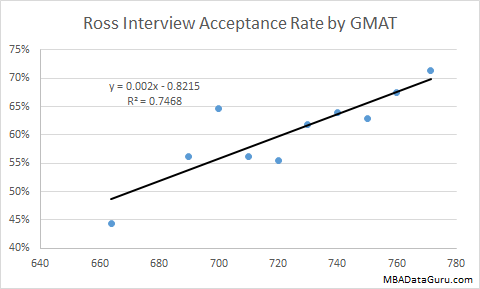
Ross Interview Acceptance Rate by GMAT Michigan MBA Business School AdmissionsIn the graph above you can see that there is a clear relationship between Ross acceptance rate even among the applicants selected to interview. The R-squared is 74% which is fairly high, so GMAT is an accurate predictor of admissions post interview. The slope of the line suggests that for every 10 points higher your GMAT is, you have a 2% higher chance of admissions. Unfortunately for those with a low GMAT score, you are not on an equal playing field even after being selected for an interview at Ross.

Ross Interview Acceptance Rate by GPA
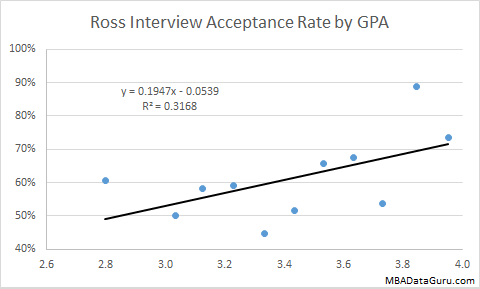
Ross Interview Acceptance Rate by GPA Michigan MBA Business School AdmissionsThere is also a relationship between Ross interview acceptance rate and GPA, but the correlation is much weaker. Just from looking at the graph you can see that the data is more spread out from the regression line. The R-squared of 32% is much lower than the R-squared for GMAT of 74%. All else equal, it would help your chance of admission if you have a high GPA, but it does not seem to matter as much as GMAT.

When I analyzed Harvard Business School acceptance rate, I found that GMAT and GPA could not predict acceptance rate from the pool of applicants selected to interview. Which means everyone who was interviewed were on a level playing field once invited to interview. That does not seem to be the case for Ross. In the end, even with a low GMAT or GPA, you still have a 50% of being accepted after your interview. All you can do is prepare for your Ross MBA interview as much as possible and hope for the best.

Tuck Admissions Analysis

Tuck Admissions Analysis MBA Business SchoolThe final decision for the Tuck MBA January round applications is being released tomorrow. Tuck calls the students who have been accepted either the day of or the day before the decision is released. Today, mostly international acceptance calls were made, and I have not been called yet. I am based in the US so I am not super nervous yet, but I am finding it difficult to think of anything other than the Tuck decision. I was incredibly unproductive at work today because I spent the entire time hoping my phone would ring. To help ease my worries I created this elaborate Tuck admissions analysis to try to figure out my chances of getting in. Each of the following graphs are only acceptance rate vs. one variable. In reality there are probably interaction effects between different variables, so this is by no means especially accurate, but my final conclusion is that I have a 53% chance of being admitted. I was hoping the number would come out higher, but it is a lot better than the 20.8% acceptance rate overall at Tuck.

Tuck Admissions Analysis

Tuck Admissions Analysis GMAT Acceptance Rate MBA

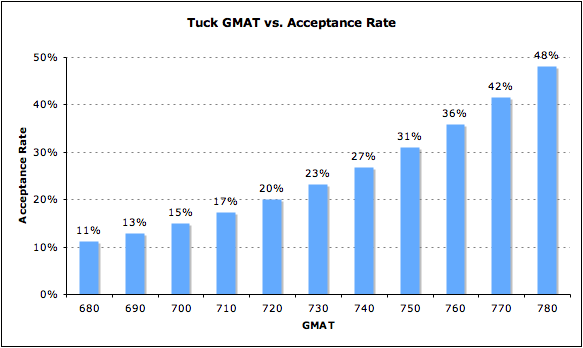
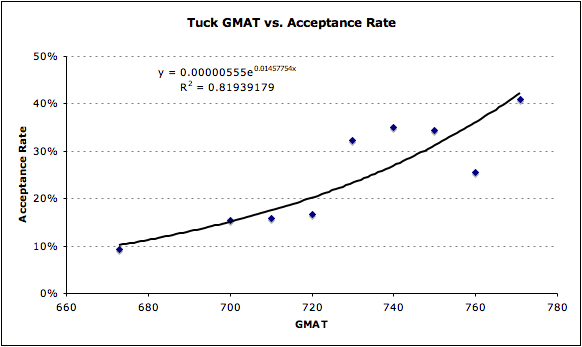
The first variable I looked at was GMAT. I did a scatter-plot by acceptance rate and found the best trendline for fitting the trendline. This line has an R squared of .82, which is a fairly strong correlation. I then created the smoothed out graph below, which probably does a better job of estimating the impact of GMAT on your application odds.

Tuck Admissions Analysis GMAT Acceptance Rate MBA

My 770 on the GMAT really helped to boost my Tuck admissions chances since it is significantly higher than the 718 average. However, I know my GPA is below the average Tuck GPA of 3.5. So next I looked at how GPA impacts acceptance rate.

Tuck Admissions Analysis MBA GPA Acceptance Business School

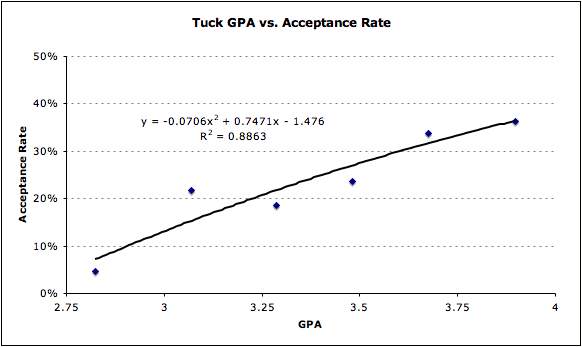
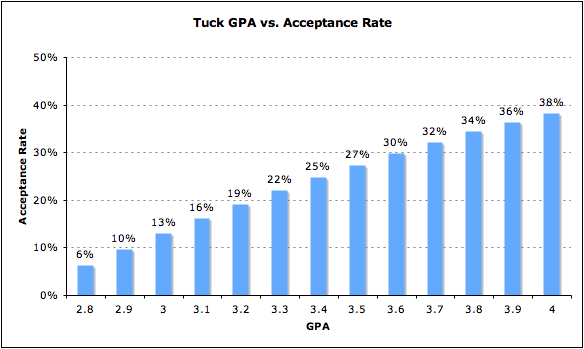
For Dartmouth, GPA is highly correlated with chance of acceptance, as one would expect. The GPA scatter-plot has a .89 R squared, which is very high. However, the line is not nearly as steep as it is for GMAT. Similar to GMAT, I smoothed out the curve to account for noise and came up with the graph below.

Tuck Admissions Analysis GPA Acceptance MBA Business School Dartmouth

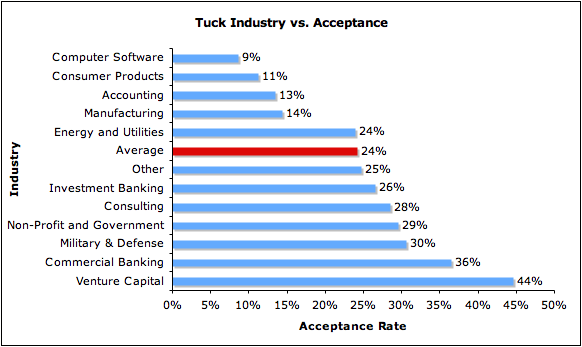
After GPA, I looked at how your industry impacts your chances of getting into Tuck. I only included an industry if it either had a high number of applicants or had a very high acceptance rate, like Venture Capital and Commercial Banking. I lumped all other industries into “other”. The trends for Dartmouth are similar to what I saw in my Wharton industry analysis. Manufacturing fared better with Tuck, but it is still significantly below average.

Tuck Admissions Analysis Industry Acceptance Rate Dartmouth MBA

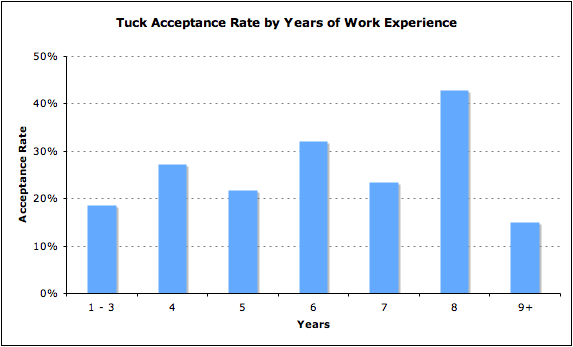
Finally, I looked at Dartmouth acceptance rate by years of work experience. The results of this graph do not seem to be as conclusive as other variables. The acceptance rate kind of jumps around. My interpretation is that in general the more years of work experience, the higher your chance of admissions is, until you reach 9+ years. Then the admissions committee starts to wonder why you are even applying for an MBA.

Tuck Admissions Analysis Dartmouth MBA Acceptance Rate

All in all, my predicted chance of getting into Dartmouth is pretty decent at 53%. My chance is theoretically a little better than a flip of a coin. I know that very few people who don’t do a applicant initiated interview are invited to a Tuck interview. An admissions committee member told me that roughly 55% of applicants self-initiate interviews, and I am going to guess that only 5% of total applicants are invited. If this is correct, then the fact that I already interviewed means that I have a pretty good chance of getting in. On top of that, I had one recommender who wrote an amazing recommendation for me. I sent it to NYU, Wharton and Tuck. I was admitted to NYU and I have been interviewed at Wharton and am waiting for my final decision. I was rejected from every school that he didn’t recommend me at. I am hoping the trend continues that I get into every school that my super recommender submitted to.

For those of you who are still waiting for the Tuck admissions decision, I hope that this article is able to distract you for a little while while you wait for the decision tomorrow. I wish everyone the best of luck.

The data used to create this Tuck admissions analysis is from GMAT Club. I used the data from the class of 2014, 2015 and the first two rounds of the class of 2016.

The Most Common Tuck Interview Questions

Tuck Interview MBA Dartmouth Business School Admissions

Tuck interviews are typically 30 to 45 minutes. Typically, the interviewer is a second year student, but on occasion you will be interviewed by an admissions staff member. Unlike most schools, Tuck allows anyone who visits campus to interview. Since Tuck is in a very remote location in New Hampshire, Tuck wants to see that you are committed to the school and are willing to travel to campus. Tuck does extend interview invites to a few select candidates who did not self-initiate an interview, but it is very rare. A member of the admission committee told me that slightly over half the candidates self-initiate an interview.

I highly recommend you self-initiate an Tuck interview on campus, because if you don’t then you put yourself at a huge disadvantage.  While visiting campus, visit a class and go on a tour. It is a great way for you to gather material for your essays.

Here is a list of the most common questions asked during a Tuck interview. I also included the probability that each question is asked based on Clear Admit interview reports.

Tuck Interview Questions

  1. Why Tuck?  –  (100%)
  2. Walk me through your resume  –  (82%)
  3. Do you have any questions for me?  –  (76%)
  4. What are your short-term and long-term goals?  –  (71%)
  5. Why an MBA or why now?  –  (65%)
  6. Tell me about a challenge, conflict or difficult situation at work? How did you deal with it?  –  (59%)
  7. What is the accomplishment you are most proud of?  –  (29%)
  8. What kind of leader are you or how do you interact in a group?  –  (29%)
  9. What extracurricular activities do you plan to participate in at Tuck?  –  (29%)
  10. What are your three biggest strengths?  –  (29%)
  11. What is your biggest weakness, or three biggest weaknesses?  –  (29%)
  12. What would you contribute to Tuck?  –  (29%)
  13. Tell me about yourself  –  (18%)
  14. Are there any questions you wish I had asked you?  –  (18%)
  15. What are your other interests or passions?  –  (18%)
  16. If you attend Tuck, how would your classmates describe you?  –  (12%)

I interviewed back in December and most if not all of the questions I was asked are on this list. My Tuck interview was with a second year student. He was friendly and laid back. We chatted a little before and after the interview.

Check out my new MBA Interview Guide.

Sloan Interview Preparation Guide

MIT Sloan Interview MBA Admission

At this point all of the Sloan interview invites have been sent out for this year. Unfortunately, I did not receive an invite from Sloan, but I am happy to say that due to all of my preparation, my Wharton interview went very well. Although the team based discussion is a new interview format, I was able to assume a leadership role without being aggressive or obnoxious about it. Since I had already started preparing for a Sloan interview incase I got an invite, I decided to post the Sloan interview preparation I was working on for myself. I hope this is helpful for those who will be interviewing with sloan over the next few weeks. Sloan interviews can take place on campus, in hub cities or even at the offices of alumni. Most Sloan interviews last 40 to 50 minutes, but some have been as short as 15 minutes. I have listed out the questions found in Clear Admit over the past 2 or 3 years in order from most common to least common. The number to the right indicates how many times it was asked.

Sloan Interview Questions:

  1. Why MBA? (5)
  2. Describe a time I had to resolve a conflict.  (5)
  3. Anything new to add to your resume since submitting application? (4)
  4. Why Sloan? (4)
  5. What do you me to get across to the admissions committee about you? (3)
  6. Questions? (3)
  7. Tell me of a time you received feedback and how did you respond? (3)
  8. Tell me about a time you helped a colleague who was struggling professionally. (3)
  9. Tell me of a time when you had to mentor someone. (3)
  10. Describe a time when one of your ideas was rejected and what you did. (3)
  11. Why get an MBA now? (2)
  12. Tell me about a time you had to persuade your colleagues. (2)
  13. Walk me through your resume. (2)
  14. Describe a time when you had to rally a team  (2)
  15. Describe a major initiative that you have worked on. (2)
  16. What would your recent team members say about you, if they were asked what its like to work with you?
  17. Tell me about a company in your industry that has caught your eye.
  18. Given your role at your company (work for a startup), what will it be like when you leave?
  19. Describe a time when you took a big risk.
  20. Elaborate on your leadership role in your extracurricular activity.
  21. Why did you change jobs from (company x) to (current company)?
  22. You have an offer from (current company) to return. Do you intend on taking it?
  23. Explain what your prior employer does, your contributions there and why you decided to move to your current job.
  24. Will you return to your employer after graduation?
  25. Describe a time when you had to say “no” to a boss.
  26. Tell me about your biggest achievement.
  27. Did you talk to someone about the Sloan program?

You will be in good shape if you prepare for the 10 to 15 most common questions. It may be helpful to look at the questions that have only been asked once, but I would not spend too much time prepping for them. For more info on preparing for a Sloan interview, check out my MBA interview preparation guide.

Few MIT Interview Invites for Round 2

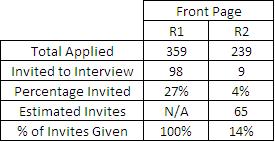
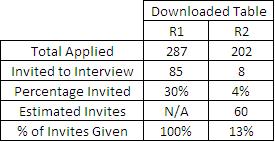
Similar to many of the applicants on the GMAT Club forum I have been impatiently waiting to hear from Sloan about an interview invite. It seemed to me that the number of invites have been very low so I decided to take a quick look at how low. I put together two charts, one based on the front page statistics and one based off of the table you can download with detailed stats.


MIT Sloan MBA Interview Invite

 MIT Sloan MBA Interview Invite


For some reason the two sets of numbers do not tie together but they tell the same story. Even though the Sloan interview invite period is more than half over, only 14% of the estimated interview invites have been sent out. My best guess is that the weather has been even worse than normal in Boston this year and has significantly delayed MIT. It is really hard for me to stay positive as the invite deadline quickly approaches, but given the numbers, I think we should all stay positive. It will be interesting to see if Sloan misses the invite deadline for R2 in addition to missing it for R1.

Wharton Interview Preparation Guide

wharton interview preparation guide MBA business schoolCheck out my updated Wharton MBA Interview Questions and preparation guide for the most up to date list of questions.

Now that I have been invited to a Wharton interview, I am spending as much time as I can prepping for interview. In the spirit of teamwork and cooperation, I’ll share with you the most common Wharton interview questions I found on Clear Admit. I only included questions from interviews that happened in the past two years, since the Wharton interview format changed. I don’t think that the older interviews are relevant anymore. If questions were asked to more than one person on a Clear Admit interview report then I put the number of times in parentheses.

Wharton Interview Questions:

1)    Describe your views of the Team Based Discussion. (7)

2)    Do you have any questions for me? (6)

3)    Do you have any updated to your application? (4)

4)    What extracurricular at Wharton? (4)

5)    Was your behavior in the Team Based Discussion representative of the way you typically act in a group setting? (4)

6)    Walk me through your resume. (4)

7)    Why MBA? (2)

8)    What could you have done differently as a team? (2)

9)    Why Wharton? (2)

10) Tell me about a time you had to persuade others. (2)

11) What are your post MBA goals? (2)

12) What specific quality or qualities do you hope to hone at Wharton?

13) Tell me about one time you had to overcome an obstacle working in a group and what you would do differently if you had to do it again?

14) Tell me about a time you failed and what you learned.

15) What are the 3 top qualities you think a leader should have?

16) What are 3 qualities you look for in a business school, especially our school

17) Why now?

18) What do you do in free time?

19) Tell me about a time you faced a leadership challenge.

20) Tell me about a time when you worked in a group in which everyone did not agree and how did your team resolve the situation?

21) What do you think worked well in the Team Based Discussion?

It seems that pretty much everyone is asked how they thought the team based discussion went and everyone is given the chance to ask questions at the end. Beyond that there are four other questions that are asked frequently, which you should prepare for. Good luck in your Wharton interview! Check out my MBA Interview Preparation Guide for more tips.