Tag Archives: GPA

Harvard GPA Impact on Acceptance Rate

Harvard business school is ranked first and it is incredibly difficult for applicants to get admitted. If you are applying, then you might wonder what is the minimum Harvard GPA requires in order to have a decent chance of acceptance. I analyzed the data from GMAT Club application data to discover the relationship between Harvard GPA and acceptance rate.
Harvard GPA MBA Acceptance Rate Business SchoolUpdate: I have posted a more up to date analysis of Harvard Business School acceptance rate which looks at how GPA, GMAT and application round impacts your chance of admission.

At Harvard GPA is Not Important Unless it is Very High or Very Low

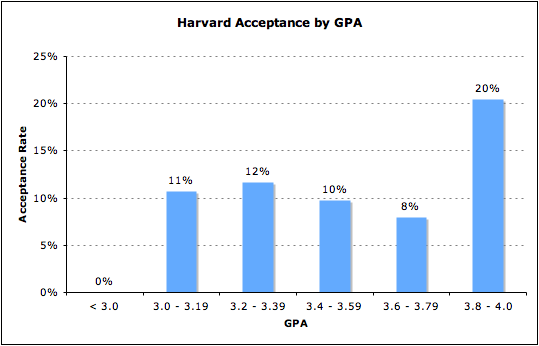
As you can see, the acceptance rate between 3.0 and 3.79 is relatively flat. GPA only seems to have any impact if you are above 3.8 or below 3.0. The acceptance rate for Harvard is higher in the 3.0 to 3.39 range than 3.4 to 3.79. This is likely due to low sample size in the lower GPA range. Although the acceptance rate is 0% below 3.0 in my dataset, I don’t think there is no chance of getting in, it is just very challenging.

At Harvard GPA only starts to help you when your GPA is 3.8 or higher. The average acceptance rate at Harvard is 12%, but it is 20% for applicants with a 3.8 or higher. I could not find any data published by Harvard on average GPA or GPA range. In my dataset, the average GPA of an applicant was 3.55, but the average GPA for someone who was accepted was 3.66. The middle 80% for Harvard GPA was 3.2 to 3.98, which means that 10% of those applicants that Harvard accepts have a GPA of 3.98 or higher.

In summary, if you are applying to Harvard, don’t stress out too much about your GPA as long as it is at least 3.0. Having a somewhat low GPA isn’t going to hurt your chances very much. Harvard only seems to care about how high your GPA is if you have a low GMAT score.

For this analysis, I used data from September 2011 through February 2014. There were 774 applicants in my data set.
Harvard GMAT vs. GPA Comparison

I have posted a more up to date Harvard Business School acceptance rate analysis which is based on GPA, GMAT and application round.

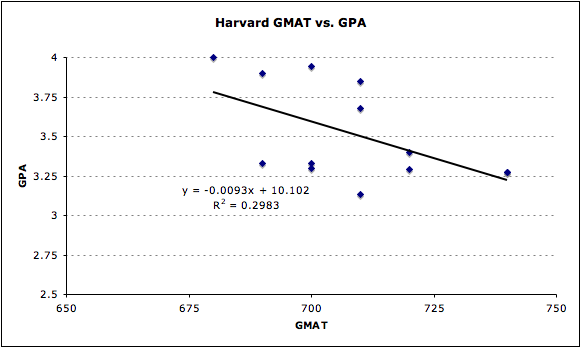
Word is that Harvard will take a chance on applicants who have low scores, but impressive accomplishments. Lets see if Harvard lives up to its reputation.

Harvard GMAT vs. GPA Admissions Accepted MBA Business School
As you can see the slope for Harvard is much steeper than for the other schools. The slope of -.0093 means that Harvard would look at an application with a 750 GMAT and 3.0 GPA similarly to a 650 and 3.93. This result is interesting, it shows that on the margin Harvard is weighs GMAT very strongly, however, the marginal Harvard GMAT scores are lower than other schools. Harvard is willing to take a chance on a low GMAT, but you better have a damn high GPA to make up for it.

Harvard GMAT vs. GPA All Accepts

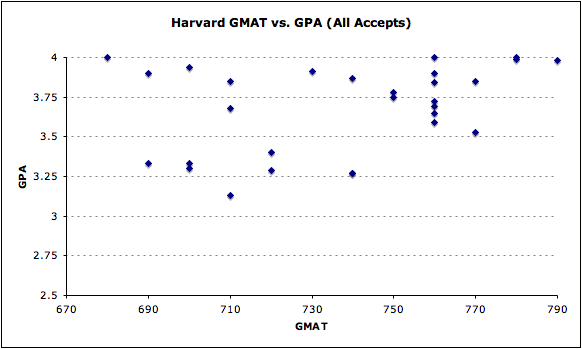
It is interesting to look at the total accepts instead of just the accepts on the margin. As you can see below, Harvard seems to be completely missing the population of students with low GPA and really high GMAT. I guess the admissions committee isn’t interested in students who slacked in undergrad and tried to make up for it with GMAT. I find that odd given Harvard’s reputation for grade inflation. They say that the hardest part of Harvard is getting in.

Harvard GMAT vs. GPA (all accepts)

The median Harvard GMAT score is 730. It is interesting that Harvard posts the median GMAT score instead of mean score like other schools. You can hide some very low GMAT scores by only posting a median. I would venture a guess that Wharton’s mean GMAT score, at 725, is higher than Harvard’s GMAT mean. After all, Harvard did accept a person with a 550 GMAT score last year. That has to be bringing down the average.

Check out how some of the other schools weigh GMAT vs. GPA:

Upenn / Wharton GMAT vs. GPA

MIT / Sloan GMAT vs. GPA

Dartmouth / Tuck GMAT vs. GPA

NYU / Stern GMAT vs. GPA

Methodology: The scatterplot represents the 50% of applicants who are accepted with the lowest GMAT and GPA. It isn’t helpful to look at the top 50% of applicants because those are not the marginal candidates who barely got in. I occasionally will remove very low outliers because those candidates may have been admitted due to very strong connections that most applicants don’t have. I never remove more than 5% of the total accepted students as outliers. The slope of the scatterplot demonstrates the point at which the school is indifferent to GMAT vs. GPA. The data for this analysis comes from GMAT Club.

Stern: How Important is the GMAT vs. GPA

I posted an updated analysis of Stern Acceptance rate for GPA vs. GMAT on this page.

NYU is currently ranked 10th by US News and World Report for full-time MBA programs and is tied for the 3rd highest average GMAT score. I expected to see Stern prefer GMAT over GPA, but that is not what I found.

Stern NYU GMAT GPA Admissions MBA Business School

It turns out that Stern has by far the smallest slope of any of the other schools I have looked at so far. The .0043 slope means that Stern would view a candidate with a 800 GMAT and 3.00 GPA similarly to one with a 700 GMAT and 3.43 GPA.

Other Schools:

Sloan

Wharton

Tuck

Columbia Business School

Methodology: The scatterplot represents the 50% of applicants who are accepted with the lowest GMAT and GPA. It isn’t helpful to look at the top 50% of applicants because those are not the marginal candidates who barely got in. I occasionally will remove very low outliers because those candidates may have been admitted due to very strong connections that most applicants don’t have. I never remove more than 5% of the total accepted students as outliers. The slope of the scatterplot demonstrates the point at which the school is indifferent to GMAT vs. GPA.

Sloan: How Important is the GMAT vs. GPA

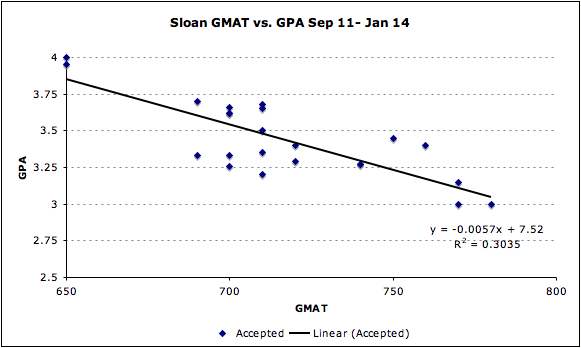
MIT is well known for highly intelligent students who are gifted in math. The rumor is that Sloan cares a lot more about your GMAT score than other schools. Do you think that this is true?

In the graph below you can see that Sloan has a slope of .0057. This means that MIT would consider a 800 GMAT with 3.0 GPA roughly similarly to a 700 GMAT with a 3.57 GPA.

Sloan GMAT GPA MBA Business MIT Score

Sloan is tied with Tuck (so far) for the lowest reliance on GMAT score. So far in my analysis Columbia cares the most about GMAT score. Sloans GMAT vs. GPA slope is relatively similar to the other schools, so  you should still take the GMAT seriously when applying to Sloan, but clearly it is not the singular most important component of the application.

Methodology: The scatterplot represents the 50% of applicants who are accepted with the lowest GMAT and GPA. It isn’t helpful to look at the top 50% of applicants because those are not the marginal candidates who barely got in. I occasionally will remove very low outliers because those candidates may have been admitted due to very strong connections that most applicants don’t have. I never remove more than 5% of the total accepted students as outliers. The slope of the scatterplot demonstrates the point at which the school is indifferent to GMAT vs. GPA.

How important is the GMAT to Tuck

Tuck is a school that is well known for its close-knit friendly community. During my interview, the second year student told me that the admissions committee specifically selects for people with terrific people skills who know how to collaborate in a team environment. Given that Tuck is looking for team players, does this mean that they put less of an emphasis on the GMAT? Lets find out.

In the chart below you can see that the slope the GMAT vs GPA scatter-plot is .0057. This means that for admissions purposes, Tuck would view a person with 800 GMAT and 3.00 GPA the same as someone with 700 GMAT and 3.57.

Tuck Dartmouth GMAT GPA Admissions MBA Business


The slope of .0057 is slightly lower than Wharton and Columbia who have slopes of .0061 and .0063 respectively. This supports Tucks claim that they weight interpersonal skills higher than they do test scores.

Methodology: The scatterplot represents the 50% of applicants who are accepted with the lowest GMAT and GPA. It isn’t helpful to look at the top 50% of applicants because those are not the marginal candidates who barely got in. I occasionally will remove very low outliers because those candidates may have been admitted due to very strong connections that most applicants don’t have. I never remove more than 5% of the total accepted students as outliers. The slope of the scatterplot demonstrates the point at which the school is indifferent to GMAT vs. GPA.

How Important is the GMAT to Wharton

I posted an updated Wharton acceptance rate analysis which is more accurate than this article. It shows how GPA and GMAT affect your odds of admissions.

Continuing the series on GMAT vs. GPA, here is the article on how much Wharton values the GMAT. Wharton is the 3rd ranked school according to US News and World Report.

Over the past year, both the director of MBA admissions Ankur Kumar and dean Dean Thomas S. Robertson have left Wharton. Many people have suggested that the quality of a Wharton MBA is declining due to dropping application numbers and prominent staff quitting. I personally think that Wharton is just as strong as it has ever been, and that it has just had an unlucky streak of staff quitting.

Some experts have suggested that because Wharton has seen a drop in applications and has had high level staff quit recently, Wharton will have a very conservative year for admissions and will focus on raising the measurable statistics such as GPA and GMAT. Lets see how recent events have shaped Wharton’s weighting for the GMAT.

The first graph was created using the admissions data from the past three years. The slope is .0036 for accepts. This means that over the past 3 years Wharton values 10 GPAT points the same as it values .036 GPA points. An application with an 800 and 3.00 would be viewed similarly to a 700 and 3.36.

Wharton MBA GMAT vs. GPA Admissions StatisticsThe interesting question is how have recent events shaped Wharton’s admissions decisions. In the graph below you can see that slope of the accepted students has increased from .0036 to .0061, suggesting that this recruiting cycle Wharton has been weighting GMAT more heavily than GPA compared to previous years. The slope is now .0061, which means that 10 GMAT points are considered similarly to .061 GPA points.  An application with an 800 and 3.00 would be viewed similarly to a 700 and 3.61.

Wharton GMAT vs. GPA Admissions MBAAlthough recent data suggests that Wharton has decided to weight GMAT as more important than GPA, this conclusion is premature. This recent data is very thin (it is based on only 14 accepts) and should not be considered completely accurate.

Methodology: The scatterplot represents the 50% of applicants who are accepted with the lowest GMAT and GPA. It isn’t helpful to look at the top 50% of applicants because those are not the marginal candidates who barely got in. I occasionally will remove very low outliers because those candidates may have been admitted due to very strong connections that most applicants don’t have. I never remove more than 5% of the total accepted students as outliers. The slope of the scatterplot demonstrates the point at which the school is indifferent to GMAT vs. GPA.

How Important is the GMAT to Columbia Business School

Every person who has ever considered applying to business school has considered how important the GMAT is to the admissions committee. It could be because that person did well and is hoping that their GMAT score will get them in or it could be that the person is trying to overcome a low GMAT score. I used the admissions data from GMAT Club to come up with actual data to answer this question.

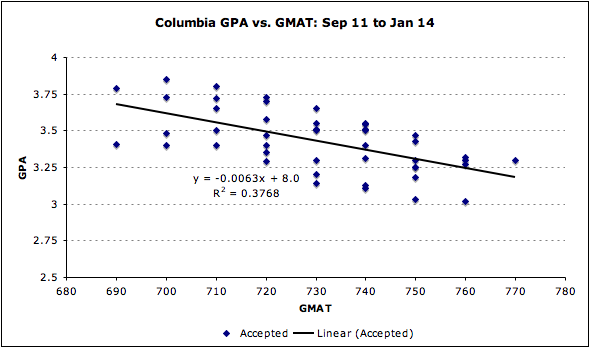
Here is my analysis of how much important to Columbia GMAT is. I looked at everyone who was admitted to CBS and also provided both GMAT and GPA. I found the slope of the admitted students with the lowest score to find out how much the CBS values the GMAT scores.

I used this methodology because it is obvious that most schools will accept someone who has a 4.0 and an 800; it is the people who are on the border who matter. I also removed a few outlier data points on the low side because they probably had very influential connections to get in with their low scores, and that information isn’t relevant to the average applicant.

Columbia GMAT vs. GPA

Columbia GMAT Business School Admissions Application GPA You can see that the slope of the line for accepted students is .0063. This means that for every 10 points higher you score on the GMAT, it is the equivalent of having a GPA that is .063 points higher. So Columbia would roughly consider an applicant with a 800 GMAT and 3.00 GPA as similar to an applicant with a 700 and a 3.63 GPA. The value of .063 is higher than most schools other than Harvard, which is at .093.

Columbia GMAT and GPA. It isn’t helpful to look at the top 50% of applicants because those are not the marginal candidates who barely got in. I occasionally will remove very low outliers because those candidates may have been admitted due to very strong connections that most applicants don’t have. I never remove more than 5% of the total accepted students as outliers. The slope of the scatterplot demonstrates the point at which the school is indifferent to GMAT vs. GPA. The data for this analysis comes from Columbia GMAT Club.