Tag Archives: GMAT

GPA unimportant to Stanford Business School Acceptance Rate

Although the original predictive model I built for Stanford suggested that GPA didn’t matter, I updated the model using different data cleaning techniques and I now believe that GPA is important to Stanford. Although GPA does matter, GMAT is still much more important. The new Stanford MBA Acceptance Rate Analysis can be found here.

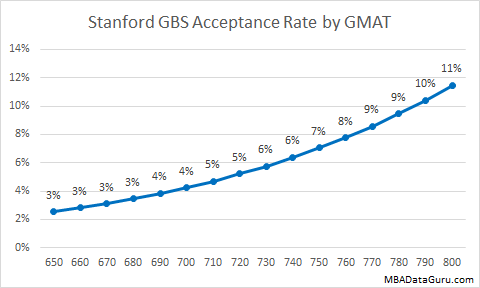
Stanford business school has the lowest acceptance rate of 6% out of all MBA programs in the US. I am sure everyone wants to know the secret to increase their Stanford business school acceptance rate. Shockingly Stanford GBS does not care about your GPA. I built a statistical model to predict Stanford business school acceptance rate, and there was no evidence that a high GPA increases your chance of admission at Stanford.

Stanford Business School Acceptance Rate by GMAT

Stanford Business School Acceptance Rate by GMAT GBS MBA AdmissionThe graph above shows how Stanford business school acceptance rate changes based on GMAT. There is a strong relationship between GMAT and  Stanford MBA acceptance rate. Surprisingly, even with an 800 GMAT your chance of admission is still only 11%. Since there are over 7,000 applicants for only 400 spots it is difficult to be accepted.
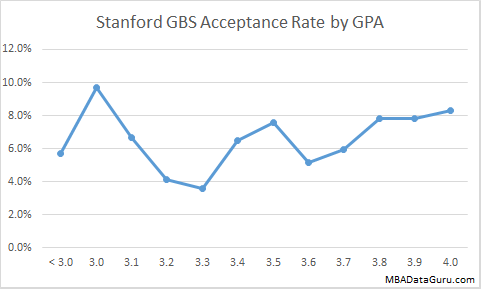
Stanford Business School Acceptance Rate by GPA

Stanford Business School Acceptance Rate by GPA GBS MBA AdmissionAlthough GMAT is important to GBS, there is no relationship between GPA and acceptance rate. This is completely the opposite of Harvard where GPA is more important than GMAT. Surprisingly the highest admission rare is for applicants with a 3.0 GPA.  Don’t worry too much about the high acceptance rate for low GPAs, there were only 28 applicants with a 3.0, which is not enough of a sample size to be confident. There is however enough data to confirm that there is no strong relationship between GPA and admissions. For those stats nerds out there, the P-value for the GPA variable was 33%, so clearly it had to be eliminated.
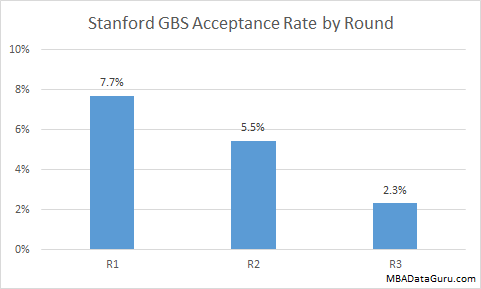
Stanford Business School Acceptance Rate by Round

Stanford Business School Acceptance Rate by Round GBS MBA AdmissionAlthough GPA doesn’t affect Stanford MBA admission rate, the round you apply in does have a large impact on your chances. The acceptance rate for round one is already below 8% and only drops even lower after that. This is similar to Harvard where application round has a strong impact on acceptance rate. If you are not a perfect candidate with great GMAT and work experience, don’t even bother with round 2 or 3. Might as well wait until next year’s round one unless you enjoy throwing away $250 on your application.
The only other factor that impacts acceptance rate is your pre-MBA industry. Consultants have a 9% acceptance rate compared to other candidates’ 6% chance of admission to GBS. Undergraduate major, years of work experience, and age have no affect on your chances at Stanford business school.

The data used to do this analysis came from GMAT Club website.

Kellogg Acceptance Rate Analysis

Kellogg’s acceptance rate is on the higher side for a top 10 MBA program at over 20%. But don’t be fooled, getting into Kellogg is still very difficult. In addition to high expectations for GMAT and GPA, Kellogg allows all applicants to interview. This allows Kellogg to find candidates with the best interpersonal skills even if they don’t have high scores. Since I don’t have information on candidates’ interpersonal skills, I’ll stick to GMAT and GPA. I built a model that can estimate an applicants chance of admissions to Kellogg based on a few key pieces of data . I am posting the insights I found in the model here until I am able to build the admissions calculator over winter break.

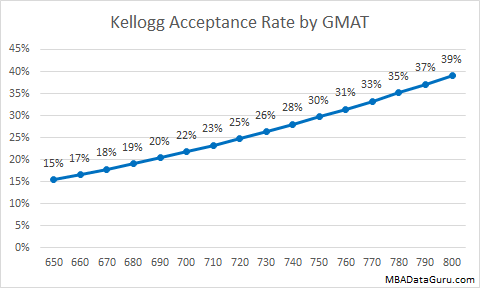
Kellogg Acceptance Rate by GMAT

Kellogg Acceptance Rate by GMAT MBA Admissions Business School

The average GMAT score for Kellogg’s 2 year MBA program is 717, however the average GMAT for applicants is lower, coming in at 709. The graph above shows the relationship between GMAT and Kellogg acceptance rate for the average applicant, who has a GPA of 3.38. You can see there is a strong relationship between GMAT and Kellogg acceptance rate. An applicant to Northwestern has twice the chance of getting in with a 750 compared to a 650.

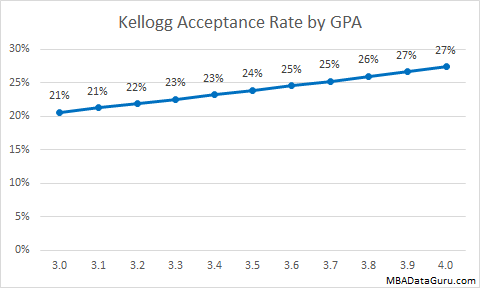
Kellogg Acceptance Rate by GPA

Kellogg Acceptance Rate by GPA MBA Business School Admissions

Similar to GMAT, having a higher GPA increases your chance of admission at Kellogg. Even with a low GPA of 3.0, the admission rate is still over 20%. The graph above shows Kellogg acceptance rate by GPA for the average candidate, who has a GMAT of 709 (yes I know that it is not a possible score).

Kellogg prefers GMAT over GPA

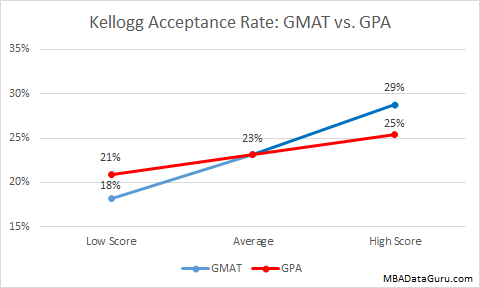
Kellogg Acceptance Rate GMAT vs GPA MBA Admission Business School

By comparing admissions for candidates with a high GMAT score vs high GPA, I found that Kellogg prefers a high GMAT over a high GPA.* This is good news for candidates who are willing to put in the hard work to get a high GMAT score. Having a high GPA only increases your chance of admission by 2% to 25%. On the other hand, having a high GMAT increases the Kellogg acceptance rate to 29%. On the flip side, if you have a low GMAT then it will harm your chance of admission more than a low GPA.

Kellogg Acceptance Rate by Round

Kellogg Acceptance Rate by Round MBA Admissions

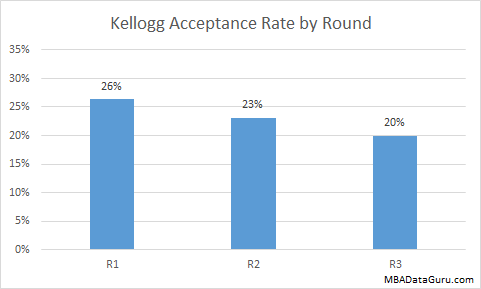
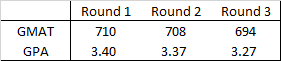
Round 1 applicants had the highest acceptance rate, with round 3 acceptance rate the lowest. These numbers are a little misleading because they don’t take into account difference in the average candidate quality for the different rounds.

Kellogg MBA Applicant Statistics by Round AdmissionsThe lower acceptance rate for Kellogg applicants in later rounds is explained by lower GMAT and GPA. This is why application round is not a factor in my admission model. Applying in a later round does not appear to harm your chance of admission at Kellogg significantly, especially if you can use that time to raise your GMAT or improve your essay.

Other Admissions Factors

The last two factors that had an impact on admission rate were country and industry. Applicants who were living in India had a roughly 6% chance of admission. Candidates who worked in computer software while applying had a 5% chance of admission. Both of these factors were statistically significant, meaning that there was enough data to verify the effect.

Good luck with your applications! Let me know if you have any questions.

*A high score on GMAT or GPA is defined by one standard deviation above average.

Stern Interview Acceptance Rate Analysis

I know that the final decisions for applicants who were interviewed for New York University’s business school are expected soon. I decided to perform a Stern interview acceptance rate analysis to see if I could predict the chance of acceptance for applicants who were invited to interview. From my data sample 74% of applicants who were invited to interview were ultimately accepted.

Stern Interview Acceptance Rate by GMAT

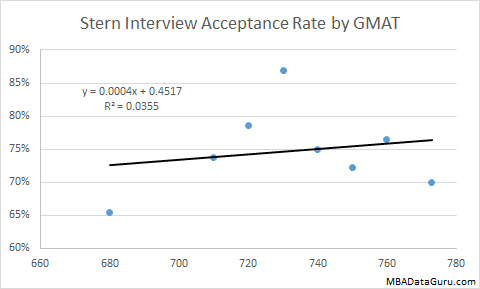
Stern Interview Acceptance Rate by GMAT NYU MBA School AdmissionsNot only is the slope of the regression line very flat, but also the the R-squared is only 3%. These two pieces of information suggest that once a candidate is invited to interview, their GMAT has no impact on acceptance rate.

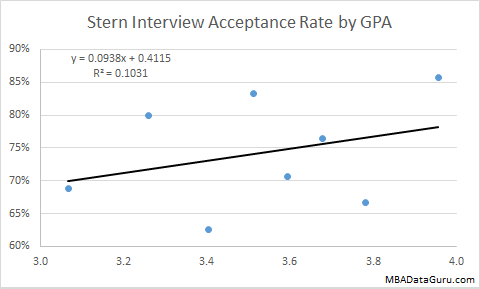
Stern Interview Acceptance Rate by GPA

Stern Interview Acceptance Rate by GPA NYU Business School AdmissionThe slope of the GPA graph is a little steeper than the GMAT graph slope. The R-squared is also higher, coming in at 10%. Once again, this indicates that GPA has a little more impact on your chance of admission after being invited to interview compared to GMAT.

The low R-squared of the GPA and GMAT compared to admissions for interviewed applicants suggest that NYU treats all applicants as equal once they are invited to interview. If interviewed you are on equal footing compared to all other candidates invited to interview. This is different compared to Ross, which has a much higher correlation between GMAT / GPA and acceptance rate. The GMAT & GPA acceptance rate R-squared ranged from 30% to 75% for Ross, which is much higher than the 3% to 10% for Stern.

The data used for this post comes from GMAT Club.

Ross Interview Acceptance Rate Analysis

Earlier today I posted the Ross acceptance rate analysis which shows how GPA and GMAT scores affect your chance of admission at University of Michigan’s MBA program. I received a request to see if GMAT and GPA can still predict acceptance rate out of the applicants who were selected to interview. I would never want to disappoint a reader, so here is my Ross interview acceptance rate analysis. While reading this analysis, keep in mind that around 62% of interviewed applicants are accepted, which is higher than schools like Harvard and Wharton but lower than Stern.

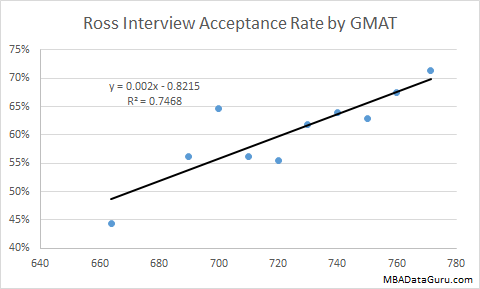
Ross Interview Acceptance Rate by GMAT

Ross Interview Acceptance Rate by GMAT Michigan MBA Business School AdmissionsIn the graph above you can see that there is a clear relationship between Ross acceptance rate even among the applicants selected to interview. The R-squared is 74% which is fairly high, so GMAT is an accurate predictor of admissions post interview. The slope of the line suggests that for every 10 points higher your GMAT is, you have a 2% higher chance of admissions. Unfortunately for those with a low GMAT score, you are not on an equal playing field even after being selected for an interview at Ross.

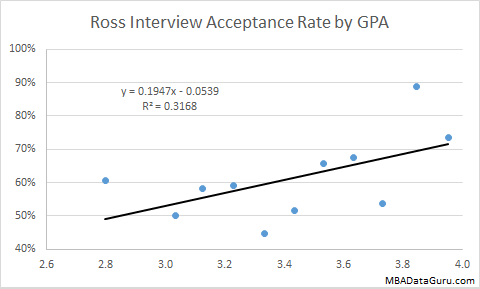
Ross Interview Acceptance Rate by GPA

Ross Interview Acceptance Rate by GPA Michigan MBA Business School AdmissionsThere is also a relationship between Ross interview acceptance rate and GPA, but the correlation is much weaker. Just from looking at the graph you can see that the data is more spread out from the regression line. The R-squared of 32% is much lower than the R-squared for GMAT of 74%. All else equal, it would help your chance of admission if you have a high GPA, but it does not seem to matter as much as GMAT.

When I analyzed Harvard Business School acceptance rate, I found that GMAT and GPA could not predict acceptance rate from the pool of applicants selected to interview. Which means everyone who was interviewed were on a level playing field once invited to interview. That does not seem to be the case for Ross. In the end, even with a low GMAT or GPA, you still have a 50% of being accepted after your interview. All you can do is prepare for your Ross MBA interview as much as possible and hope for the best.

Ross Acceptance Rate Analysis

I plan to post the Ross admission calculator online as soon as I have time to build that portion of the website, probably over Christmas break. In the mean time I will share some of the insights I got from building the predictive model.

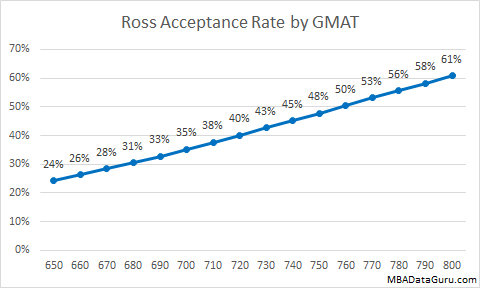
Ross Acceptance Rate by GMAT

Obviously your chance of admission to Ross School of Business increases if you score higher on the GMAT. The good news is that Ross’s acceptance rate of 34% is significantly higher than almost all other business schools in the top 20. The Ross class of 2016 profile shows that the average GMAT and GPA are 702 and 3.4 respectively. The data used to create this analysis comes from GMAT Club. Of the applicants in my data set, 84% had GMAT of 700 or higher, which means that I am fairly confident about the relationship between GMAT and admissions in the 700’s but not as confident in the 600’s.

Ross Acceptance Rate by GMAT MBA Admissions Michigan School of Business To create the graph above, I used the average GPA from my data set which is 3.42 and then shifted the GMAT score in my model. The model takes into account the interaction of GMAT, GPA, years of work experience, undergraduate major and the industry you worked in.
Ross Acceptance Rate by GPA

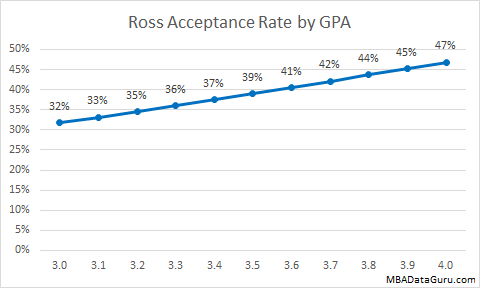
Next I looked at how GPA affects Ross acceptance rate. I’m sure it is not a surprised to hear that a higher GPA increases your chance of admissions at Michigan school of business. Ross Acceptance Rate by GPA MBA Admissions Michigan School of Business

Ross Acceptance Rate: GMAT vs. GPA

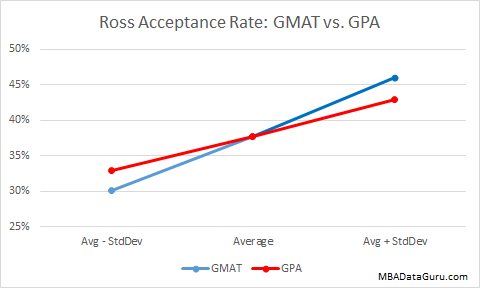
The real question is which is more important for raising your Ross acceptance rate, GPA or GMAT? In the graph below I compare how much the admissions rate changes if I alter the GMAT or GPA by a standard deviation. A standard deviation is a measure of variance in a population or sample. Since I can’t compare the absolute variance because GMAT and GPA are on different scales, I compare how the shift of one standard deviation impacts the Ross MBA acceptance rate.

Ross Acceptance Rate GMAT vs. GPA Admision Michigan School of BusinessAs you can see the slope is steeper for the GMAT line. This means that Ross prefers applicants with a high GMAT over applicants with a high GPA. One standard deviation higher in GMAT increases acceptance rate by 22% while a standard deviation in GPA only increases chances of admission by 14%.

Other Ross Acceptance Rate Insights

similar to Harvard and Wharton, at Michigan the acceptance rate is noticeably lower for Indian applicants vs. non-Indian applicants, 17% vs. 41% respectively. Engineering majors have a lower chance of admission while liberal arts majors have a higher chance. Many schools are trying to increase the number of women in their program. The higher acceptance rate for liberal arts majors may reflect Ross trying to attract more women, however my data set is missing gender information. More years of work experience increases the chance of admission by around 2.5% per year. Also military applicants have a higher chance of admissions.

For those of you who have already been invited to interview at Ross, your acceptance rate is higher at around 62%. Check out my Ross Interview Acceptance Rate Analysis to see what your chance of getting admitted is.

Good luck with your applications!

Harvard Business School Acceptance Rate Analysis

How can anyone ensure that they will be accepted to Harvard Business School? Unfortunately there are no assurances at the number one ranked business school which has an acceptance rate of 12%. This analysis will show you what factors impact Harvard Business school acceptance rate, such as GMAT and GPA.

Harvard Business School Acceptance Rate by GMAT

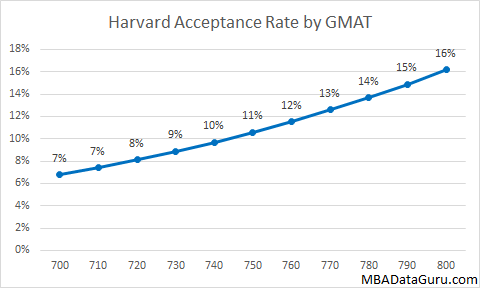
Similar to all other business schools, Harvard does care about your GMAT score. As you can see in the graph below, a higher GMAT results in a better chance of admission. If you want a double digit chance of admission you had better score a 740 or higher. Even at 800 the HBS acceptance rate is surprisingly only predicted to be 16%.

Harvard Business School Acceptance Rate by GMAT MBA HBS Admissions

Harvard Business School Acceptance Rate by GPA

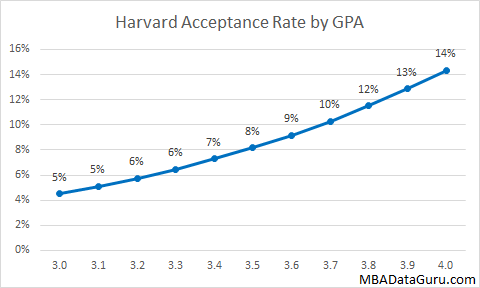
Next we look at how GPA affects Harvard Business School acceptance rate. Obviously a higher GPA results in a better chance of admission at HBS. Acceptance rate doesn’t break into the double digits until you hit 3.7. This reminds me of why I didn’t even bother applying to Harvard with my 3.33 GPA. Damn you engineering, why did you ruin my grades?Harvard Business School Acceptance Rate by GPA HBS MBA Admission

Harvard Business School Acceptance: GMAT vs. GPA

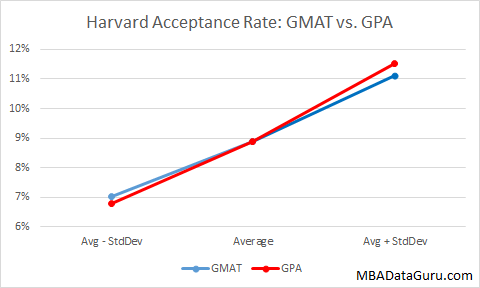
The real question is which is more important for raising your chance of admission to HBS, GPA or GMAT? In the graph below I compare how much the admissions rate changes if I alter the GMAT or GPA by one standard deviation. A standard deviation is a measure of variance in a population or sample. Since I can’t compare the absolute variance because GMAT and GPA are on different scales, I compare how the shift of one standard deviation impacts the Harvard MBA acceptance rate.

Harvard Business School Acceptance Rate GMAT vs GPA MBA HBS AdmissionsUnlike at Stern and Wharton, Harvard values GPA over GMAT. Harvard acceptance rate increases by 30% when GPA increases by one standard deviation but only by 25% when GMAT increases by a standard deviation. This indicates that GPA is more important than GMAT at HBS, and they are willing to roll the dice on a candidate with low GMAT like the guy who was accepted last year with a 550.

Other HBS Acceptance Rate Insights

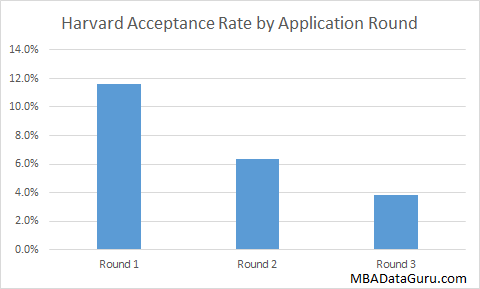
The round you apply in does have an impact on your chance of being accepted at HBS. Applying in a later round significantly reduces your chance of admission at Harvard. The data for round 3 is not statistically significant due to low sample size, but I wouldn’t risk applying in round 3 unless you have a godly application. Perhaps after this recruiting year is over I’ll have enough data to confirm and update the model.

Harvard Acceptance Rate by Round HBS MBA AdmissionsIf you want to maximize your chances of getting into Harvard, then be sure to apply during round 1. Additional work experience does increase your odds of getting into Harvard by a small amount, roughly .5% per year. I’m sure a lot of peoples’ next question is what about the 2+2 program? I do know about the 2+2 program Harvard has but I can’t tell which candidates are applying through the 2+2 program vs. not. However I can tell you that of the 59 people in my sample who are 24 years old or younger , none were admitted. So although it is possible to get in if you are younger, it certainly is more challenging.

Next I’ll mention a few factors that are out of your control in the short term but should be known so you can plan accordingly. Similar to Wharton, applicants who are applying from India have a lower chance of admissions, only 1.5% of applicants from India are accepted. Applicants who majored in finance also have a significantly lower chance of being admitted, only 2%. And finally applicants who have worked in venture capital or the military have a much higher admissions rate, 16% and 17% respectively.

Update: I took a quick look if I could predict acceptance rate accurately for people who were already selected for an interview. They only factors that had any predictive power were round, age and major. Average acceptance rate is 49%, with older candidates doing a little better about 7% higher acceptance rate for someone a year older than average. Round 2 applicants had a 37% acceptance rate, while round one had a 57% chance. And finally, applicants who majored in finance had a 16% chance of admittance. In the end, it is very difficult to predict admissions for candidates once they have been invited to interview, which suggests that to Harvard the interview actually matters.

Good luck with your Harvard applications!

For undergrads, check out the Harvard acceptance rate analysis at College Admit Me.

Stern Acceptance Rate Analysis

I just finished building the Stern acceptance rate prediction model. I will post the admissions calculator as soon as I have time to finish learning PHP and then build that portion of the website. I’ll probably have time to work on it over Christmas break, but right now I am too busy applying for interviews for summer internships. In the mean time I will share some of the insights I got from building the model.

Stern Acceptance Rate by GMAT

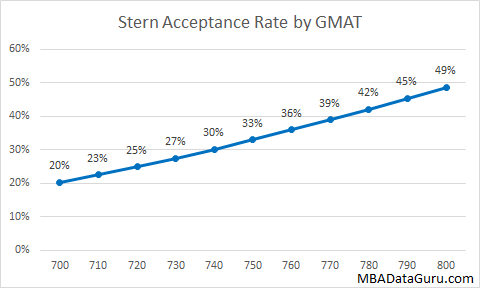
The first thing that jumped out at me was that the acceptance rates I came up with are noticeably higher than the published acceptance rate of 15%. I believe that this is because the average candidate who applies and posts their data on GMAT Club, where I get my data, is more competitive than the average candidate. The average GMAT Club applicant to Stern has a GPA or 3.45 and GMAT of 709, which is not too far from the scores listed on the class profile for Sterns class of 2016 of 3.52 and 721.

Stern Acceptance Rate by GMAT MBA Admissions Business School NYUIf you are applying to Stern, it is pretty obvious that having a higher GMAT is important and will significantly raise your chances of being admitted. To create the graph above, I used my model with the average GPA of 3.45.

Stern Acceptance Rate by GPA

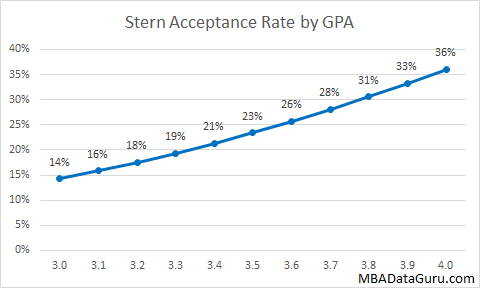
Next I looked at how GPA affects Stern acceptance rate. Once again there is a clear relationship between GPA and admission rate for NYU. In the graph below I used the average GPA score of 709 in my admissions model.Stern Acceptance Rate by GPA NYU Admissions Business School

Stern Acceptance Rate by Round

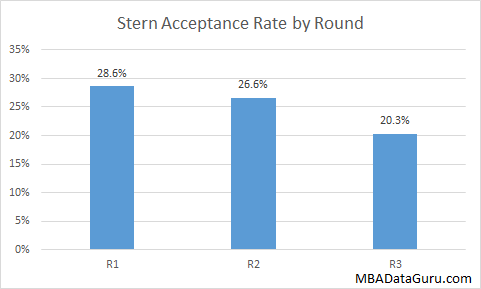
Many candidates want to know if it matters in which round you apply. I took a look at the raw acceptance rate by round for NYU. As you can see the acceptance rate for round 2 is slightly lower and for round 3 it is noticeably lower.

Stern Acceptance Rate by Round MBA NYU Admissions Business SchoolThe acceptance rates above are raw numbers, not the predicted values from my admissions model. Why you ask? Because when I took into account all of the other factors, the round you apply in is not statistically significant. The reason the acceptance rate is lower in round 2 and 3 is not because the schools are more selective but because on average lower quality candidates apply in those rounds. If you are a qualified candidate, do not worry about applying to Stern in round 3, you still have a good chance of getting in.

Stern Prefers GMAT over GPA

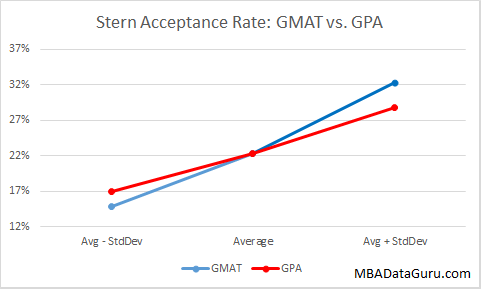
In the past I tried to figure out if Stern prefers a high GMAT or GPA and didn’t come up with anything conclusive. Now that I have built the Stern admissions model I can see how a similar change in GMAT or GPA impact acceptance rate at Stern. In the graph below I compare how much the admissions rate changes if I alter the GMAT or GPA by a standard deviation. If you are applying to business school then you should probably know what a standard deviation is, however if you don’t it is a standard measure of variance in a population or sample. Since I can’t compare an absolute variance because GMAT and GPA are on different scales, I compare how the shift of one standard deviation impacts the Stern acceptance rate.

Stern Acceptance Rate GPA vs GMAT MBA NYU Admissions Business SchoolIn the graph above, you can see that increasing the GPA by one standard deviation (.28) increase acceptance rate by 29%, but raising the GMAT score by one standard deviation (39) leads to a 45% higher chance of admissions. It is clear that Stern prefers candidates with high GMAT score over ones with a high GPA. This is good news for candidates with a low GPA because with enough hard work, you can increase your odds significantly by raising your GMAT.

Other NYU Admissions Insights

I also found that NYU prefers candidates with an average age of 27 to 28, the further you are from this average age, the lower your chance of getting in. Stern really likes candidates that come from consulting. Applicants from consulting had a acceptance rate of 42% vs. 21% for non-consultants. Having more work experience also increased your odds of admissions. Acceptance rate increased by about 2% for each year of work experience. However, once you pass 28, the age deviation factor is significantly stronger than the work experience factor so you shouldn’t wait until after 28 to apply.

I noticed that candidates that majored in business or engineering had a lower chance of admission. Business majors with average scores had a 8% chance of admission compared to 24% for non-business majors. Engineers had a 13% chance of getting in compared to a 26% chance for non-engineers. These differences are statistically significant even after taking into account all other factors. That being said, I majored in engineering and I got into Stern. I also know many other business and engineering majors who are currently attending Stern with me.

Wharton Acceptance Rate Analysis for Indian Applicants

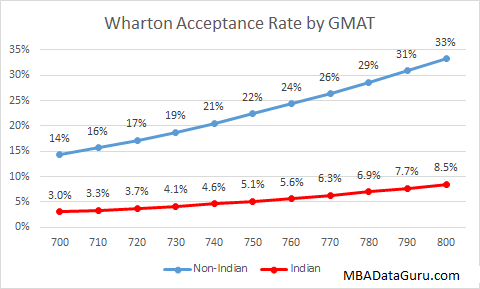
Last week I posted an article discussing the Indian application disadvantage at Wharton. I received a request to go into more detail about how GMAT impacts the Wharton acceptance rate for Indian applicants. Given that only 5% of applicants identified as Indian and the acceptance rate is low, I don’t have enough data to look at that relationship in isolation. However, I have built a model that can predict what that relationship would be for Indian applicants based off of data from other Wharton applicants.

Wharton Acceptance Rate by GMAT

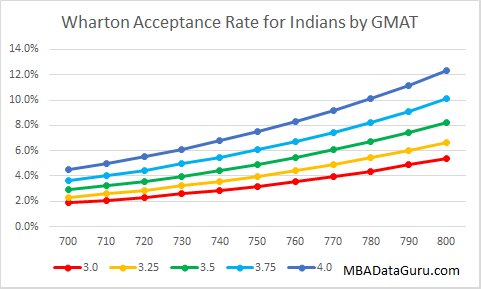
As you can see, my model predicts that there is a relationship between GMAT and the Wharton acceptance rate. This acceptance rates in the graph assumes a GPA of 3.54, which is the average for Wharton applicants. As you would expect, the higher the GMAT score, the higher the chance of getting in. Unfortunately, even with an 800, the forecast acceptance rate is still less than 10% for Indian applicants. Wharton Acceptance Rate GMAT India MBA Application

Wharton Acceptance Rate by GPA

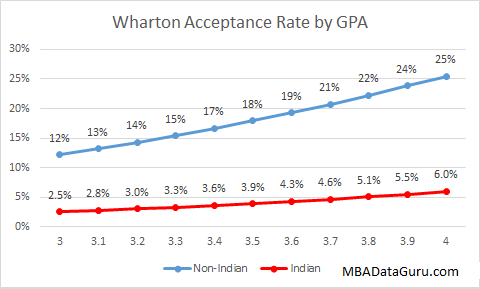
I decided to also look at the relation ship between GPA and acceptance rate as well. Similar to GMAT, higher GPAs increase your chance of acceptance. For the graph below I used the average Wharton GMAT score of 728 to calculate the acceptance rate. Even for candidates with a 4.0 GPA, they only have an acceptance rate of 6%.

Wharton Acceptance Rate GPA India MBA Application

After that I made a graph displaying the relationship between GMAT and GPA on acceptance rate for Indian applicants. With a 4.0 GPA and 800 GMAT, the acceptance rate increased to 12%, but that is still very low for such a qualified candidate.

Wharton_GMAT_vs_GPA_12-4-14

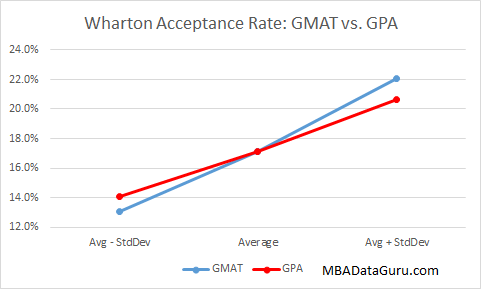
The final question to answer is which is more important to Wharton, GMAT or GPA. I already had suspicions that Wharton cared more about GMAT than GPA, and this analysis confirmed it. I looked at the average candidate (both Indian and non-Indian) then compared the average acceptance rate to the acceptance rate one standard deviation above and below for both GMAT and GPA.

Wharton Acceptance Rate GPA vs GMAT MBA AdmissionsAs you can see the slope for the line is steeper for the GMAT than for GPA. What this means is that a candidate who score one standard deviation above average for GMAT will be rewarded more than a candidate who has a GPA one standard deviation above average. Similarly a candidate will be punished more for having a low GMAT. This suggests that GMAT is more important to Wharton than GPA.

The data used to make this post came from GMAT Club and included applicants from 2012 through 2014.

Significant Indian Application Disadvantage at Wharton MBA Program

Recently I discovered an Indian application disadvantage at Wharton’s MBA program while reviewing their admissions data. I have been busy over the past few months at business school and haven’t been able to post. I am attending NYU Stern school of business and loving it. I have a little bit of free time over Thanksgiving break so I decided to make a little progress towards building my MBA admission calculator. I started by analyzing Wharton’s admission data because I have far more data available for Wharton compared to other schools. This makes it easier to find statistical significance in the model. For example, there are 1,093 Wharton applicants verses 498 NYU applicants. I built a beta version of a model to predict admissions into Wharton, but plan to spend a lot more time working on it before I release it on this website.

The Indian Application Disadvantage at Wharton

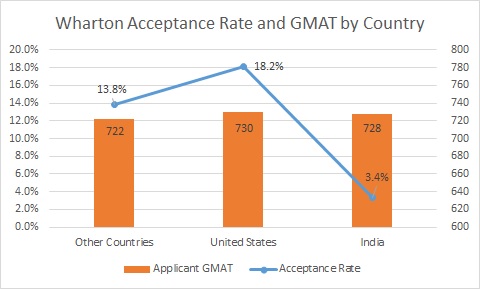
In building the logistic regression, I found that the only three variables had statistic significance, including GPA, GMAT and whether the applicant was from India. I was shocked to find a significant Indian application disadvantage, the acceptance rate for Indians was 3.4% compared to 18.2% for Americans and 13.8% for non-Indian Internationals.

Indian Application Disadvantage Wharton MBA GMAT

Despite similar GMAT scores, Indian applicants had significantly lower acceptance rate at Wharton.

The difference between American and non-Indian acceptance rates was not statistically significant. However, the Indian acceptance rate difference was significant, with a confidence interval of 0% to 8%. This means we can be about 95% sure that the Indian acceptance rate is equal to or lower than 8%. For this analysis I excluded all entries that were missing both GMAT and GPA. If I had included these applicants who didn’t share their scores, then the Indian acceptance rate would have dropped to 2.8%.

I don’t know why the acceptance rate for Indian applicants is lower despite similar GPAs and GMAT scores. It could be due to trouble writing application essays or some other explanation, but I think this matter needs to be looked at closer.

GMAT Preparation: How I Scored a 770

GMAT Preparation Studying MBA Application TestGMAT Preparation is a challenging experience. The average GMAT score at top schools has increased significantly over the past 5 years. The GMAT score is up at 19 out of the 25 top schools in that time period. It is critical for aspiring MBA students to study for the GMAT in an intelligent manner so they can maximize their chance of admission to their dream school. Here is how I was able to score a 770 on my first attempt at the GMAT.

Do Not Rush Your GMAT Preparation, I Studied for 6 Years

I know right now you think I am crazy for studying for 6 years, but it’s not what you think. I first started my GMAT preparation during the summer between my junior and senior year of undergrad. I had free time and GMAT scores are valid for 5 years. I studied for 10 to 15 hours and then life got in the way. I never ended up taking the test at that time. Since then, every year or two when I had some down time I would begin studying again, once again finishing about 10 to 15 hours of GMAT preparation before something would prevent me from finishing studying. Each time I came back to studying for the GMAT it was easier.

I finally got serious about studying for the GMAT in January 2013 because I knew I would be applying in the Fall. I studied from January until October when I eventually took the test. Studying over a long period of time has several benefits. Your brain can only absorb so much information per day. When you rush your learning by cramming last minute, you will forget almost as much as you learn, and it will not become second nature. The human brain commits information to memory during the rem cycle of sleep. If you are up late at night cramming last minute then you will not be getting enough sleep and benefit from all your studying. By studying slowly over time and getting enough sleep, you will absorb more information and your GMAT preparation will be more efficient.

I do not recommend studying over a 6 year timeframe for anyone. It is much more reasonable to plan for 6 months to a year of GMAT preparation. So if you are planning to apply for the class of 2017, now is the time to start studying.

Set a Date Test Date as Soon As Possible

When I began studying last year, my plan was to take the GMAT two months later. My goal was to study five to ten hours a week. Since I did not actually commit and schedule my test, I did not feel motivated to stick to my study plan, and the date I wanted to take the test slipped further and further. If I had a fixed date I needed to be ready by, then I would have done a better job of prioritizing my GMAT preparation. During January through May, I probably only studied two or three hours a week instead of the five to ten I wanted to. Spreading out my studying over nine months did end up benefiting me by allowing me to slowly absorb the material and get plenty of sleep, but it forced me to miss the round 1 application deadlines.

Diversify Your GMAT Preparation Techniques

GMAT preparation is not fun, but it is necessary in order to achieve a high score. Between work, social life and chores, I did not have a ton of time for GMAT preparation. I decided to try to optimize my limited time so I could study as efficiently as possible without letting the other areas of my life suffer. I found that a great way to multitask is to watch GMAT videos while doing chores or other low brain function tasks. Manhattan GMAT has some great GMAT videos posted on Vimeo that I used to study. There are also hundreds if not thousands of GMAT preparation videos on YouTube. I watched these videos every night while I cooked dinner, folded laundry, and cleaned my room. Over the course of 9 months of studying, I watched approximately 40 hours of GMAT videos without losing any time I needed for other tasks.

In addition to the videos, I also studied from traditional GMAT preparation text books. I found the official Guide by GMAC to be the best book. GMAT books are helpful for practicing problems. The books usually have problems in order of type of problem. On the test the questions will be in random order, so be sure to spend time practicing problems in random order rather than doing all algebra questions for an hour then all trigonometry questions for an hour.

Remember that the actual test is computer based, so be sure to practice doing some questions on your computer. There are a lot of great website such as GMAT Club and Beat the GMAT that offer resources for studying.

Practice Tests

GMAC offers two free practice tests that are very similar to the real GMAT. I don’t recommend wasting one early in your GMAT preparation because you only have two. Take a pen and paper test, Kaplan test or Manhattan GMAT test to roughly see where you are early on in your studying. Take your first real GMAC practice test about half way through your GMAT preparation to measure your progress. You can take the first practice test more than once. If you retake the first practice test, a lot of the questions will be different if you get certain questions right that you missed the first time. This give you a mostly different experience. I recommend retaking the first practice test once or twice. Take the second official GMAC practice test approximately two weeks before your actual test to see if you are close to the score you are hoping for.

The Human Brain Has Limited Capacity

I did all of my studying and practice tests after a full 10+ hour day of hard thinking at work. All of that thinking drains your brain’s capacity to perform on the GMAT and will slow you down. On my first official practice test I scored a 740. On my second official practice test I got a 730. Both of these tests were taken at 6 pm after working around 10 hours. On my actual test day, I took the test at 10 am without having worked all day. My brain was fresh which allowed me to move through the test faster and achiever a higher score of 770. I was in the 97th percent for quantitative and 98th percent for verbal. If you do decide to take your practice tests at night after working all day, you can be reasonably sure that you will perform at least as well as you score if not noticeably better.

GMAT Timing is Critical

Most GMAT questions can be answered pretty easily with enough time, but test takers have limited time to complete the test. Be sure to not only practice getting the questions right, but getting them right in the appropriate time period. If you can figure out within 30 seconds that you have a low chance of getting a question right, then make an educated guess and save the extra minute or so for a question you have a better chance of getting right.

The more answers you get right, the harder questions get. Some test takers go with an unconventional approach of randomly guessing on the first two questions. If you get them right then you have bought yourself 4 free minutes on the rest of the questions. If you get them wrong then the next several questions will be easier, so you can complete them faster and save time for the later more challenging questions, plus you still have the 4 free minutes for later in the test during the difficult questions.

Some people try the opposite approach, spend more time on the early questions so they can get them right. This is a bad approach because you will end up with harder questions faster and end up having less time for the hard questions later since you spent extra time on the early problems.

Good luck with your GMAT preparation. Studying is difficult and boring, but it pays off in the end. Having a high GMAT score significantly increases your chance of acceptance at top schools like Wharton.