Tag Archives: GMAT

MBA Acceptance Rate by Country

Most elite American business schools brag about how internationally diverse they are. Although American business schools try to make sure they have students from all over the world, the reality is that there are winners and losers. Applicants from some countries have an easier time than others. In this analysis I calculated the MBA acceptance rate by country and region for American MBA programs.

MBA Acceptance Rate by Region
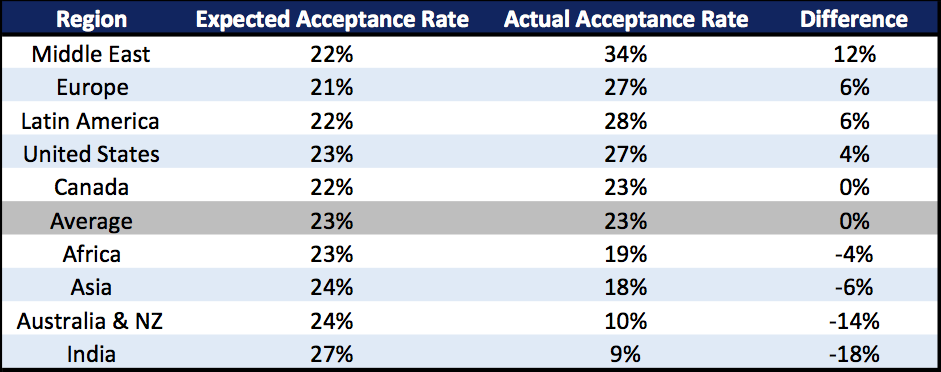
MBA Acceptance Rate by Region International Business SchoolSince there is limited data for many of the countries, first I grouped the countries to look at MBA acceptance rates at a high level. Not all regions apply to the schools in the same proportion. In fact European applicants tend to apply to the higher ranked schools with lower acceptance rates. On the other hand applicants from India are more likely to apply to lower ranked school with higher acceptance rates. I calculated the expected acceptance rate for each region based on the school application distribution.

The regions that have the highest acceptance rates are the Middle East, Europe and Latin America. If you limit Europe to the large western countries such as England, France, Germany, Italy and Spain, then the acceptance rate for Europe jumps to 31%. The USA has a slightly higher acceptance rate than average. On the other hand, Asia, Australia and India are all at a significant disadvantage when applying to business school in the United States.
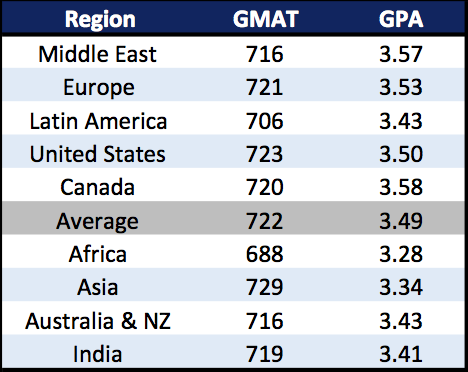
GMAT and GPA by Region MBANext I looked to see if the difference in acceptance rates could be explained by GMAT. GPA isn’t a good indicator because different regions have different average GPAs based on how much grade inflation there is in the area. Most regions are clustered around the average GMAT of 722 with two exceptions. Latin America has an average GMAT 16 points lower than average and still has an acceptance rate 6% higher than expected. Africa has an average GMAT that is 34 points lower than average but it only hurts them a small amount. Asian applicants have the highest average GMAT, however Asian MBA acceptance rate is 6% lower than average.

MBA Acceptance Rate by Country
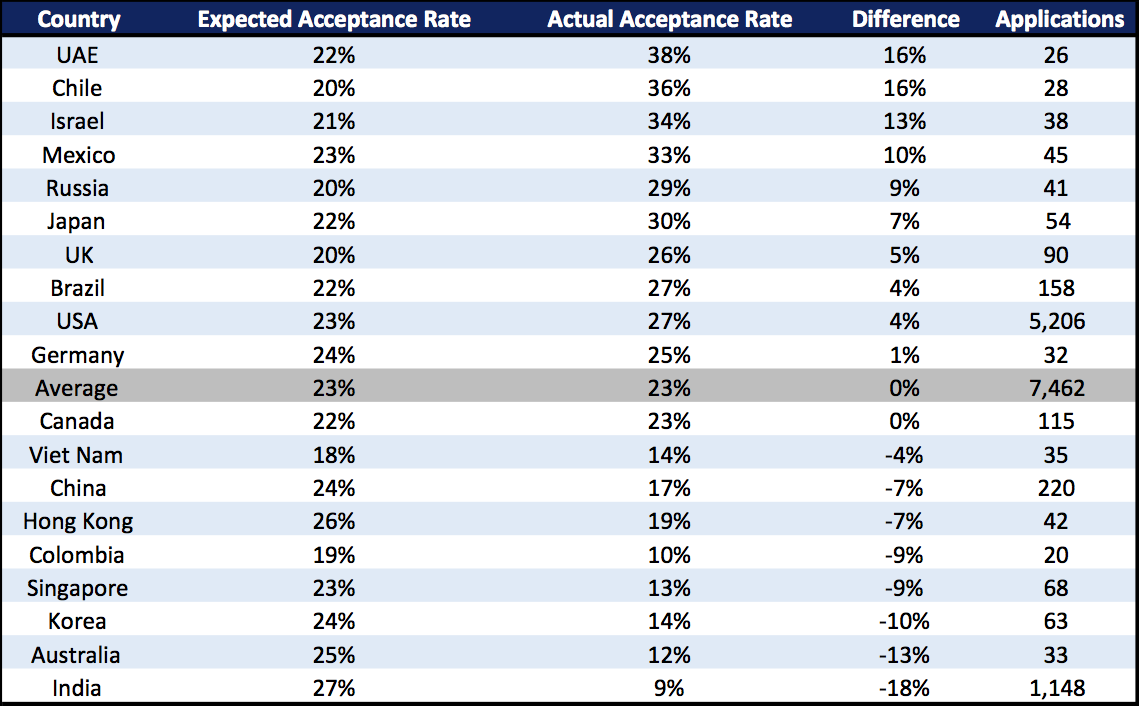
MBA Acceptance Rate by Country International Business SchoolNext I looked at MBA acceptance rate by country for those countries with high enough application volume. I excluded all countries with lower than 20 applications. It is not surprising to see United Arab Emirates and Israel at the top given that the Middle East has a high acceptance rate. Chile, Mexico and Brazil all helped to pull up Latin America’s acceptance rate. The United Kingdom and Russia are the European countries with the highest acceptance rates.

Viet Nam, China, Hong Kong, Singapore and Korea all have acceptance rates that are below average. The only Asian country with a high acceptance rate is Japan. Given that Asian acceptance rates are so low, I would recommend using the help of an admissions consultant if you are applying from one of these countries.

The data for this analysis came from the GMAT Club forum. If you are looking to increase your GMAT, check it out.
McCombs MBA Acceptance Rate Analysis

McCombs School of Business is a top MBA program and part of University of Texas Austin. The full-time program is small; the class of 2017 is 267 students. McCombs average GMAT is 694 and average GPA 3.40. The acceptance rate is at the higher end of the spectrum at 35%. UT Austin also has an evening business school with more relaxed admissions criteria. For the evening MBA, GMAT is 640 and GPA is 3.34.

McCombs MBA Acceptance Rate by GMAT

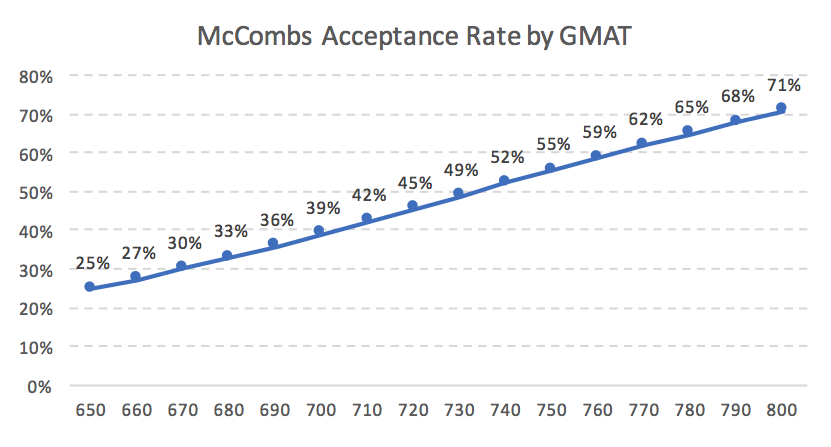
McCombs MBA Acceptance Rate by GMAT MBA Business SchoolGMAT has a strong impact on acceptance rate at McCombs. If you raise your GMAT by 100 points, from 650 to 750, your chance of admission increases by 120%. Even with a relatively low GMAT of 650, an applicant still has a respectable 1 in 4 chance of admission.

McCombs MBA Acceptance Rate by GPA

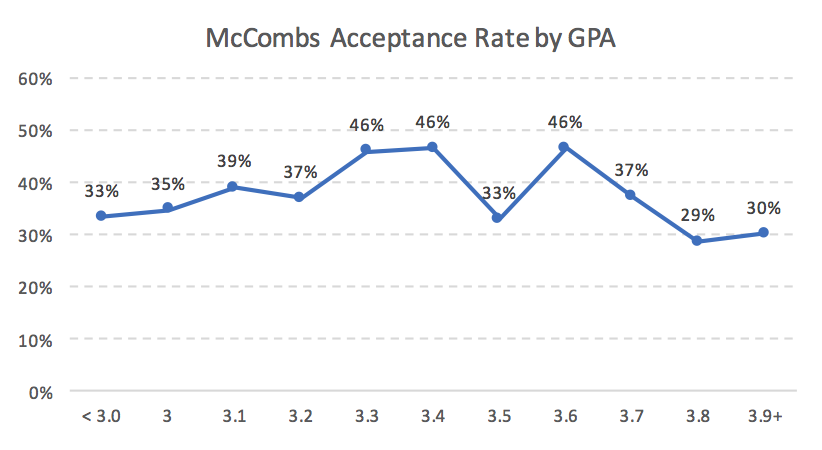
McCombs MBA Acceptance Rate by GPA MBA Business School
Although GMAT is critical when applying to University of Texas Austin, GPA does not appear to be important as long as it is above 3.0. When I built the acceptance model for McCombs, GPA was one of the first variable eliminated. As you can see in the graph above, GPA seems to have no impact on acceptance rate. Data is sparse below 3.0, so I cannot be confident how low an applicants GPA can be before it hurts them. However, if you have a low GPA and want to go to a top 20 MBA program, then McCombs is a great place for you to apply.

McCombs MBA Acceptance Rate by Application Round

McCombs MBA Acceptance Rate by Round MBA Business School
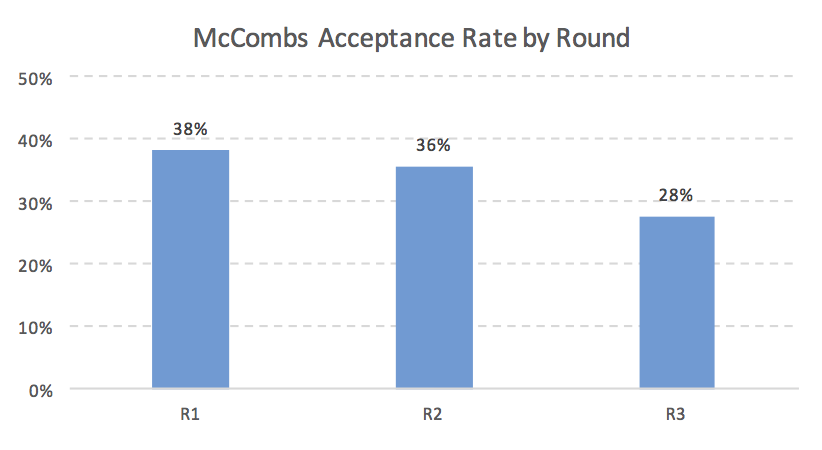
When applying to McCombs, the round you apply during matters. Round 2 acceptance rate is not statistically different than round 1, but there is a penalty for applying round 3. Round 3 applicants are 25% less likely to by admitted than applicants from the first two rounds.

Other Factors that Impact McCombs MBA Acceptance Rate

Although a quarter of applicants studied engineering for their undergraduate degree, McCombs does not seem to love engineers. The acceptance rate for engineers is two thirds that of non-engineers. On the other hand, McCombs loves economics majors. Applicants who majored in economics are 70% more likely to be accepted to McCombs than other majors.

Data for this article was collected from GMAT Club, one of the best websites for preparing for the GMAT.

Yale MBA Acceptance Rate Analysis

Yale School of Management, also known as YSOM, is a prestigious school located in New Haven, Connecticut. It is difficult to gain admission to Yale’s MBA program, similar to their undergraduate school. The YSOM class of 2016 has impressive statistics, with a median GMAT of 720 and median GPA of 3.56. Only 22% of applicants who apply to Yale will be accepted.

Yale MBA Acceptance Rate by GMAT

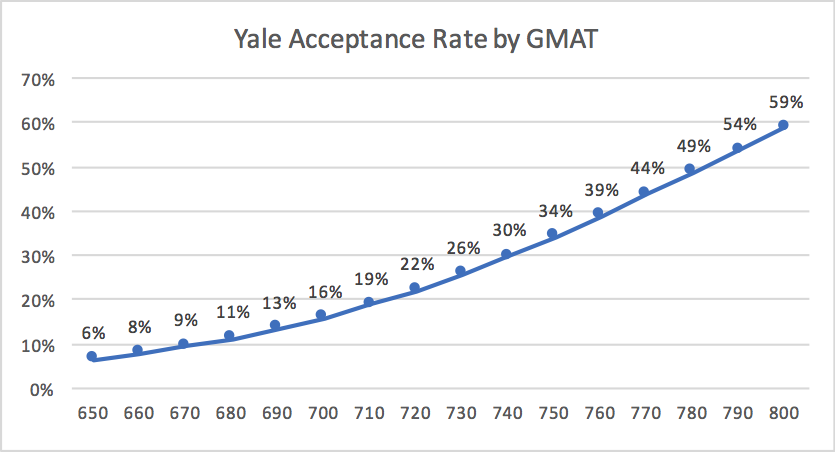
Yale MBA Acceptance Rate by GMAT Business School AdmissionsSimilar to all other schools, a high GMAT score will increase your chance of being admitted to Yale. Although the average GMAT score for the class of 2016 is 720, the average score for applicants is 7 points lower at 713. The GMAT range of the middle 80% of Yale MBA students is 680 to 760. However, the difference in acceptance rate for the bottom of that range is substantially lower than the top. An applicant with a 760 is more than three times more likely to be admitted than an applicant with a 680.

Yale MBA Acceptance Rate by GPA

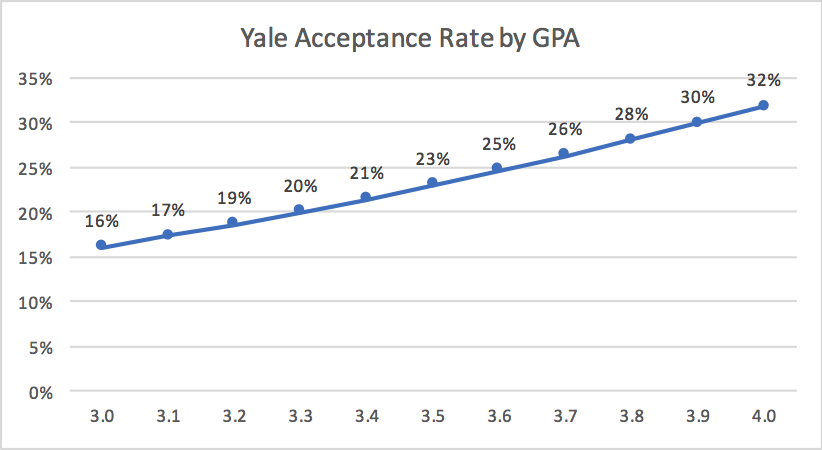
Yale MBA Acceptance Rate by GPA Business School AdmissionsA high GPA also raises the acceptance rate at Yale. The middle 80% students in the class of 2016 have a GPA between 3.17 and 3.87. An applicants with 3.87 is surprisingly only 50% more likely to be admitted than one with a 3.17. Even a perfect 4.0 only raises Yale MBA acceptance rate to 32%.

Yale MBA Acceptance Rate: GMAT vs. GPA

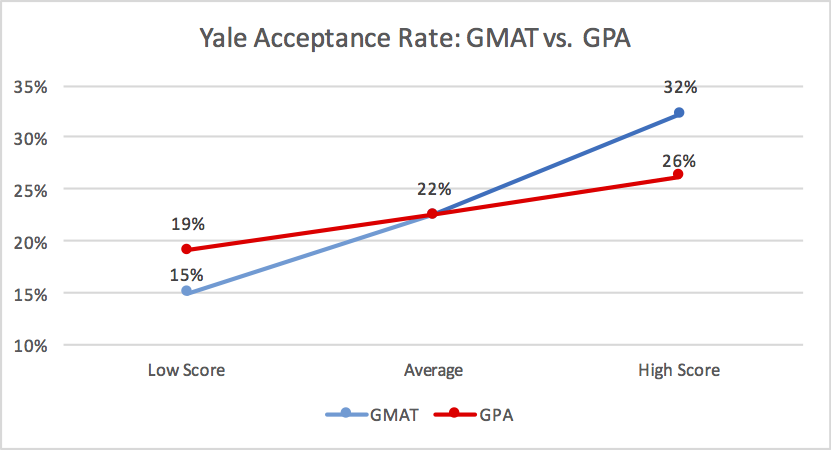
Yale MBA Acceptance Rate GMAT vs GPAThe chart above shows that GMAT is more important for admission to Yale than GPA. A high GPA will only increase acceptance rate by 4%, while a high GMAT results in a 10% higher chance of being admitted.* If you have a low GPA and a high GMAT, Yale is a great school to consider. For example, an applicant with a 3.0 and a 770 has a 34% chance of admission.

Yale MBA Acceptance Rate by Application Round

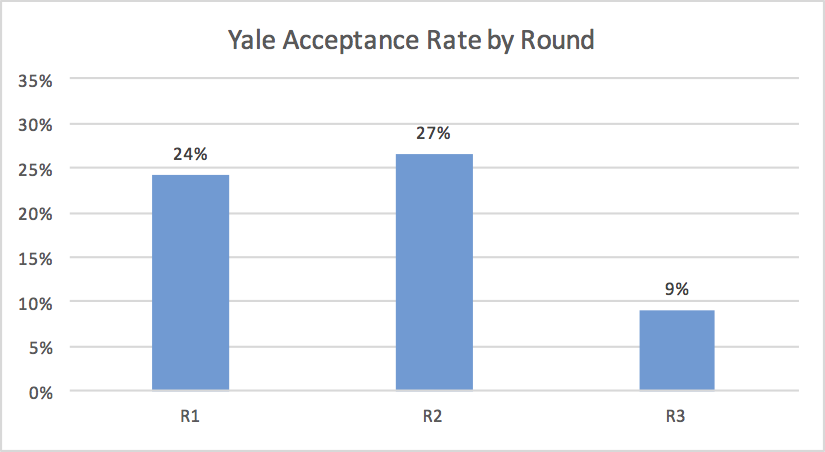
Yale MBA Acceptance Rate by Application Round Business School AdmissionsWhen applying to Yale, it does not matter whether you apply during the first or second round. However, applying in the third round is a huge disadvantage. Your chance of admission is less than half as likely compared to the first two rounds, so be proactive and submit your app early.

Other Admissions Factors

Indian applicants are at a significant disadvantage at Yale, with only a 6% acceptance rate. On the other hand, Yale seems to really like applicants with experience working for consumer packaged goods companies. Their acceptance rate is shockingly high, almost three times higher than average.

*A high score is defined as one standard deviation higher than average.

Darden MBA Acceptance Rate Analysis

Darden, UVA’s business school, is the business school ranked 11th in the US. Darden is a prestigious school and only 25% of applicants are accepted. I built a predictive model to see which factors are most and least important for Darden admission, the results may surprise you.

Darden MBA Acceptance Rate by GMAT

Darden MBA Acceptance Rate by GMAT UVA MBA Admissions Business School

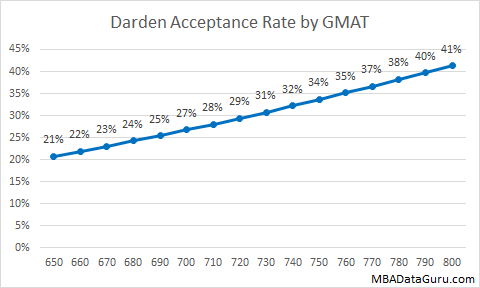
It is not shocking that increasing your GMAT will raise your Darden admission chance. The average GMAT score for accepted students at UVA’s business school is 706. If you were to increase your GMAT by 100 points from 650 to 750 when applying to Darden, you would raise your acceptance rate by an impressive 62%. Even at a GMAT score of 650, chance of acceptance is still over 20%.

Darden MBA Acceptance Rate by GPA

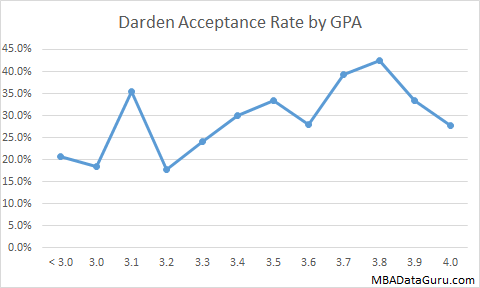
Darden MBA Acceptance Rate by GPA UVA MBA Admissions Business SchoolShockingly, GPA has little to no impact on your chance of admission to Darden. The average GPA of accepted students is 3.52. When I ran a regression model on factors that predict the chance of acceptance at Darden, GPA was one of the first variable eliminated. The graph above confirms my conclusion, a person with a 4.0 GPA has only a slightly higher chance of admission than a person with a 3.0. If you have a low GPA and a high GMAT, then Darden is a great school for you.

Darden MBA Acceptance Rate by Round

Darden MBA Acceptance Rate by Round UVA MBA Admissions Business School
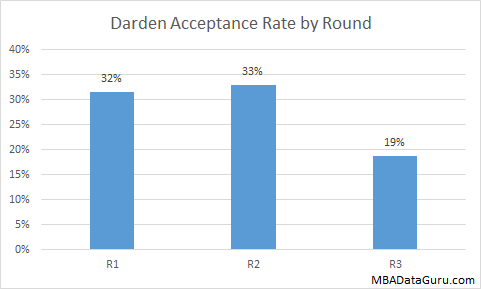
Recently I performed an analysis of MBA acceptance rates by application round. The Darden MBA acceptance rate was noticeably lower during round 3. When building the Darden predictive model I confirmed that the low round 3 acceptance rate was in fact statistically significant. Although round 3 applicants still have a fairly reasonable 19% acceptance rate, it is still significantly lower than the round 1 and 2 Darden admission rates. If you are on the fence about applying round 3 to Darden, you might as well wait for next year.

Other Darden MBA Acceptance Rate Factors

Similar to Wharton, Darden MBA applicants from India have roughly a 75% lower chance of admission. Computer science majors also have a similarly low chance of being accepted, coming in at 11%.

Tuck Acceptance Rate Analysis

Tuck School of Business is a top MBA program with a competitive admissions process. The Tuck acceptance rate is low, at 20%. Unlike most other top MBA programs, Tuck is a self initiated interview. Anyone who visits campus can schedule an interview. In this article I will discuss which factors impact Tuck acceptance rate.

Tuck Acceptance Rate by GMAT

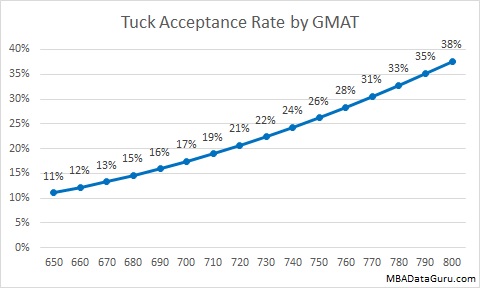
Tuck Acceptance Rate by GMAT Dartmouth MBA AdmissionsGMAT score has a large influence on Tuck acceptance rate. The average Tuck GMAT score is fairly high at 716. Adding a hundred points to your GMAT more than doubles your chance of admission. Even with a low GMAT of 650, acceptance rate at Dartmouth is still more than 10%, unlike Harvard where you need a 740 to have a 10% chance of admission.

Tuck Acceptance Rate by GPA

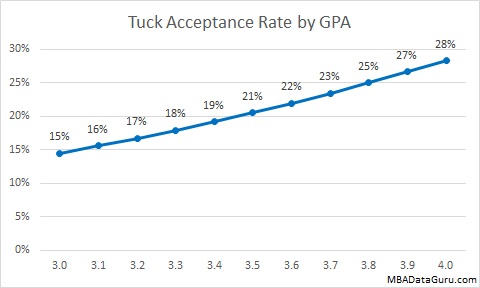
Tuck Acceptance Rate by GPA Dartmouth MBA AdmissionsThe average Tuck GPA is a solid 3.5. It is clear that applicants with a higher GPA have a better chance of being accepted. Once graduated, GPA is set in stone, so you might as well focus on increasing your GMAT which can still be increased.

Tuck GMAT vs. GPA

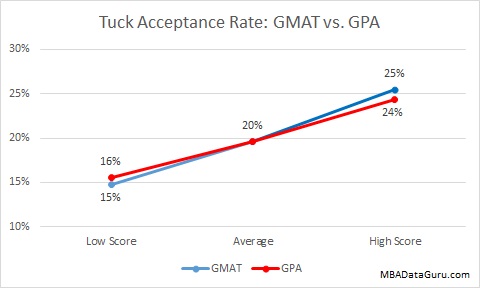
Tuck Acceptance Rate GMAT vs GPA Dartmouth MBA AdmissionsNext we look at whether Tuck prefers a high GMAT or a high GPA. The graph above shows that applicants with a high GMAT have a slightly better chance of being admitted than an applicant with a high GPA. The difference is so small that it is not very important.

Tuck Acceptance Rate by Application Round

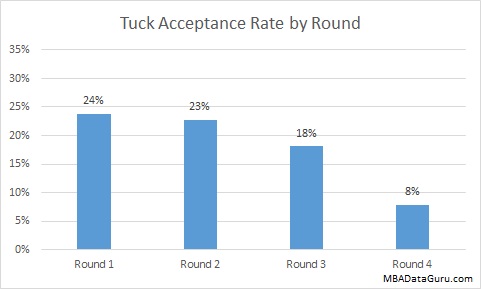
Tuck Acceptance Rate by Round Dartmouth MBA AdmissionsAs you can see in the graph above, the round you apply to Tuck does influence acceptance rate significantly. Round 1 and 2 have a similar admission rates of around 24%. Round 3 acceptance rate starts to drop off noticeably to 18% but not much below the 20% average acceptance rate. The Tuck acceptance rate for round 4 is extremely low, at 8%. Unless you have an incredible application or are desperate to leave your current job for business school, I recommend avoiding round 4 and waiting for the next year.

Tuck Acceptance Rate by Years of Work Experience

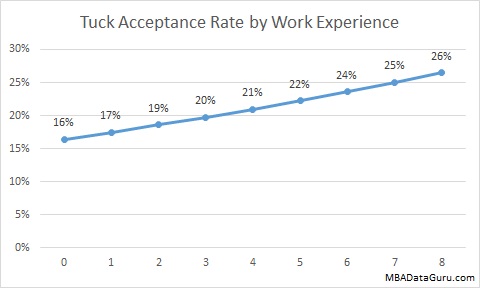
Tuck Acceptance Rate by Years Work Experience Dartmouth MBA AdmissionsTuck values applicants that have a longer work experience. Each year of work experience raises your chance of admission by a little more than 1%.

Tuck Acceptance Rate by Age

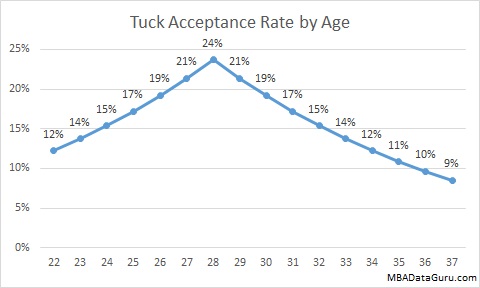
Tuck Acceptance Rate by Age Dartmouth MBA AdmissionsSimilar to other schools such as Columbia, Duke, Cornell and Booth, Tuck prefers applicants who are around 28 years old. I believe that this is because they have enough work experience to draw on during school but are not too old to be placed at companies during recruiting. In the above graphs I look at age and years of work experience separately, however in reality they are closely related.

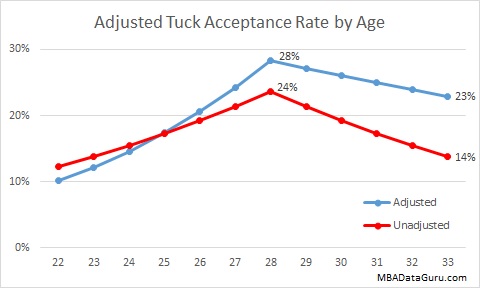
Adjusted Tuck Acceptance Rate by Age Dartmouth MBA AdmissionsIn the graph above I adjusted the original acceptance rate by age graph and added in the impact of work experience. For simplicity I assume that everyone graduates at 22 and works full time from graduation until they apply for business school. When these two factors are combined, you see that older applicants have a large advantage compared to younger applicants.

Other Tuck Admissions Factors

There are a few other factors that affect your chance of admission to Tuck. International applicants (excluding India) have a significantly higher chance of admission, at 28% acceptance rate. Applicants that worked in Venture Capital are especially prized at Tuck, with an impressive 47% chance of admission.

If you are thinking of applying to Tuck, be sure to check out my Tuck Interview Question Guide so you know what questions to expect. The data for this analysis came from GMAT Club.

Columbia MBA Acceptance Rate Analysis

The Columbia MBA acceptance rate is on the higher side for a top 10 school, at around 18%. Despite the deceptively high acceptance rate, Columbia is still a tough school to gain admission. I built a predictive model which can give you some insight into what the Columbia Business School admissions committee is looking for in applicants.

Columbia MBA Acceptance Rate by GMAT

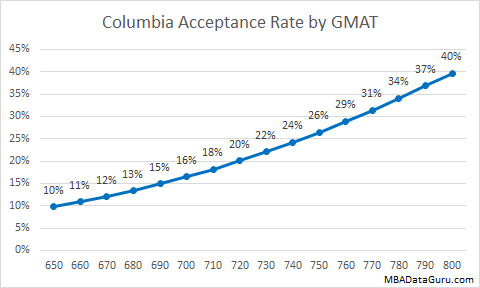
Columbia MBA Acceptance Rate by GMAT CBS AdmissionsAs expected, Columbia MBA acceptance rate increases as GMAT rises. The average GMAT score is an impressive 719. Increasing GMAT score by 100 points from 650 to 750 increases odds of acceptance by 140%, which is a bigger benefit than MIT.

Columbia MBA Acceptance Rate by GPA

Surprisingly GPA has little to no affect on acceptance rate at Columbia. The average GPA of Columbia applicants is 3.49 while the GPA for those admitted is almost unchanged at 3.51. Stanford is the only other school where GPA doesn’t matter. For those of you out there with a low GPA and high GMAT, Columbia is a great school to apply.

Columbia MBA Acceptance Rate by Round

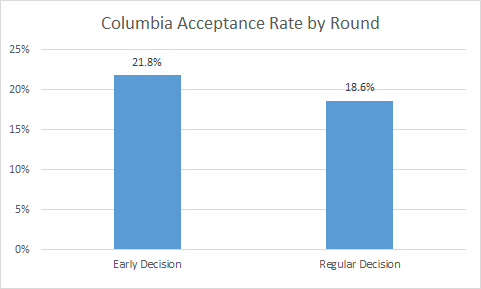
Columbia MBA Acceptance Rate by Round CBS AdmissionsThe round you apply in impacts Columbia MBA acceptance rate. At CBS, if you apply during Early Decision then you are forced to enroll if accepted. Columbia seems to be worried about yield for accepted students if they are forcing applicants to choose them. If you are serious about Columbia then consider applying Early Decision because you have a slight edge otherwise you might as well wait for regular decision. Columbia is actually rolling admissions, so the sooner you submit your app the faster you get your decision.

Columbia MBA Acceptance Rate by Age

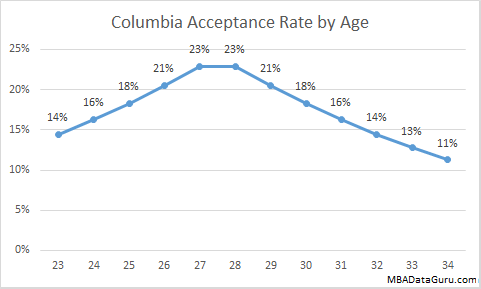
Columbia MBA Acceptance Rate by Age CBS AdmissionsThe age at which you apply has a strong impact on your chance of admission. The best time to apply is when you are 27 or 28. The further a candidate is from the average age, the lower their chance of acceptance is. I believe that this is because candidates with around 5 years of work experience have worked long enough to impress potential employers and contribute to classroom discussion while not being over qualified for on campus recruiting positions. Duke, Cornell and Booth all have a similar age effect.

Other Admissions Factors

Liberal arts majors have roughly twice the acceptance rate as others. I don’t have gender in my data set but my hypothesis is that Columbia is trying to attract women which is why the acceptance rate is so high for liberal arts majors. Acceptance rate is higher for economics majors but lower for finance majors. Consultants also have a major advantage, with an impressive 30% acceptance rate.

Columbia MBA Acceptance Rate by GPA

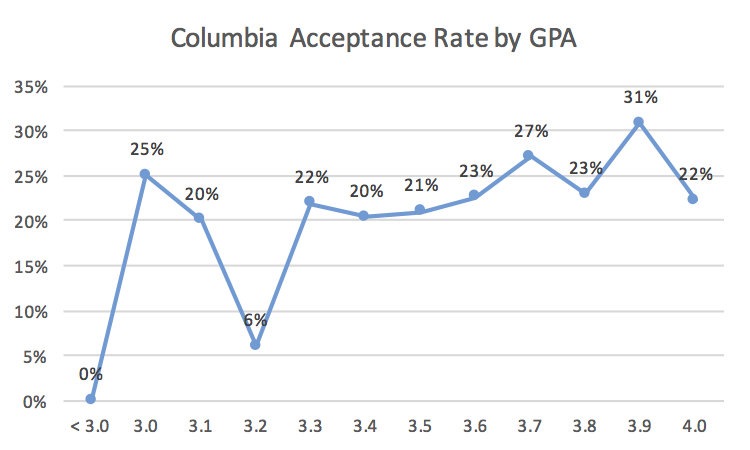
I updated this article by request to show how Columbia acceptance rate changes by GPA. In the chart below you can see that from 3.0 to 4.0 the acceptance rate stays fairly stable, slightly above 20% for all GPAs other than 3.2 and 3.9. Shockingly the acceptance rate at 3.0 is actually higher than 4.0.Columbia MBA Acceptance Rate by GPA Business School Admissions

CBS Interview Invite Rate and Acceptance Rate by Round

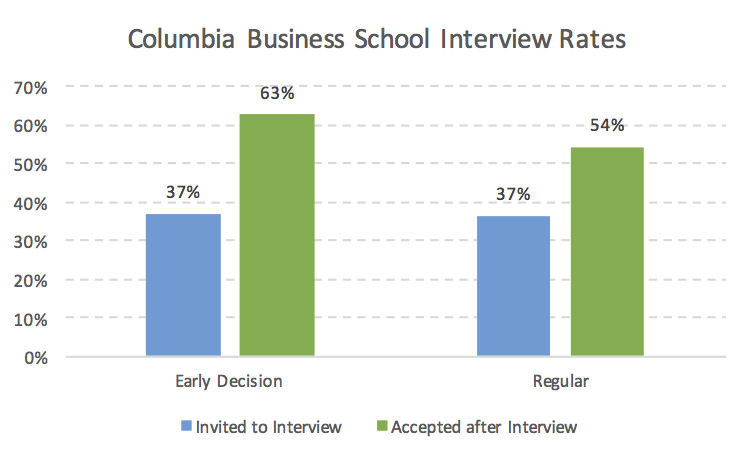
Columbia Business School Interview Rates and Acceptance by Round

A reader asked me how applying early vs. regular affected an applicants chance of being invited to interview and accepted after interview. It looks like applying early does not improve an applicant’s chance of being interviewed but does raise the acceptance rate if invited to interview. Approximately 40% of applicants apply through early decision.

The data for this post comes from GMAT Club.

MBA Admissions Process Advice

The MBA admissions process is long and difficult. It is no wonder that many people pay a lot of money to hire admissions consultants to help them with the process. This article will help you to understand the critical parts of the application process.

MBA Admissions Process Components

  1. GMAT
  2. Resume
  3. Recommendations
  4. Essays
  5. Application

This list of components for an MBA application is ranked from most important to least important as far as I’m concerned. Every school worth going to will have all of these components, if not more

  1. GMAT – All top MBA programs require the GMAT (or GRE). It is extremely important for admissions. If you want to be admitted to a top ten school then shoot for 700+. Preferably 720+ given that GMAT scores at top schools have been on the rise in recent years due to more international applications.
  2. Resume – The resume is made up of your work experience, leadership experience, undergraduate school and interests. The truth of the matter is that business schools care a lot about name brand for the companies you have worked at as well as the undergraduate school you attended. If possible try to work at a desirable company such as Google, Goldman Sachs or McKinsey but at the very least, try to have at least one company on your resume that a normal person will have heard of. For additional advice, check out my article on improving your resume.
  3. Recommendations – Your recommendations are critical! If any of your recommenders give you even lukewarm recommendations then you can kiss your acceptance goodbye. Everyone gets good recommendations because we all pick people that like us. It is helpful to pick alumni of the school if possible or at least people that have an MBA. Recommenders who don’t have an MBA probably won’t understand the process and what the admissions committee is looking for. If your recommender did not go to a top MBA school, spend some time explaining to them what schools are looking for in a recommendation.
  4. Essay – The essay is your chance to explain to the admissions committee why you are a good fit and why you need an MBA. You should do as much research as possible for each school before writing the essay so that you can tailor it to the school. In researching a school you should use their website, visit the school and network with currents students/alumni. I can’t stress enough networking with current students. They recently went through the same process that you will be going through and they know what the culture of the school is. If you really befriend a student they may even help you by editing your resume and essays, but don’t expect it. If I were you I’d avoid asking too much of the tour guide who shows your around because they meet hundreds of prospective students a month and don’t have enough time to spend helping every one. Instead I would ask the tour guide to connect you with a student who is in the area in which you are interested. For example, if I were applying again then I would email the tour guide and ask them to connect me with someone who knows about financial services consulting or maybe someone who did an internship at XYZ consulting company. This gives the guide the option of passing you off to a friend of theirs who doesn’t get as many emails from prospective students. That person will probably be willing to spend more time talking to you.
  5. Even after you have done all the other components of the application you will still have to fill out the actual application. It typically takes two or three hours and will require you to have all the information about each job you worked and degree you received. If you have ever gotten into trouble, most schools ask if you were ever on probation or arrested, so have an answer ready.

Booth Admissions Rate Analysis

University of Chicago is a fairly selective business school with an acceptance rate of 22%. Similar to Kellogg, Booth has one of the higher acceptance rates for a top 10 school. While building an MBA admission calculator, I uncovered some insights on how Booth evaluates MBA applicants.

Booth Admissions Rate by GMAT

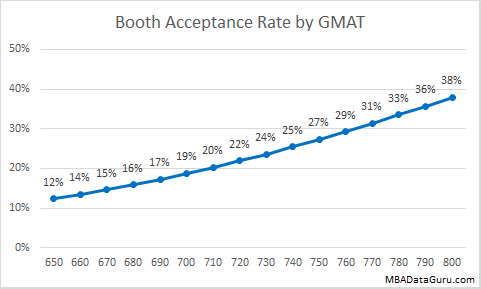
Booth Admissions Rate by GMAT University of Chicago MBA AcceptanceThe graph above demonstrates that GMAT has a high impact on Booth admissions. Increasing your GMAT from 650 to 750 more than doubles your chance of admission. The average GMAT score for an applicant is 718, but the admitted applicants have a slightly higher GMAT of 724.

Booth Admissions Rate by GPA

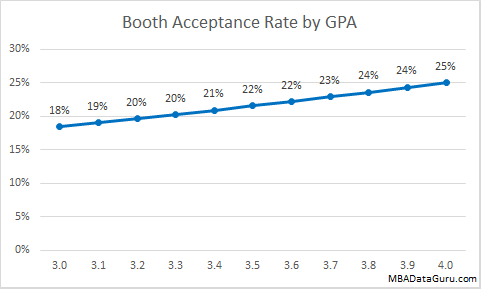
Booth Admissions Rate by GPA University of Chicago MBA AcceptanceA high GPA will give you a slightly higher acceptance rate at University of Chicago, but it is easy to see that GPA doesn’t have a very large impact on admission rate. Even with a 3.0 GPA the Booth acceptance rate is 18% which is higher than the acceptance rate at Harvard for an applicant with a 4.0.

Booth Acceptance Rate GMAT vs. GPA

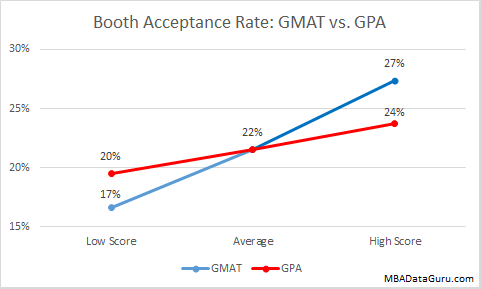
Booth Admissions Rate GMAT vs. GPA University of Chicago MBA AcceptanceThe graph above compares the importance of GMAT vs. GPA to Booth admissions. Candidates with a high GMAT score had a significantly higher acceptance rate than those who had a high GPA.* If you have a high GMAT and a low GPA, University of Chicago is an ideal school at which to apply. For example an applicant with 3.0 GPA and a 760 GMAT has a 25% chance of being admitted.

Booth Admission Rate by Age

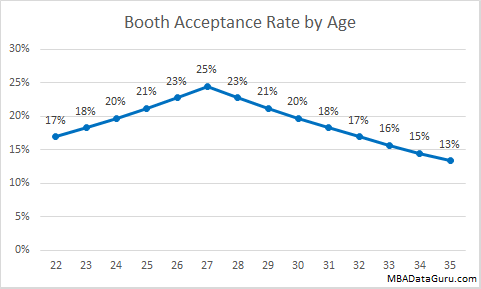
Booth Admissions Rate by Age University of Chicago MBA AcceptanceSimilar to Duke and Cornell, the Booth admission committee prefers applicants who are around 27. The further a candidate is from the average age, the lower their chance of acceptance is. I believe that this is because candidates with around 5 years of work experience have worked long enough to impress potential employers and contribute to classroom discussion while not being over qualified for on campus recruiting positions.

Booth Admissions Rate by Round

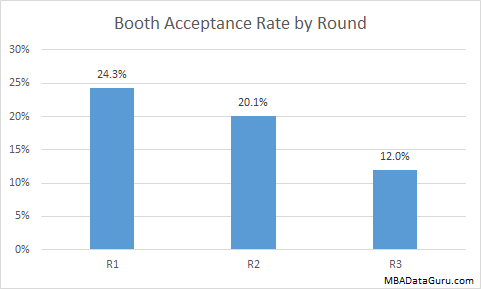
Booth Acceptance Rate by Round University of Chicago MBA AdmissionWhich round you apply in does actually affect your chance of admission at University of Chicago. There is a small drop off in acceptance rate between round 1 and 2, but then a large drop in round 3.

Other Factors that Impact Booth Acceptance Rate

Applicants who are living in India have only a 7% chance of being accepted at Booth. Science and Math majors have a slightly higher chance of admission. Liberal Arts and Humanities majors have an exceptionally high chance of being accepted, at 56%, while Engineering majors have lower odds at 17%. I think that it is not that Booth is specifically trying to attract Liberal Arts majors, but that they are trying to bring in more women, who happen to be more likely to major in Liberal Arts. Finally investment bankers have only a 14% acceptance rate at Booth.

*A high GMAT or high GPA is defined as one standard deviation above average.

Duke MBA Acceptance Rate Analysis

Duke’s Fuqua School of Business is one of the top 20 MBA programs in the US. The Duke MBA acceptance rate is 25%, which makes being admitted a big accomplishment. The next question is obviously what characteristics does the Duke admissions committee look for in Fuqua applicants? Not only are GMAT and GPA important factors that will impact your admissions, but also your age and the round you apply in affect your chance of acceptance.

Duke MBA Acceptance Rate by GMAT

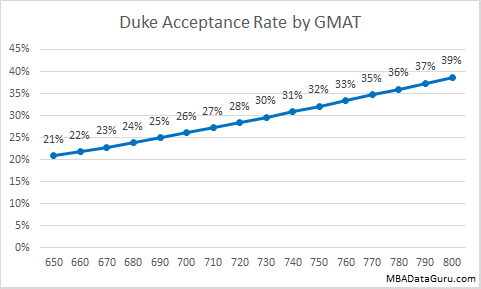
Duke MBA Acceptance Rate by GMAT Fuqua Business School AdmissionThe average Duke applicant has a GMAT of 690, several points lower than the 697 for accepted candidates. As expected the acceptance rate increases as an applicants GMAT rises. The graph above shows Duke MBA acceptance rate by GMAT for the average applicant with a GPA of 3.35.

Duke MBA Acceptance Rate by GPA

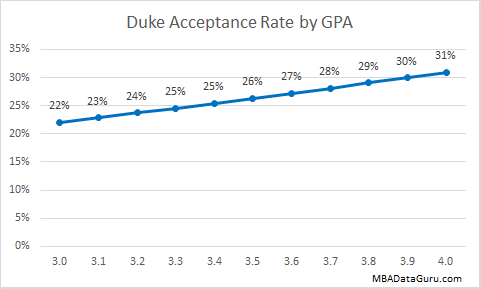
Duke MBA Acceptance Rate by GPA Fuqua Business School AdmissionUnlike schools such as Stanford and Cornell, GPA does affect Duke MBA acceptance rate. The average applicant has a GPA of 3.35, however accepted applicant’s GPA is slightly higher. Above you can see the admission rate by GPA at Fuqua.

Duke MBA Acceptance Rate GMAT vs. GPA

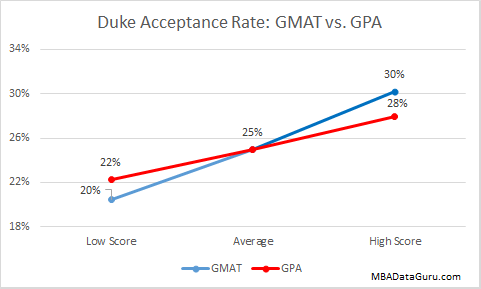
Duke MBA Acceptance Rate GMAT vs. GPA Fuqua Business School AdmissionNow that you know that GMAT and GPA both matter to Duke, the next question is which is more important. My admissions analysis shows that Duke prefers GMAT over GPA*. A high score on the GMAT will increase Duke MBA acceptance rate from 25% to 30%. However, a high GPA only increases your chance of admission at Duke to 28%. For applicants with a high GMAT and low GPA, Duke is a good school at which to apply. For example an applicant with a 750 GMAT and 3.0 GPA has a 29% chance of getting into Duke.

Duke MBA Acceptance Rate by Age

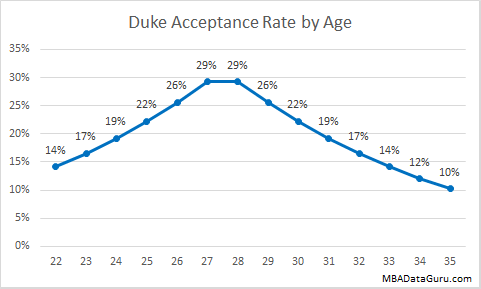
Duke MBA Acceptance Rate by Age Fuqua Business School AdmissionSimilar to other schools such as Stern, age impacts acceptance rate. Applicants who are around 27 to 28 have the highest chance of being accepted at Duke, while older and younger candidates have lower odds of being admitted. My hypothesis is that younger applicants don’t bring as much work experience to the class room discussion while older applicants are hard to place at top companies during on campus recruiting.

Duke MBA Acceptance Rate by Round

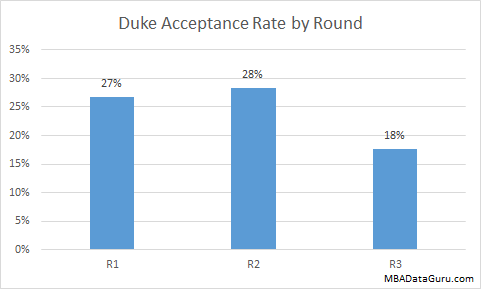
Duke MBA Acceptance Rate by Round Fuqua Business School AdmissionI looked into how application round affected your chance of admission at Duke, and it was not statistically significant. Even the low round 3 acceptance rate cannot be confirmed as accurate because of low volume. Don’t worry too much about applying first or second round, but you may want to avoid round 3 just to be safe.

Other Factors Affecting Acceptance Rate

People applying from India had a significantly lower chance of admissions, while applicants from the US had a higher acceptance rate at Duke. Applicants who majored in business had a slightly lower admission rate. Military applicants had an astonishingly high acceptance rate of 50%. So all you veterans out there should strongly consider applying to Duke.

The data used for this analysis comes from GMAT Club.

*For GMAT vs. GPA comparison a high score is defined by one standard deviation above the average GMAT or GPA.

Cornell MBA Acceptance Rate Analysis

Many MBA applicants wonder what their chances of getting into a top school is. This analysis looks at Cornell MBA acceptance rate based on data such as GMAT, GPA, undergraduate major, and age at application. The average acceptance rate at Cornell’s Johnson Graduate School of Management is 22%, which is higher than all of the schools in the top 10 but lower than many of the schools ranked 11 to 20.

Cornell MBA Acceptance Rate by GMAT

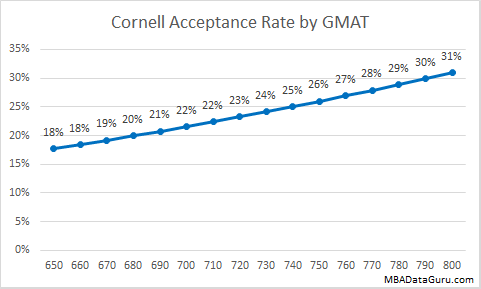
Cornell MBA Acceptance Rate by GMAT Johnson AdmissionAs you would expect, GMAT has a high impact on Cornell MBA acceptance rate. The average GMAT for the Cornell MBA class of 2016 is 700. Although GMAT does affect Cornell MBA acceptance rate, GMAT has a smaller importance than other schools such as Kellogg. Increasing your GMAT score by 30 points raises your chance of admission by 5% at Kellogg but only by 2% at Cornell.

Cornell MBA Acceptance Rate by GPA

Strangely enough it appears that GPA has little to no impact on your acceptance rate at Johnson. When I ran the logistic regression, GPA was the first variable I eliminated. Even at Stanford, GPA wasn’t eliminated until almost at the end. This suggests to me that Cornell really doesn’t care about GPA. If you have a low GPA and a high GMAT, then you should be applying to Cornell for the highest chance of admission. The average GPA from my data set, which came from GMAT Club, was 3.40 for both accepted and for declined applicants.

Cornell MBA Acceptance Rate by Age

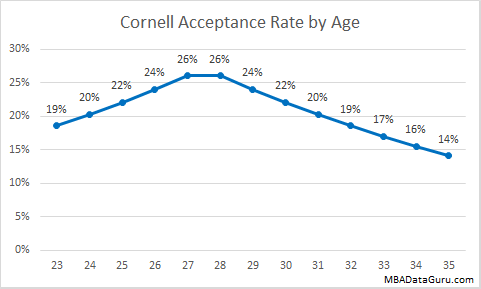
Cornell MBA Acceptance Rate by Age Johnson School AdmissionAlthough your GPA doesn’t matter to Cornell, the age at which you apply does matter. Similar to other schools, such as NYU, the age at which you apply does impact your chance of admission. Cornell prefers candidates who are close to the average age of around 27 or 28. The further you deviate from this average age, the lower your chances of admission are. I believe that the schools do this for two reasons. The first is that young people don’t have as much work experience, so they tend to have less to contribute to the conversation in class. At the other end, candidates that are too old are harder to place in  recruiting because companies wonder why someone who is so old is getting an MBA. I have noticed that the women in my program tend to be younger on average than the men. I imagine that the admissions department will give women a little more leeway on applying younger because some women want to finish their MBA before they start a family.

Other Factors that Impact Acceptance Rate

Candidates who apply while living in India have a lower acceptance rate, while those applying while in the US have a higher admission rate. Applicants who majored in engineering during their undergraduate program have a lower acceptance rate. The admission rate for applicants who are currently working in manufacturing is significantly lower than anyone else.

Good luck with your applications!