Tag Archives: Application

Darden MBA Acceptance Rate Analysis

Darden, UVA’s business school, is the business school ranked 11th in the US. Darden is a prestigious school and only 25% of applicants are accepted. I built a predictive model to see which factors are most and least important for Darden admission, the results may surprise you.

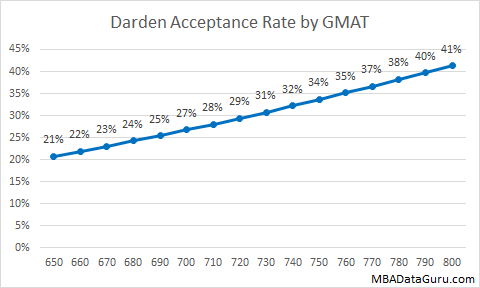
Darden MBA Acceptance Rate by GMAT
Darden MBA Acceptance Rate by GMAT UVA MBA Admissions Business School

It is not shocking that increasing your GMAT will raise your Darden admission chance. The average GMAT score for accepted students at UVA’s business school is 706. If you were to increase your GMAT by 100 points from 650 to 750 when applying to Darden, you would raise your acceptance rate by an impressive 62%. Even at a GMAT score of 650, chance of acceptance is still over 20%.

Darden MBA Acceptance Rate by GPA
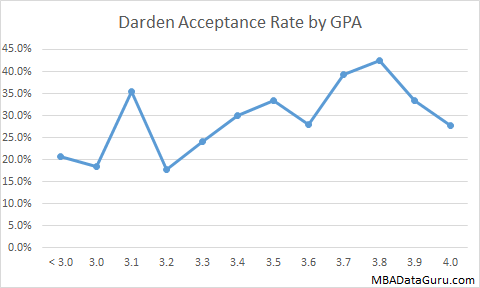
Darden MBA Acceptance Rate by GPA UVA MBA Admissions Business SchoolShockingly, GPA has little to no impact on your chance of admission to Darden. The average GPA of accepted students is 3.52. When I ran a regression model on factors that predict the chance of acceptance at Darden, GPA was one of the first variable eliminated. The graph above confirms my conclusion, a person with a 4.0 GPA has only a slightly higher chance of admission than a person with a 3.0. If you have a low GPA and a high GMAT, then Darden is a great school for you.

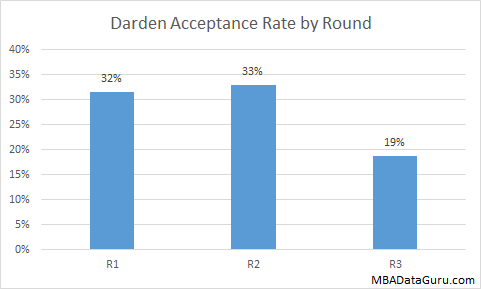
Darden MBA Acceptance Rate by Round
Darden MBA Acceptance Rate by Round UVA MBA Admissions Business School
Recently I performed an analysis of MBA acceptance rates by application round. The Darden MBA acceptance rate was noticeably lower during round 3. When building the Darden predictive model I confirmed that the low round 3 acceptance rate was in fact statistically significant. Although round 3 applicants still have a fairly reasonable 19% acceptance rate, it is still significantly lower than the round 1 and 2 Darden admission rates. If you are on the fence about applying round 3 to Darden, you might as well wait for next year.

Other Darden MBA Acceptance Rate Factors

Similar to Wharton, Darden MBA applicants from India have roughly a 75% lower chance of admission. Computer science majors also have a similarly low chance of being accepted, coming in at 11%.

MBA Admissions Process Advice

The MBA admissions process is long and difficult. It is no wonder that many people pay a lot of money to hire admissions consultants to help them with the process. This article will help you to understand the critical parts of the application process.

MBA Admissions Process Components

  1. GMAT
  2. Resume
  3. Recommendations
  4. Essays
  5. Application

This list of components for an MBA application is ranked from most important to least important as far as I’m concerned. Every school worth going to will have all of these components, if not more

  1. GMAT – All top MBA programs require the GMAT (or GRE). It is extremely important for admissions. If you want to be admitted to a top ten school then shoot for 700+. Preferably 720+ given that GMAT scores at top schools have been on the rise in recent years due to more international applications.
  2. Resume – The resume is made up of your work experience, leadership experience, undergraduate school and interests. The truth of the matter is that business schools care a lot about name brand for the companies you have worked at as well as the undergraduate school you attended. If possible try to work at a desirable company such as Google, Goldman Sachs or McKinsey but at the very least, try to have at least one company on your resume that a normal person will have heard of. For additional advice, check out my article on improving your resume.
  3. Recommendations – Your recommendations are critical! If any of your recommenders give you even lukewarm recommendations then you can kiss your acceptance goodbye. Everyone gets good recommendations because we all pick people that like us. It is helpful to pick alumni of the school if possible or at least people that have an MBA. Recommenders who don’t have an MBA probably won’t understand the process and what the admissions committee is looking for. If your recommender did not go to a top MBA school, spend some time explaining to them what schools are looking for in a recommendation.
  4. Essay – The essay is your chance to explain to the admissions committee why you are a good fit and why you need an MBA. You should do as much research as possible for each school before writing the essay so that you can tailor it to the school. In researching a school you should use their website, visit the school and network with currents students/alumni. I can’t stress enough networking with current students. They recently went through the same process that you will be going through and they know what the culture of the school is. If you really befriend a student they may even help you by editing your resume and essays, but don’t expect it. If I were you I’d avoid asking too much of the tour guide who shows your around because they meet hundreds of prospective students a month and don’t have enough time to spend helping every one. Instead I would ask the tour guide to connect you with a student who is in the area in which you are interested. For example, if I were applying again then I would email the tour guide and ask them to connect me with someone who knows about financial services consulting or maybe someone who did an internship at XYZ consulting company. This gives the guide the option of passing you off to a friend of theirs who doesn’t get as many emails from prospective students. That person will probably be willing to spend more time talking to you.
  5. Even after you have done all the other components of the application you will still have to fill out the actual application. It typically takes two or three hours and will require you to have all the information about each job you worked and degree you received. If you have ever gotten into trouble, most schools ask if you were ever on probation or arrested, so have an answer ready.