Tag Archives: Age

Military MBA Acceptance Rate Analysis

Military MBA Acceptance Rate Analysis - GMAT GPA AgeTransitioning from the military to MBA is a fairly popular path to follow. A little over 4% of MBA applications come from military veterans. When looking at the data comparing military applicants to traditional MBA applicants, a few trends become clear:

  • Military / Veteran applicants tend to be a year or two older.
  • Scores for military applicants are a little lower on average, about 15 points on the GMAT and about .15 for GPA
  • Military applicants on average have another year or two of work experience
  • Military MBA acceptance rate is about 50% higher than the acceptance rate for traditional applicants
  • Some schools have a very large advantage for military applicants while others have little to no advantage

For the purposes of this article, I define traditional applicants as individuals that have worked in finance, marketing, accounting, retail, STEM and healthcare. They make up around 86% percent of MBA applicants. I excluded applicants that had a background in education, entertainment, sports, hospitality, tourism, human resources, journalism, publishing, government and non-profit.

Military applicants on average have the highest acceptance rate despite having the lowest average scores. My hypothesis is that they tend to have more significant leadership experience than other applicants and tend to do well in job placement. They also know how to operate well under pressure. These traits are desirable for MBA programs.

Military MBA Acceptance Rate by Tier

For the purposes of this analysis, I broke the schools into tiers since not all schools have enough data on military applicants to look at individually.

  • Tier 1 is defined as the schools ranked 1 through 7: Harvard, Wharton, Booth, Stanford, Sloan, Kellogg and Haas.
  • Tier 2 is defined as schools ranked 8 through 14: Tuck, Yale, Columbia, Ross, Stern, Fuqua and Darden.
  • Tier 3 is defined as schools ranked 15 through 25: Anderson, Johnson, McCombs, Kenan-​Flagler, Tepper, Goizueta, McDonough, Kelley, Olin, Marshall, Carey and Owen.
Tier
Applicant Group
Accepted
GMAT
GPA
Age
1
Traditional
14%
727
3.53
27.3
1
Military & Defense
23%
719
3.39
28.4
2
Traditional
25%
718
3.45
27.3
2
Military & Defense
39%
705
3.28
28.9
3
Traditional
37%
709
3.43
27.1
3
Military & Defense
55%
685
3.23
28.8

As you can see, military applicants have a substantial advantage at tier 1, 2 and 3 schools. The tier with largest lift is actually tier 1, which has a 62% higher acceptance rate for military applicants compared to traditional applicants. Military applicants had a 58% higher acceptance rate for Tier 2 schools and 49% for tier 3. Military applicants had the smallest score gap for tier 1 schools and the largest gap for tier 3 where military applicants had a GMAT that is 24 points lower.

Military MBA Acceptance Rate Lift

School
Military Acceptance Rate Lift
Harvard University (HBS)
117%
University of Michigan—​Ann Arbor (Ross)
94%
Duke University (Fuqua)
90%
University of Pennsylvania (Wharton)
75%
Massachusetts Institute of Technology (Sloan)
71%
Northwestern University (Kellogg)
57%
Columbia University (CBS)
39%
Dartmouth College (Tuck)
36%
University of Texas—​Austin (McCombs)
30%
University of Virginia (Darden)
19%
University of Chicago (Booth)
11%

The chart above shows how much higher the acceptance rate for military applicants is compared to traditional applicants. Harvard had the highest lift, where military applicants are more than twice as likely to get accepted. At the other end of the spectrum is Booth, where military applicants only have a 11% advantage over traditional applicants. My advice for military applicants is to apply to Ross and Duke. They are really strong schools with a greater than 50% chance of admission. I only included schools where there is enough data.

I looked at the acceptance rates for the other schools but there wasn’t enough data to publish an actual number. So I grouped them into categories.

  • Schools with a large lift ( greater than 70%): Haas, Emory, Tepper, and Kelley
  • Schools with a medium lift (30% to 60%): Stern, Anderson, Johnson, and Marshall.
  • Schools with little to no lift (lower than 30%): Stanford, Georgetown, Olin, Owen, Carey, UNC, and Yale.

I plan to do a similar analysis for other non-traditional applicants in the near future.
Best Schools for Young MBA Applicants

Deciding when to start applying to business school can be a challenge. Salary increases dramatically after an MBA, but schools tend to prefer applicants with more work experience. I looked at the top 25 US MBA programs’ admission data to find the best schools for young MBA applicants in terms of chance of being admitted. I analyzed the MBA acceptance rate by age to see which schools had the smallest disadvantage for younger applicants relative to traditionally aged MBA applicants.

How Many MBA Applicants are Young?

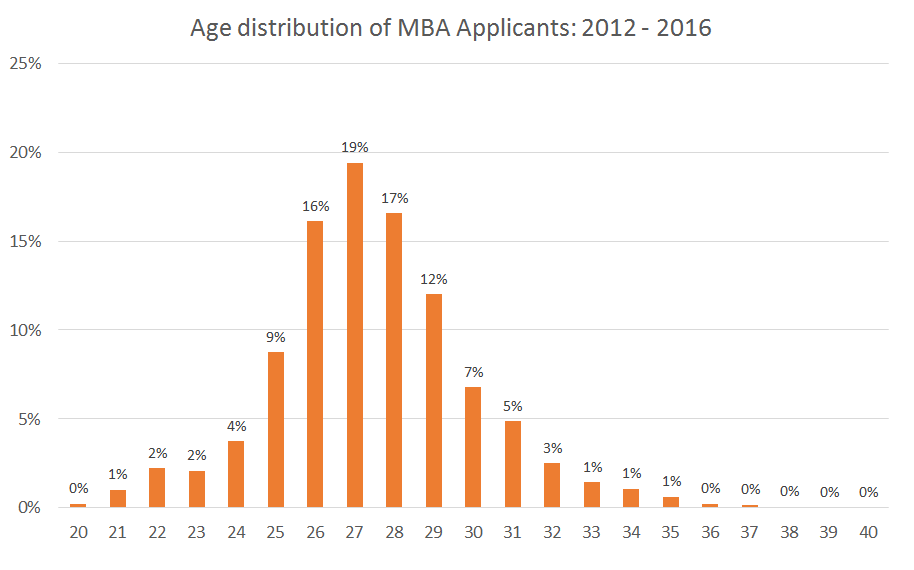
I defined an applicant as young if they are 25 or younger. I compared the young MBA applicants to those who are the more typical age range of 26 to 29. Over the past 5 years, the number of young applicants has increased significantly from 13% of the applicant pool to 21% over the past 5 years. Despite the increase in supply of young applicants, there has not been a drop in acceptance rate for younger candidates.

MBA Applicant Age Distribution

MBA Applicant Age Distribution

The rise in applications from younger applicants could be driven by some schools adopting programs specifically targeted at undergraduates. Harvard has the 2+2 program that allows undergraduates to apply to HBS while they are still in school. Those who are accepted must spend at least 2 years working full time before starting their MBA. NYU Stern also has a program targeted towards undergraduates called the Berkley Scholars. It is a very selective program where 5 to 6 undergraduates will get a full ride and a stipend for living expenses. Unlike Harvard’s 2+2 program, Berkley Scholars start their MBA immediately. The Berkley Scholars tend to do very well. From the class of 2016, two of the scholars joined McKinsey and one went to BCG.

Best Schools for Young MBA Applicants

Almost every school in the top 25 penalizes young applicants in admissions. On average young applicants have only 2.5 years of work experience which, is 2 years lower than traditionally aged applicants that are 26 to 29. Most of the best schools for young MBA applicants still moderately penalize younger applicants. Stanford is the only school that actually gives young applicants an advantage when they apply. My hypothesis is that it is related to their affinity for startups. If a young person has a great idea for a startup, will 2 more years working as a low level analyst really improve the odds of it working out? In the table below, the “Disadvantage for <25” column shows how much lower the odds are for a young applicant to be admitted. For example at MIT an applicant that is 26 to 29 has a 16% acceptance rate. The disadvantage factor is -10%, so the young MBA acceptance rate is 14.4%. I have included the average GMAT and GPA for reference.

School
Disadvantage
for <25
GMAT
(<25)
GMAT
(26 – 29)
GPA
(<25)
GPA
(26 – 29)
Stanford University (GSB)
52%
733
731
3.57
3.59
Washington University in St. Louis (Olin)
3%
719
712
3.52
3.46
Massachusetts Institute of Technology (Sloan)
-10%
720
729
3.56
3.52
Carnegie Mellon University (Tepper)
-16%
714
714
3.43
3.39
Georgetown University (McDonough)
-20%
699
699
3.43
3.35
University of North Carolina—​Chapel Hill (Kenan-​Flagler)
-26%
709
712
3.42
3.37
Cornell University (Johnson)
-28%
712
715
3.32
3.36
Columbia University (CBS)
-29%
722
726
3.55
3.49
Vanderbilt University (Owen)
-30%
698
692
3.49
3.34
University of Virginia (Darden)
-35%
723
718
3.44
3.39

Worst Schools for Young MBA Applicants

These schools are at the complete other end of the spectrum. These MBA programs severely penalize young applicants. It is interesting to see Berkeley, the other top California school, treats young applicants completely contrary to Stanford. Young applicants have a 72% lower chance of being admitted then applicants 26 to 29, despite the young applicants having higher GMAT and GPA. I was a little shocked to see Harvard featured so prominently on the list of worst schools for young MBA applicants given that they have the 2+2 program to attract young talent.

School
Dissadvantage for <25
GMAT
(<25)
GMAT
(26 – 29)
GPA
(<25)
GPA
(26 – 29)
University of California—​Berkeley (Haas)
-72%
722
721
3.56
3.51
University of Michigan—​Ann Arbor (Ross)
-64%
721
720
3.33
3.41
Harvard University (HBS)
-63%
731
732
3.59
3.58
Arizona State University (Carey)
-52%
690
687
3.46
3.41
University of Pennsylvania (Wharton)
-52%
734
731
3.56
3.55
Duke University (Fuqua)
-50%
716
717
3.46
3.42
University of Texas—​Austin (McCombs)
-49%
717
708
3.38
3.44
Dartmouth College (Tuck)
-48%
716
727
3.51
3.46
Indiana University (Kelley)
-47%
694
698
3.43
3.39
Yale University (YSOM)
-46%
713
724
3.49
3.47
University of California—​Los Angeles (Anderson)
-45%
720
718
3.48
3.47
University of Chicago (Booth)
-44%
726
731
3.56
3.52
Emory University (Goizueta)
-44%
714
705
3.46
3.37
Northwestern University (Kellogg)
-42%
730
724
3.5
3.49
New York University (Stern)
-41%
711
718
3.47
3.43
University of Southern California (Marshall)
-40%
703
707
3.52
3.42

MBA Acceptance Rate by Age Group

For reference, here are the raw MBA acceptance rates by age group for each school. I also looked at older applicants and plan to do a follow-up article focusing on applicants that are 30 years old and older.

Rank
School
<= 25
26 – 29
30+
1
Harvard University (HBS)
4%
12%
12%
1
University of Pennsylvania (Wharton)
10%
22%
15%
3
University of Chicago (Booth)
16%
28%
18%
4
Stanford University (GSB)
8%
5%
5%
4
Northwestern University (Kellogg)
14%
24%
26%
4
Massachusetts Institute of Technology (Sloan)
14%
16%
11%
7
University of California—​Berkeley (Haas)
4%
16%
8%
8
Dartmouth College (Tuck)
14%
27%
17%
9
Columbia University (CBS)
15%
21%
13%
9
Yale University (YSOM)
13%
24%
16%
11
University of Michigan—​Ann Arbor (Ross)
14%
40%
36%
12
New York University (Stern)
15%
26%
14%
12
Duke University (Fuqua)
13%
26%
24%
14
University of Virginia (Darden)
23%
36%
19%
15
University of California—​Los Angeles (Anderson)
14%
24%
22%
16
Cornell University (Johnson)
28%
40%
41%
17
University of Texas—​Austin (McCombs)
19%
37%
29%
18
University of North Carolina—​Chapel Hill (Kenan-​Flagler)
30%
41%
42%
19
Carnegie Mellon University (Tepper)
34%
40%
38%
20
Emory University (Goizueta)
22%
39%
42%
21
Georgetown University (McDonough)
39%
49%
46%
21
Indiana University (Kelley)
22%
42%
56%
21
Washington University in St. Louis (Olin)
34%
33%
38%
24
University of Southern California (Marshall)
24%
40%
35%
25
Arizona State University (Carey)
19%
39%
62%
25
Vanderbilt University (Owen)
35%
50%
63%

Are you curious what round to apply during? Check out my article on MBA Acceptance Rate by round.

McCombs MBA Acceptance Rate Analysis

McCombs School of Business is a top MBA program and part of University of Texas Austin. The full-time program is small; the class of 2017 is 267 students. McCombs average GMAT is 694 and average GPA 3.40. The acceptance rate is at the higher end of the spectrum at 35%. UT Austin also has an evening business school with more relaxed admissions criteria. For the evening MBA, GMAT is 640 and GPA is 3.34.

McCombs MBA Acceptance Rate by GMAT

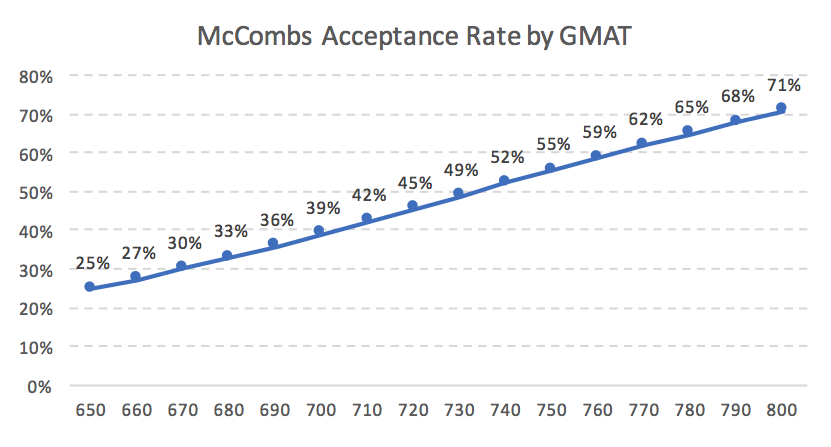
McCombs MBA Acceptance Rate by GMAT MBA Business SchoolGMAT has a strong impact on acceptance rate at McCombs. If you raise your GMAT by 100 points, from 650 to 750, your chance of admission increases by 120%. Even with a relatively low GMAT of 650, an applicant still has a respectable 1 in 4 chance of admission.

McCombs MBA Acceptance Rate by GPA

McCombs MBA Acceptance Rate by GPA MBA Business School
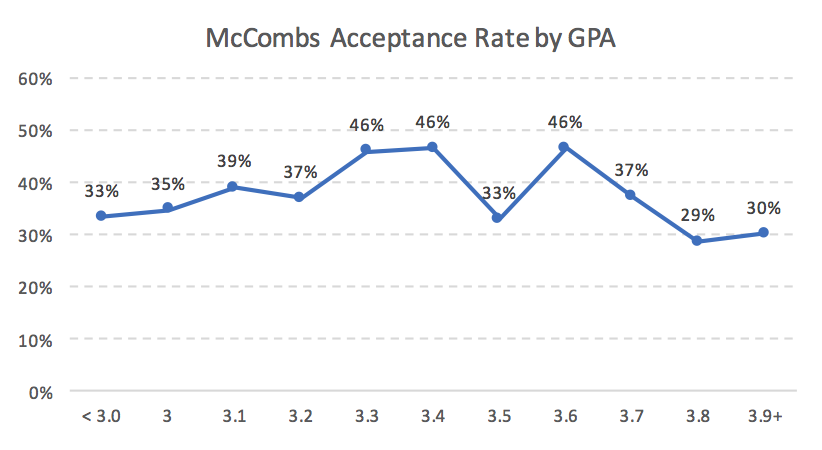
Although GMAT is critical when applying to University of Texas Austin, GPA does not appear to be important as long as it is above 3.0. When I built the acceptance model for McCombs, GPA was one of the first variable eliminated. As you can see in the graph above, GPA seems to have no impact on acceptance rate. Data is sparse below 3.0, so I cannot be confident how low an applicants GPA can be before it hurts them. However, if you have a low GPA and want to go to a top 20 MBA program, then McCombs is a great place for you to apply.

McCombs MBA Acceptance Rate by Application Round

McCombs MBA Acceptance Rate by Round MBA Business School
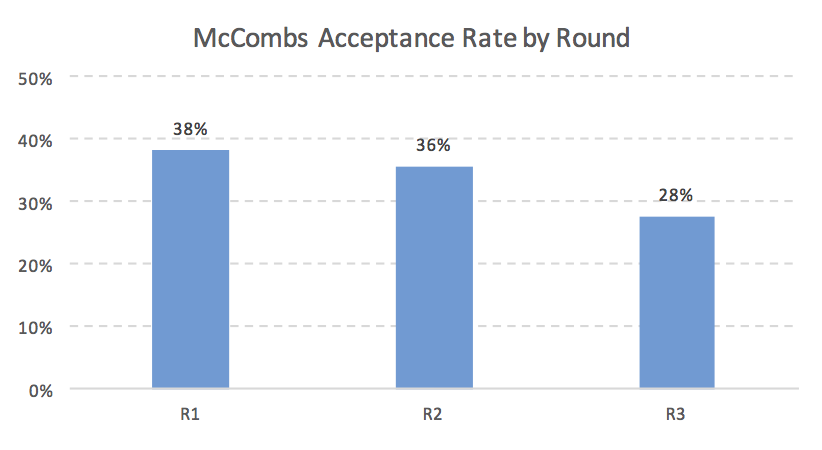
When applying to McCombs, the round you apply during matters. Round 2 acceptance rate is not statistically different than round 1, but there is a penalty for applying round 3. Round 3 applicants are 25% less likely to by admitted than applicants from the first two rounds.

Other Factors that Impact McCombs MBA Acceptance Rate

Although a quarter of applicants studied engineering for their undergraduate degree, McCombs does not seem to love engineers. The acceptance rate for engineers is two thirds that of non-engineers. On the other hand, McCombs loves economics majors. Applicants who majored in economics are 70% more likely to be accepted to McCombs than other majors.

Data for this article was collected from GMAT Club, one of the best websites for preparing for the GMAT.

Tuck Acceptance Rate Analysis

Tuck School of Business is a top MBA program with a competitive admissions process. The Tuck acceptance rate is low, at 20%. Unlike most other top MBA programs, Tuck is a self initiated interview. Anyone who visits campus can schedule an interview. In this article I will discuss which factors impact Tuck acceptance rate.

Tuck Acceptance Rate by GMAT

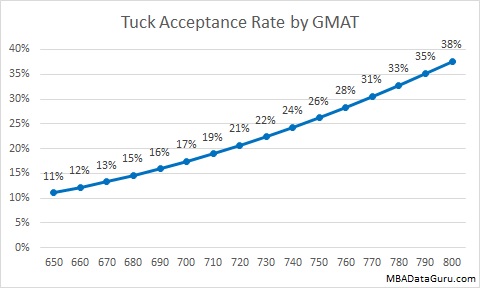
Tuck Acceptance Rate by GMAT Dartmouth MBA AdmissionsGMAT score has a large influence on Tuck acceptance rate. The average Tuck GMAT score is fairly high at 716. Adding a hundred points to your GMAT more than doubles your chance of admission. Even with a low GMAT of 650, acceptance rate at Dartmouth is still more than 10%, unlike Harvard where you need a 740 to have a 10% chance of admission.

Tuck Acceptance Rate by GPA

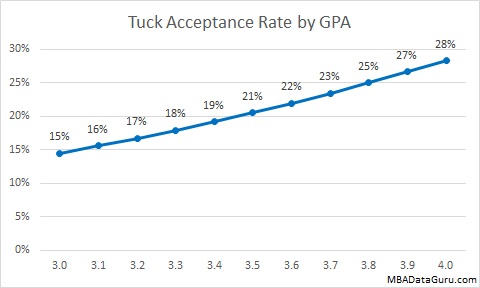
Tuck Acceptance Rate by GPA Dartmouth MBA AdmissionsThe average Tuck GPA is a solid 3.5. It is clear that applicants with a higher GPA have a better chance of being accepted. Once graduated, GPA is set in stone, so you might as well focus on increasing your GMAT which can still be increased.

Tuck GMAT vs. GPA

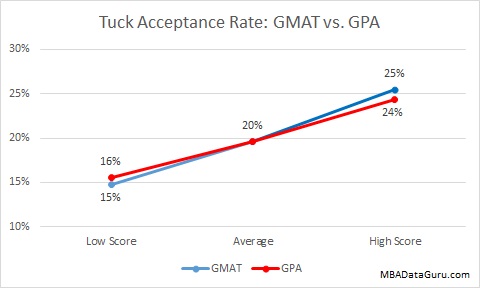
Tuck Acceptance Rate GMAT vs GPA Dartmouth MBA AdmissionsNext we look at whether Tuck prefers a high GMAT or a high GPA. The graph above shows that applicants with a high GMAT have a slightly better chance of being admitted than an applicant with a high GPA. The difference is so small that it is not very important.

Tuck Acceptance Rate by Application Round

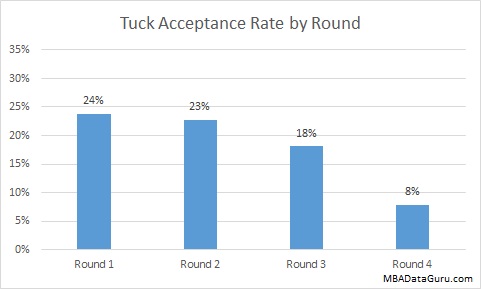
Tuck Acceptance Rate by Round Dartmouth MBA AdmissionsAs you can see in the graph above, the round you apply to Tuck does influence acceptance rate significantly. Round 1 and 2 have a similar admission rates of around 24%. Round 3 acceptance rate starts to drop off noticeably to 18% but not much below the 20% average acceptance rate. The Tuck acceptance rate for round 4 is extremely low, at 8%. Unless you have an incredible application or are desperate to leave your current job for business school, I recommend avoiding round 4 and waiting for the next year.

Tuck Acceptance Rate by Years of Work Experience

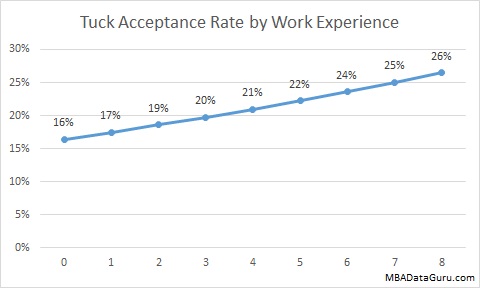
Tuck Acceptance Rate by Years Work Experience Dartmouth MBA AdmissionsTuck values applicants that have a longer work experience. Each year of work experience raises your chance of admission by a little more than 1%.

Tuck Acceptance Rate by Age

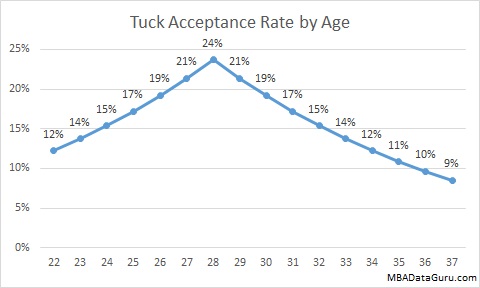
Tuck Acceptance Rate by Age Dartmouth MBA AdmissionsSimilar to other schools such as Columbia, Duke, Cornell and Booth, Tuck prefers applicants who are around 28 years old. I believe that this is because they have enough work experience to draw on during school but are not too old to be placed at companies during recruiting. In the above graphs I look at age and years of work experience separately, however in reality they are closely related.

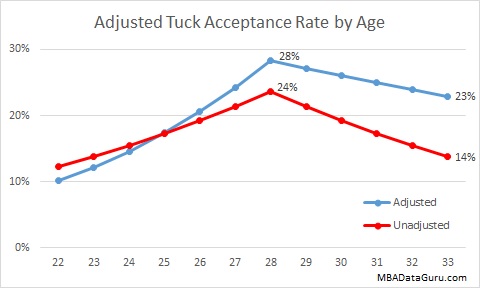
Adjusted Tuck Acceptance Rate by Age Dartmouth MBA AdmissionsIn the graph above I adjusted the original acceptance rate by age graph and added in the impact of work experience. For simplicity I assume that everyone graduates at 22 and works full time from graduation until they apply for business school. When these two factors are combined, you see that older applicants have a large advantage compared to younger applicants.

Other Tuck Admissions Factors

There are a few other factors that affect your chance of admission to Tuck. International applicants (excluding India) have a significantly higher chance of admission, at 28% acceptance rate. Applicants that worked in Venture Capital are especially prized at Tuck, with an impressive 47% chance of admission.

If you are thinking of applying to Tuck, be sure to check out my Tuck Interview Question Guide so you know what questions to expect. The data for this analysis came from GMAT Club.

Columbia MBA Acceptance Rate Analysis

The Columbia MBA acceptance rate is on the higher side for a top 10 school, at around 18%. Despite the deceptively high acceptance rate, Columbia is still a tough school to gain admission. I built a predictive model which can give you some insight into what the Columbia Business School admissions committee is looking for in applicants.

Columbia MBA Acceptance Rate by GMAT

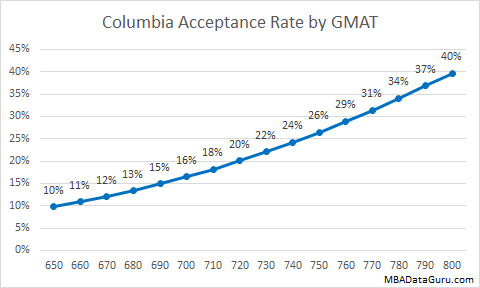
Columbia MBA Acceptance Rate by GMAT CBS AdmissionsAs expected, Columbia MBA acceptance rate increases as GMAT rises. The average GMAT score is an impressive 719. Increasing GMAT score by 100 points from 650 to 750 increases odds of acceptance by 140%, which is a bigger benefit than MIT.

Columbia MBA Acceptance Rate by GPA

Surprisingly GPA has little to no affect on acceptance rate at Columbia. The average GPA of Columbia applicants is 3.49 while the GPA for those admitted is almost unchanged at 3.51. Stanford is the only other school where GPA doesn’t matter. For those of you out there with a low GPA and high GMAT, Columbia is a great school to apply.

Columbia MBA Acceptance Rate by Round

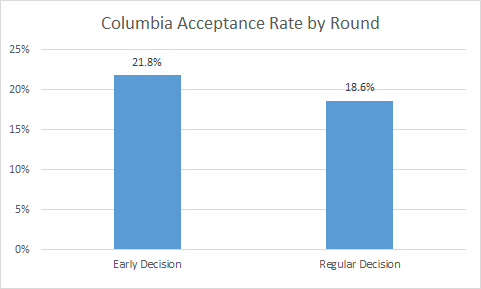
Columbia MBA Acceptance Rate by Round CBS AdmissionsThe round you apply in impacts Columbia MBA acceptance rate. At CBS, if you apply during Early Decision then you are forced to enroll if accepted. Columbia seems to be worried about yield for accepted students if they are forcing applicants to choose them. If you are serious about Columbia then consider applying Early Decision because you have a slight edge otherwise you might as well wait for regular decision. Columbia is actually rolling admissions, so the sooner you submit your app the faster you get your decision.

Columbia MBA Acceptance Rate by Age

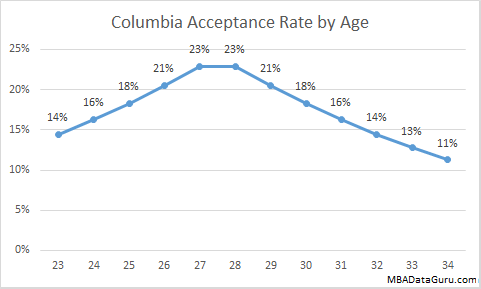
Columbia MBA Acceptance Rate by Age CBS AdmissionsThe age at which you apply has a strong impact on your chance of admission. The best time to apply is when you are 27 or 28. The further a candidate is from the average age, the lower their chance of acceptance is. I believe that this is because candidates with around 5 years of work experience have worked long enough to impress potential employers and contribute to classroom discussion while not being over qualified for on campus recruiting positions. Duke, Cornell and Booth all have a similar age effect.

Other Admissions Factors

Liberal arts majors have roughly twice the acceptance rate as others. I don’t have gender in my data set but my hypothesis is that Columbia is trying to attract women which is why the acceptance rate is so high for liberal arts majors. Acceptance rate is higher for economics majors but lower for finance majors. Consultants also have a major advantage, with an impressive 30% acceptance rate.

Columbia MBA Acceptance Rate by GPA

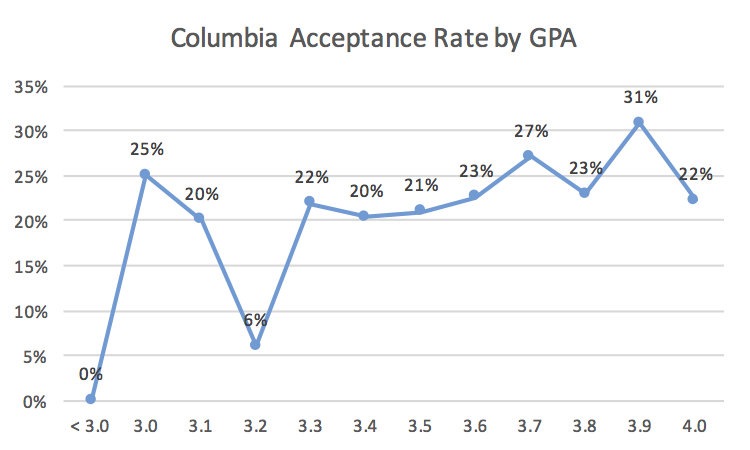
I updated this article by request to show how Columbia acceptance rate changes by GPA. In the chart below you can see that from 3.0 to 4.0 the acceptance rate stays fairly stable, slightly above 20% for all GPAs other than 3.2 and 3.9. Shockingly the acceptance rate at 3.0 is actually higher than 4.0.Columbia MBA Acceptance Rate by GPA Business School Admissions

CBS Interview Invite Rate and Acceptance Rate by Round

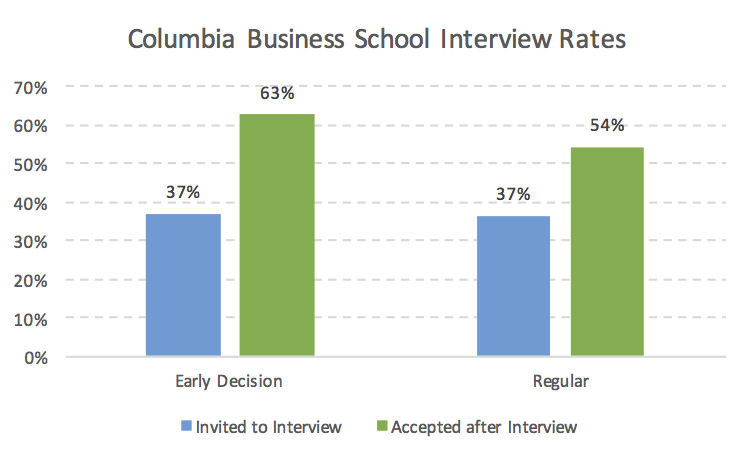
Columbia Business School Interview Rates and Acceptance by Round

A reader asked me how applying early vs. regular affected an applicants chance of being invited to interview and accepted after interview. It looks like applying early does not improve an applicant’s chance of being interviewed but does raise the acceptance rate if invited to interview. Approximately 40% of applicants apply through early decision.

The data for this post comes from GMAT Club.

Booth Admissions Rate Analysis

University of Chicago is a fairly selective business school with an acceptance rate of 22%. Similar to Kellogg, Booth has one of the higher acceptance rates for a top 10 school. While building an MBA admission calculator, I uncovered some insights on how Booth evaluates MBA applicants.

Booth Admissions Rate by GMAT

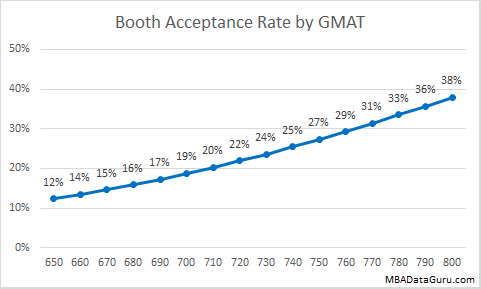
Booth Admissions Rate by GMAT University of Chicago MBA AcceptanceThe graph above demonstrates that GMAT has a high impact on Booth admissions. Increasing your GMAT from 650 to 750 more than doubles your chance of admission. The average GMAT score for an applicant is 718, but the admitted applicants have a slightly higher GMAT of 724.

Booth Admissions Rate by GPA

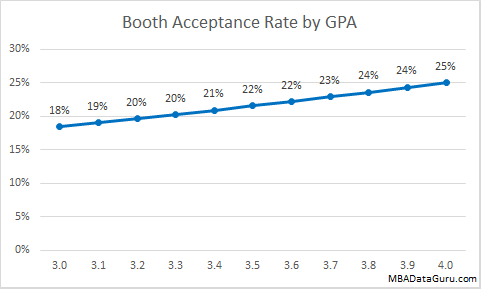
Booth Admissions Rate by GPA University of Chicago MBA AcceptanceA high GPA will give you a slightly higher acceptance rate at University of Chicago, but it is easy to see that GPA doesn’t have a very large impact on admission rate. Even with a 3.0 GPA the Booth acceptance rate is 18% which is higher than the acceptance rate at Harvard for an applicant with a 4.0.

Booth Acceptance Rate GMAT vs. GPA

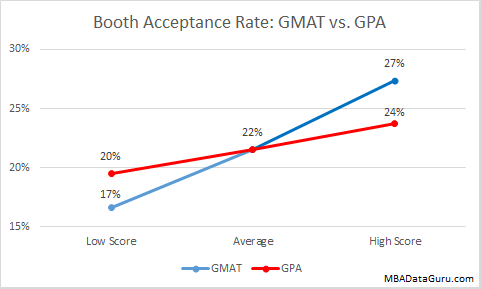
Booth Admissions Rate GMAT vs. GPA University of Chicago MBA AcceptanceThe graph above compares the importance of GMAT vs. GPA to Booth admissions. Candidates with a high GMAT score had a significantly higher acceptance rate than those who had a high GPA.* If you have a high GMAT and a low GPA, University of Chicago is an ideal school at which to apply. For example an applicant with 3.0 GPA and a 760 GMAT has a 25% chance of being admitted.

Booth Admission Rate by Age

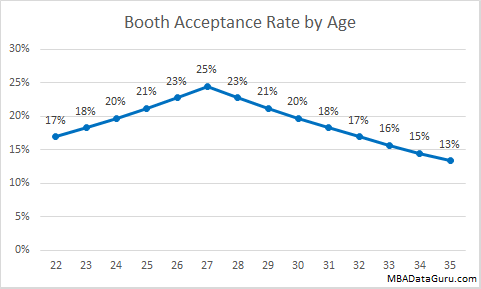
Booth Admissions Rate by Age University of Chicago MBA AcceptanceSimilar to Duke and Cornell, the Booth admission committee prefers applicants who are around 27. The further a candidate is from the average age, the lower their chance of acceptance is. I believe that this is because candidates with around 5 years of work experience have worked long enough to impress potential employers and contribute to classroom discussion while not being over qualified for on campus recruiting positions.

Booth Admissions Rate by Round

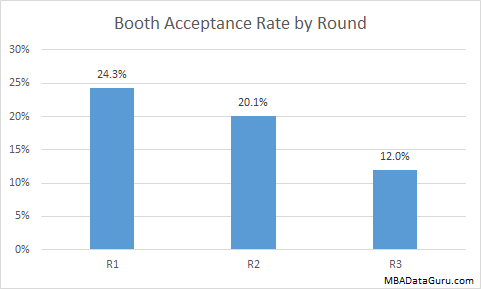
Booth Acceptance Rate by Round University of Chicago MBA AdmissionWhich round you apply in does actually affect your chance of admission at University of Chicago. There is a small drop off in acceptance rate between round 1 and 2, but then a large drop in round 3.

Other Factors that Impact Booth Acceptance Rate

Applicants who are living in India have only a 7% chance of being accepted at Booth. Science and Math majors have a slightly higher chance of admission. Liberal Arts and Humanities majors have an exceptionally high chance of being accepted, at 56%, while Engineering majors have lower odds at 17%. I think that it is not that Booth is specifically trying to attract Liberal Arts majors, but that they are trying to bring in more women, who happen to be more likely to major in Liberal Arts. Finally investment bankers have only a 14% acceptance rate at Booth.

*A high GMAT or high GPA is defined as one standard deviation above average.

Stern Acceptance Rate Analysis

I just finished building the Stern acceptance rate prediction model. I will post the admissions calculator as soon as I have time to finish learning PHP and then build that portion of the website. I’ll probably have time to work on it over Christmas break, but right now I am too busy applying for interviews for summer internships. In the mean time I will share some of the insights I got from building the model.

Stern Acceptance Rate by GMAT

The first thing that jumped out at me was that the acceptance rates I came up with are noticeably higher than the published acceptance rate of 15%. I believe that this is because the average candidate who applies and posts their data on GMAT Club, where I get my data, is more competitive than the average candidate. The average GMAT Club applicant to Stern has a GPA or 3.45 and GMAT of 709, which is not too far from the scores listed on the class profile for Sterns class of 2016 of 3.52 and 721.

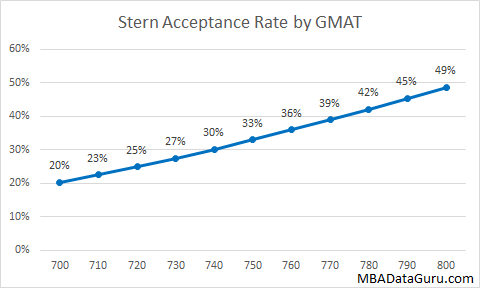
Stern Acceptance Rate by GMAT MBA Admissions Business School NYUIf you are applying to Stern, it is pretty obvious that having a higher GMAT is important and will significantly raise your chances of being admitted. To create the graph above, I used my model with the average GPA of 3.45.

Stern Acceptance Rate by GPA

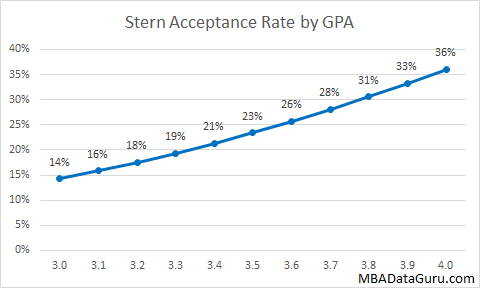
Next I looked at how GPA affects Stern acceptance rate. Once again there is a clear relationship between GPA and admission rate for NYU. In the graph below I used the average GPA score of 709 in my admissions model.Stern Acceptance Rate by GPA NYU Admissions Business School

Stern Acceptance Rate by Round

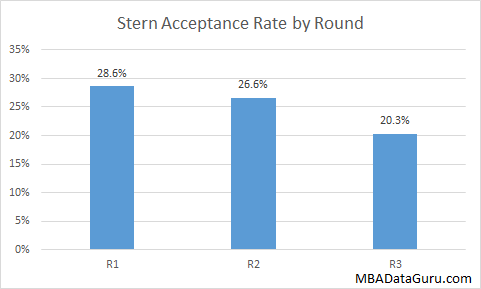
Many candidates want to know if it matters in which round you apply. I took a look at the raw acceptance rate by round for NYU. As you can see the acceptance rate for round 2 is slightly lower and for round 3 it is noticeably lower.

Stern Acceptance Rate by Round MBA NYU Admissions Business SchoolThe acceptance rates above are raw numbers, not the predicted values from my admissions model. Why you ask? Because when I took into account all of the other factors, the round you apply in is not statistically significant. The reason the acceptance rate is lower in round 2 and 3 is not because the schools are more selective but because on average lower quality candidates apply in those rounds. If you are a qualified candidate, do not worry about applying to Stern in round 3, you still have a good chance of getting in.

Stern Prefers GMAT over GPA

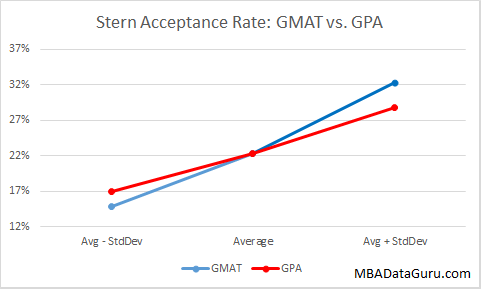
In the past I tried to figure out if Stern prefers a high GMAT or GPA and didn’t come up with anything conclusive. Now that I have built the Stern admissions model I can see how a similar change in GMAT or GPA impact acceptance rate at Stern. In the graph below I compare how much the admissions rate changes if I alter the GMAT or GPA by a standard deviation. If you are applying to business school then you should probably know what a standard deviation is, however if you don’t it is a standard measure of variance in a population or sample. Since I can’t compare an absolute variance because GMAT and GPA are on different scales, I compare how the shift of one standard deviation impacts the Stern acceptance rate.

Stern Acceptance Rate GPA vs GMAT MBA NYU Admissions Business SchoolIn the graph above, you can see that increasing the GPA by one standard deviation (.28) increase acceptance rate by 29%, but raising the GMAT score by one standard deviation (39) leads to a 45% higher chance of admissions. It is clear that Stern prefers candidates with high GMAT score over ones with a high GPA. This is good news for candidates with a low GPA because with enough hard work, you can increase your odds significantly by raising your GMAT.

Other NYU Admissions Insights

I also found that NYU prefers candidates with an average age of 27 to 28, the further you are from this average age, the lower your chance of getting in. Stern really likes candidates that come from consulting. Applicants from consulting had a acceptance rate of 42% vs. 21% for non-consultants. Having more work experience also increased your odds of admissions. Acceptance rate increased by about 2% for each year of work experience. However, once you pass 28, the age deviation factor is significantly stronger than the work experience factor so you shouldn’t wait until after 28 to apply.

I noticed that candidates that majored in business or engineering had a lower chance of admission. Business majors with average scores had a 8% chance of admission compared to 24% for non-business majors. Engineers had a 13% chance of getting in compared to a 26% chance for non-engineers. These differences are statistically significant even after taking into account all other factors. That being said, I majored in engineering and I got into Stern. I also know many other business and engineering majors who are currently attending Stern with me.

Harvard vs. Wharton: How Does Age Affect Acceptance Rates

Admissions consultants often claim that Harvard prefers younger applicants, so I decided to take a look at how age impacts Harvard acceptance rate compared to Wharton. I have heard that Harvard will ding you for waiting too long to apply. I used GMAT Club data for this analysis.

Below is a graph showing the GMAT by age. You can see that for both schools, 25-year-olds score the highest on the GMAT, then the score consistently drops from there.  Both schools have relatively similar scores, but Harvard is higher for the 27 to 29 age range.

Harvard Wharton Age GMATGiven just the GMAT information one would think that younger applicants would have the highest acceptance rate. This is not the case because top MBA programs value leadership and work experience so that students add value to the classroom.

I combined some age ranges because the accept/denied data was a little thin after I removed everyone who didn’t include their age. Wharton has a relatively flat acceptance rate, with a dip in the 29 to 30 age range. Harvard on the other hand had a large spike in the 27 to 28 age range, roughly 50% higher than any other age range. It seems that Harvard prefers applicants who are roughly 5 to 6 years out of school significantly more.

Wharton Harvard MBA Acceptance by Age Business SchoolSurprisingly, applicants who are older than 30 did pretty well. I have heard that the older you are the more difficult it is to be accepted. The over 30 group also has the lowest GMAT, so clearly the longer you are out of your undergraduate program, the less schools care about GMAT. I took a quick look at which industries had the lowest and highest application age. It wasn’t surprising to find that consultants generally applied younger, and military veterans and lawyers generally applied when they were older.