Tag Archives: Admissions

MBA Interview Acceptance Rate by GMAT and GPA

The interview is a crucial component of the MBA admission process. All top full-time MBA programs interview applicants before admitting them. Generally the MBA admissions committee is looking for two things during the interview, that you fit the culture of the school and that you have the emotional intelligence to succeed at business school. I have already looked at MBA Interview acceptance rate by itself. However, I always wondered when applying to business school if all applicants are considered equal after they have been invited to interview or does the rest of the application, like the GMAT and GPA, still matter. It turns out that it matters at some schools and not at others.

MBA Interview Acceptance Rate: High vs. Low GMAT

MBA Interview Acceptance Rate by GMATThe graph above shows the average acceptance rate for applicants who were invited to interview, separated into GMAT below 720 and GMAT 720 and higher. Two thirds of the schools have a higher acceptance rate for applicants with high GMATs. This suggests that being invited to interview does not put everyone on an even playing field, other components of the application still matter. Booth, UNC, Stanford and Columbia have the largest disadvantage for applicants with low GMAT during interviews. At the other end of the spectrum, MIT, Tepper, Emory and McCombs all have a higher acceptance rate for applicants who were invited to interview but have a lower GMAT score. I don’t think that a lower GMAT actually helped these candidates, but that these schools consider the interview to be more important than other schools, which gives low GMAT applicants the opportunity to stand out.

MBA Interview Acceptance Rate: High vs. Low GPA

MBA Interview Acceptance Rate by GPA Business School AdmissionsUnlike GMAT, half the schools seem to care about GPA after interviewing candidates while the other half do not. Similar to the GMAT table, MIT, Tepper and McCombs have a higher acceptance rate for applicants with lower GPAs. The only exception is Emory, which still doesn’t have that much of a disadvantage for low GPA. GPA does not seem to be as important as GMAT to admissions committees after interviews given that the average disadvantage for low GMAT is -10% and the average disadvantage for low GPA is -1%.

Most of the schools cut applicants with low GPA and low GMAT before interviews. I excluded Tuck and Kellogg because they will interview all applicants who want to interview. So it is not fair to compare them to the other schools who have already cut applicants with low scores. I included their tables at the end of this article for reference.

My take away from this analysis is that some schools place a lower weight on interviews while other schools place a higher weight on interviews. If you are applying to Booth with a high GMAT and GPA then you probably don’t need to stress the interview too much. On the other hand if you have a low GPA and GMAT and are applying to Sloan, you should prepare as much as possible for your MIT MBA interview because they take their interviews much more seriously than other schools.

If you are preparing for business school interviews, check out my MBA interview preparation guide.

Kellogg and Tuck MBA interview Acceptance Rate by GMAT

MBA Interview Acceptance Rate by GMAT Tuck Kellogg

Kellogg and Tuck MBA interview Acceptance Rate by GPA

MBA Interview Acceptance Rate by GPA Tuck KelloggThe data for this article came from GMAT Club, one of the best websites for GMAT preparation.
Stanford MBA Acceptance Rate Analysis

When I first built the Stanford MBA acceptance rate model, it showed that GPA had little to no impact on acceptance rate. I have reevaluated the data and now I believe that GPA does matter when applying to Stanford. Although GPA has an impact on acceptance, GMAT is still more important for Stanford MBA admissions.

Stanford MBA Acceptance Rate by GMAT

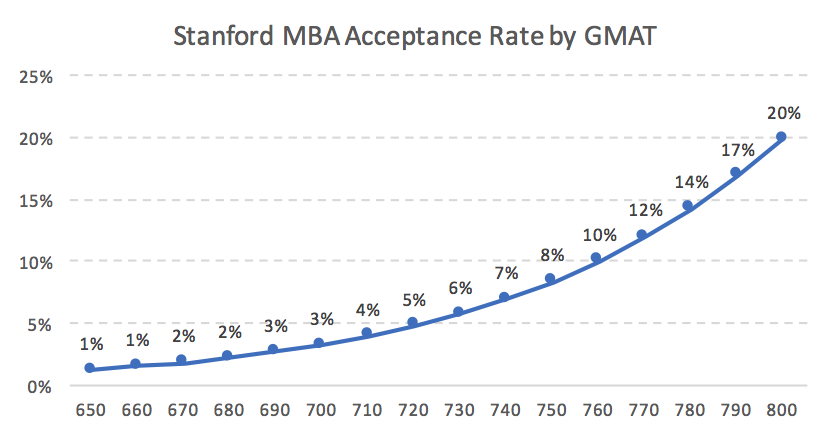
Stanford MBA Acceptance Rate by GMAT Business School AdmissionGMAT is very important when applying to Stanford’s business school. When an applicant increases their GMAT by 100 points, from 650 to 750, they increase their chance of admission 8 fold. Average GMAT is over 730 points, which means an applicant must have a GMAT north of 750 for an acceptance rate in the double digits.

Stanford MBA Acceptance Rate by GPA

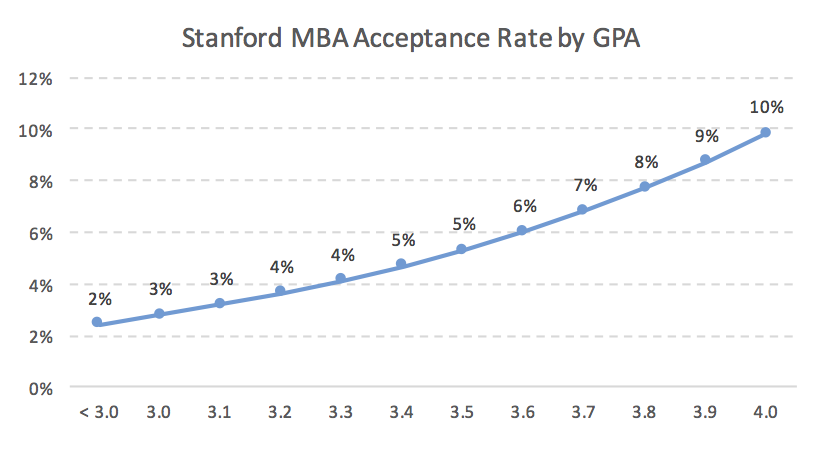
Stanford MBA Acceptance Rate by GPA Business School AdmissionMy new analysis demonstrates that GPA is actually important when applying to Stanford GSB. The average GPA of a Stanford applicant is 3.56. Each “.10” increase in GPA raises acceptance rate at Stanford by approximately 1%.

Stanford MBA Acceptance Rate GMAT vs. GPA

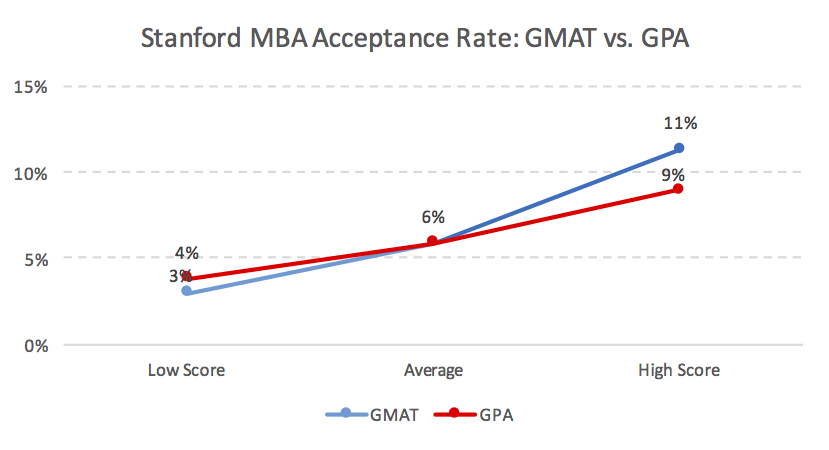
Stanford MBA Acceptance Rate by GPA Business School AdmissionAlthough both GMAT and GPA are important factors that influence an applicant’s chance of admission to Stanford Graduate School of Business, GMAT is more important than GPA. A high GMAT increases acceptance rate at Stanford by 5%*. On the other hand, a high GPA only increase acceptance rate by 3%.

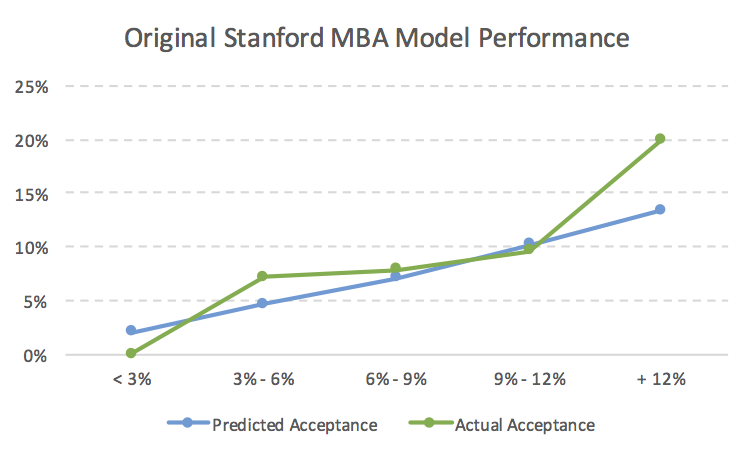
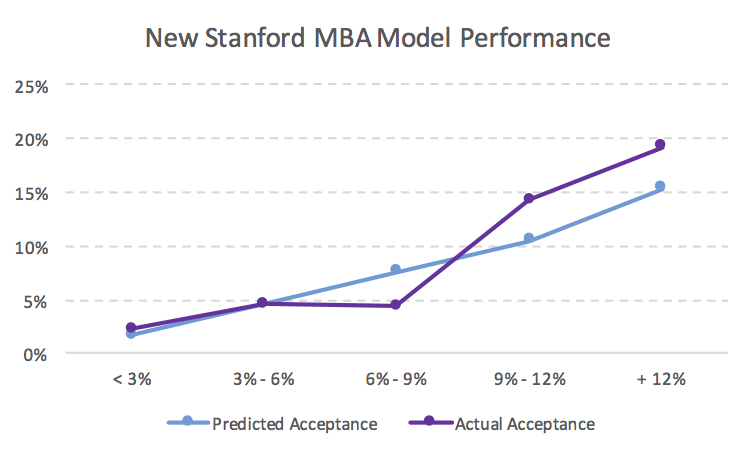
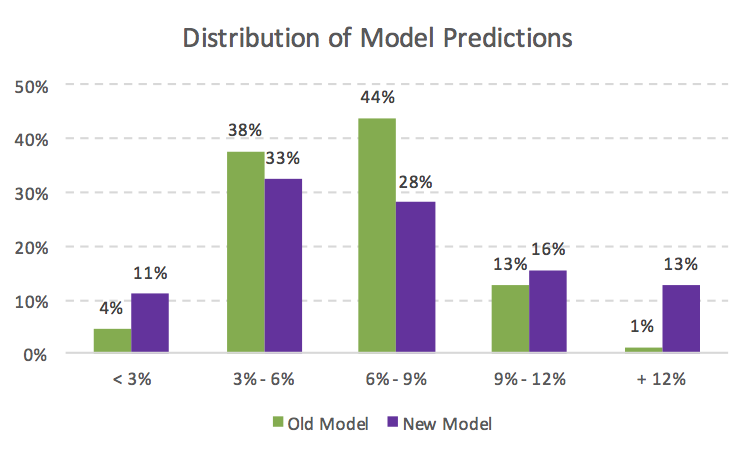
I was not happy with the original predictive model I built for Stanford. I updated my methodology for building the model, mainly in the way I cleaned the data. The results above represent my new model. Below I compare the performance of the old and new model. In order to evaluate performance, I grouped applicants into buckets based on their predicted acceptance rate, then looked at the actual acceptance rate was for that group. The X-axis is the predicted acceptance grouping and the Y-axis is the actual acceptance rate.

Original Stanford MBA Model Performance

Original Stanford MBA Acceptance Rate Model PerformanceAlthough the graph above looks like it does a good job of predicting the acceptance rate at Stanford. The results are deceptive because almost all of the population fall into the 3% – 6% or 6% – 9% groups, which have little separation.

New Stanford MBA Model Performance

New Stanford MBA Acceptance Rate Model PerformanceThe new model clearly shows significant differentiation, with the exception of the 6% – 9% group. The biggest problem is that the 6% – 9% group has an acceptance rate that is over estimated and the above 9% population is under estimated. The main difference between the original model and new model is the distribution of predictions seen below.

Stanford MBA Model Distribution: New vs. Old

Stanford MBA Acceptance Rate Model Population DistributionIn the original model, 82% of all applicants  fell into the 3% to 9% range with only 5% of applicants below 3% or above 12%. The new model has a much more even distribution of applicants. The number of low and high acceptance rate applicants has increased from 5% to 24%.

Data used to create this post came from GMAT Club, which is one of the best websites for preparing for the GMAT.

*A high GMAT or high GPA is defined as one standard deviation above average. A low score is defined as one standard deviation below.

Contact MBA Data Guru

If you have any questions about this article, please feel free to reach out to me with this form.
Name:*

E-mail:*
Subject:*
Details:

MBA Acceptance Rate by Country

Most elite American business schools brag about how internationally diverse they are. Although American business schools try to make sure they have students from all over the world, the reality is that there are winners and losers. Applicants from some countries have an easier time than others. In this analysis I calculated the MBA acceptance rate by country and region for American MBA programs.

MBA Acceptance Rate by Region

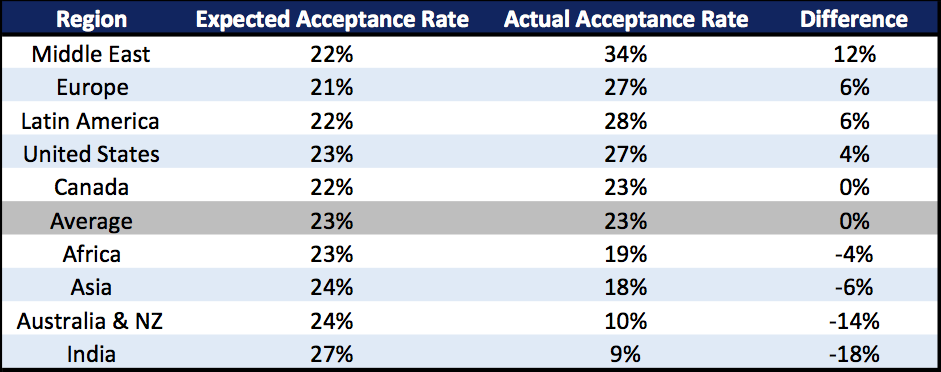
MBA Acceptance Rate by Region International Business SchoolSince there is limited data for many of the countries, first I grouped the countries to look at MBA acceptance rates at a high level. Not all regions apply to the schools in the same proportion. In fact European applicants tend to apply to the higher ranked schools with lower acceptance rates. On the other hand applicants from India are more likely to apply to lower ranked school with higher acceptance rates. I calculated the expected acceptance rate for each region based on the school application distribution.

The regions that have the highest acceptance rates are the Middle East, Europe and Latin America. If you limit Europe to the large western countries such as England, France, Germany, Italy and Spain, then the acceptance rate for Europe jumps to 31%. The USA has a slightly higher acceptance rate than average. On the other hand, Asia, Australia and India are all at a significant disadvantage when applying to business school in the United States.

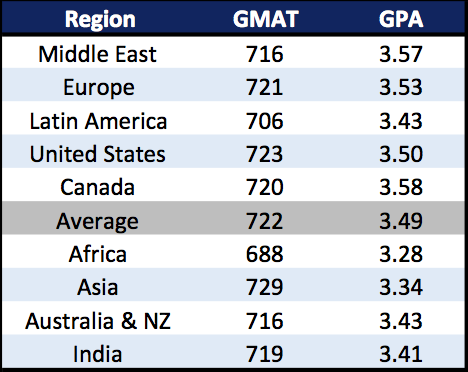
GMAT and GPA by Region MBANext I looked to see if the difference in acceptance rates could be explained by GMAT. GPA isn’t a good indicator because different regions have different average GPAs based on how much grade inflation there is in the area. Most regions are clustered around the average GMAT of 722 with two exceptions. Latin America has an average GMAT 16 points lower than average and still has an acceptance rate 6% higher than expected. Africa has an average GMAT that is 34 points lower than average but it only hurts them a small amount. Asian applicants have the highest average GMAT, however Asian MBA acceptance rate is 6% lower than average.

MBA Acceptance Rate by Country

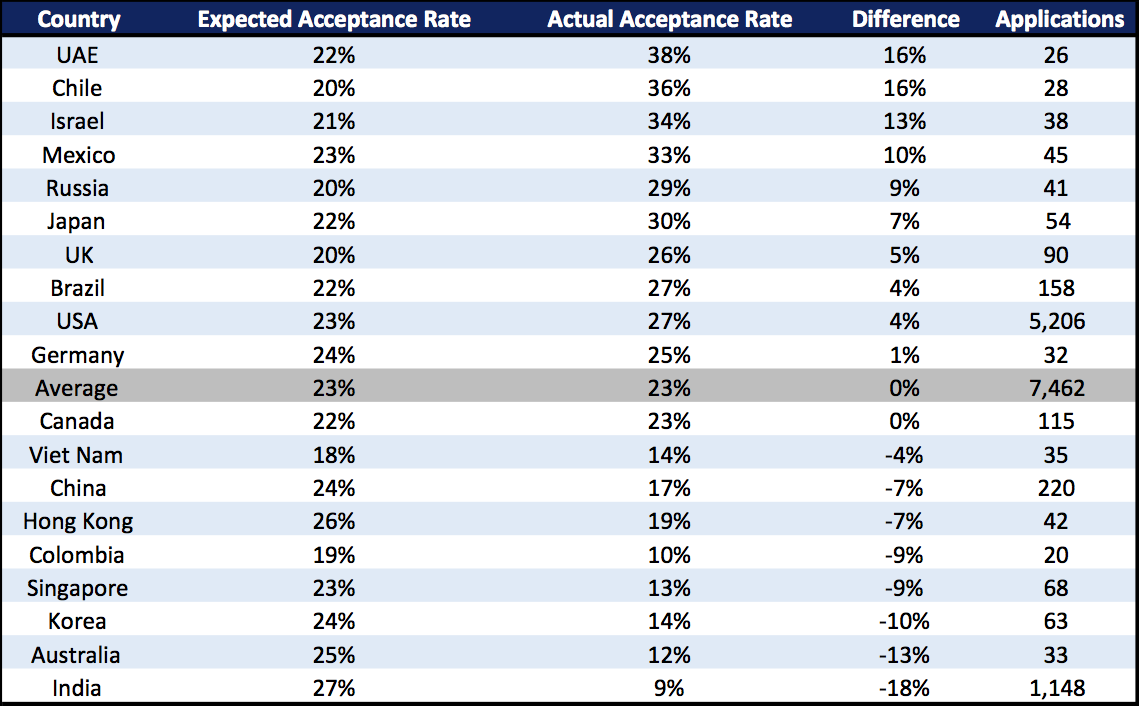
MBA Acceptance Rate by Country International Business SchoolNext I looked at MBA acceptance rate by country for those countries with high enough application volume. I excluded all countries with lower than 20 applications. It is not surprising to see United Arab Emirates and Israel at the top given that the Middle East has a high acceptance rate. Chile, Mexico and Brazil all helped to pull up Latin America’s acceptance rate. The United Kingdom and Russia are the European countries with the highest acceptance rates.

Viet Nam, China, Hong Kong, Singapore and Korea all have acceptance rates that are below average. The only Asian country with a high acceptance rate is Japan. Given that Asian acceptance rates are so low, I would recommend using the help of an admissions consultant if you are applying from one of these countries.

The data for this analysis came from the GMAT Club forum. If you are looking to increase your GMAT, check it out.

McCombs MBA Acceptance Rate Analysis

McCombs School of Business is a top MBA program and part of University of Texas Austin. The full-time program is small; the class of 2017 is 267 students. McCombs average GMAT is 694 and average GPA 3.40. The acceptance rate is at the higher end of the spectrum at 35%. UT Austin also has an evening business school with more relaxed admissions criteria. For the evening MBA, GMAT is 640 and GPA is 3.34.

McCombs MBA Acceptance Rate by GMAT

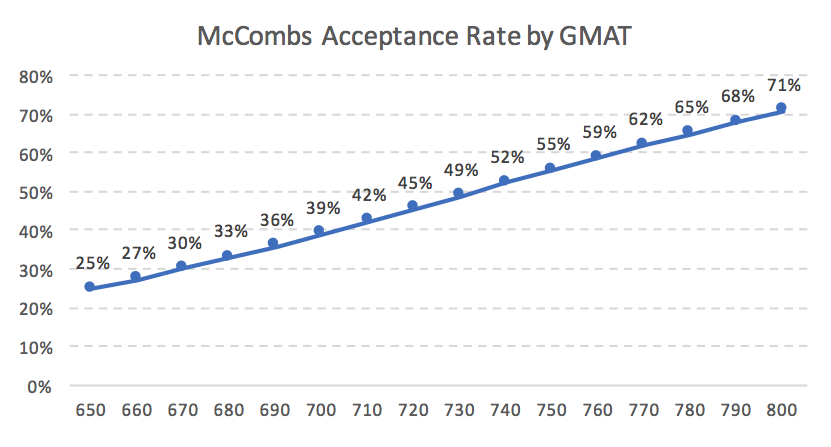
McCombs MBA Acceptance Rate by GMAT MBA Business SchoolGMAT has a strong impact on acceptance rate at McCombs. If you raise your GMAT by 100 points, from 650 to 750, your chance of admission increases by 120%. Even with a relatively low GMAT of 650, an applicant still has a respectable 1 in 4 chance of admission.

McCombs MBA Acceptance Rate by GPA

McCombs MBA Acceptance Rate by GPA MBA Business School
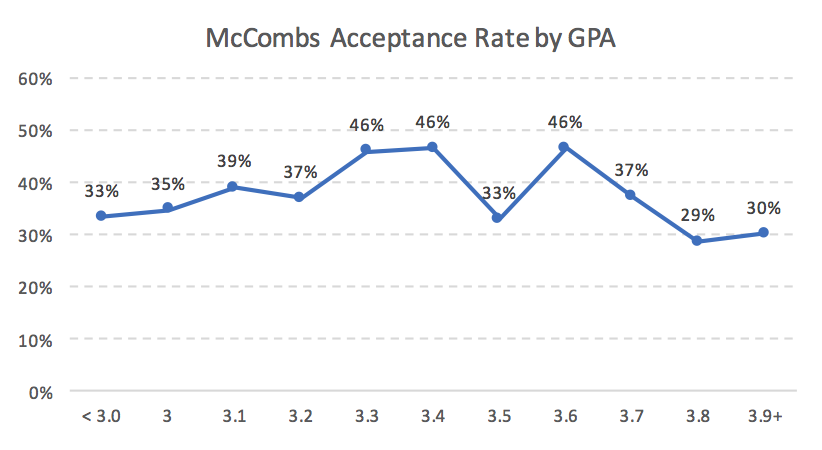
Although GMAT is critical when applying to University of Texas Austin, GPA does not appear to be important as long as it is above 3.0. When I built the acceptance model for McCombs, GPA was one of the first variable eliminated. As you can see in the graph above, GPA seems to have no impact on acceptance rate. Data is sparse below 3.0, so I cannot be confident how low an applicants GPA can be before it hurts them. However, if you have a low GPA and want to go to a top 20 MBA program, then McCombs is a great place for you to apply.

McCombs MBA Acceptance Rate by Application Round

McCombs MBA Acceptance Rate by Round MBA Business School
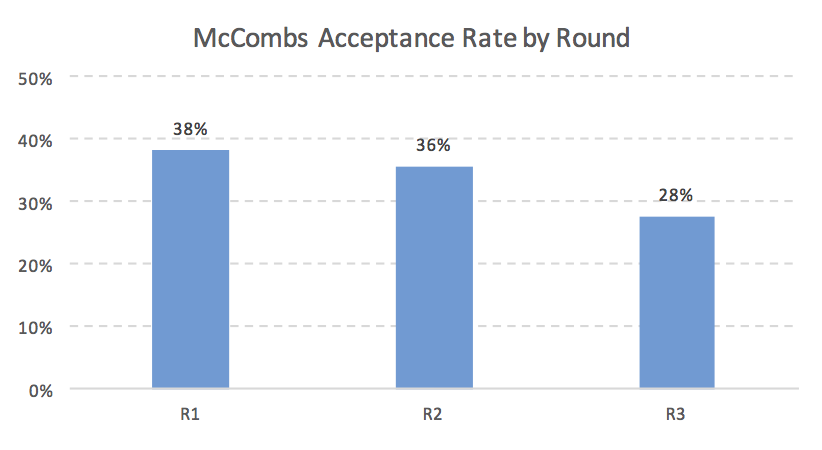
When applying to McCombs, the round you apply during matters. Round 2 acceptance rate is not statistically different than round 1, but there is a penalty for applying round 3. Round 3 applicants are 25% less likely to by admitted than applicants from the first two rounds.

Other Factors that Impact McCombs MBA Acceptance Rate

Although a quarter of applicants studied engineering for their undergraduate degree, McCombs does not seem to love engineers. The acceptance rate for engineers is two thirds that of non-engineers. On the other hand, McCombs loves economics majors. Applicants who majored in economics are 70% more likely to be accepted to McCombs than other majors.

Data for this article was collected from GMAT Club, one of the best websites for preparing for the GMAT.

Kellogg Interview Questions

Kellogg Interview Questions Preparation MBA Business School NorthwesternKellogg is somewhat unique in that it allows anyone who applies to interview. Kellogg MBA interviews are typically off-campus with an alumnus, although it is also possible to interview with an admissions committee member on campus or over Skype. Interviews with Kellogg tend to vary greatly based on who interviews you. You can expect anywhere from 6 to 14 Kellogg interview questions. Kellogg interviews are on the longer side, sometimes lasting an hour to an hour and a half. If you are interviewed by an alumni, typically they will have already read your resume but not your whole application. Below are the most common Kellogg interview questions, ranked from most to least common. Your chance of being asked each questions is in parenthesis.

Most Common Kellogg Interview Questions

  1. Why Kellogg? (87%)
  2. Why get an MBA? Why now? (87%)
  3. What is your greatest accomplishment or what is the accomplishment you are most proud of? Sometimes when this question is asked, you are limited to an accomplishment at a certain company you worked at. (67%)
  4. Walk me through your resume. (60%)
  5. What will you contribute to the program? What will you get involved with at Kellogg? (60%)
  6. Tell me about a time you faced a challenge. Frequently the interviewer asks specifically about a challenge or failure in a team environment. (53%)
  7. What is your leadership style? (53%)
  8. Tell me about your education. Why did you choose your major? (40%)
  9. Is there anything else you would like me to know? (40%)
  10. Why did you pick your company or industry? (27%)
  11. What are your hobbies outside of work? (27%)
  12. How would your coworkers or peers describe your strengths and weaknesses? (20%)
  13. What role do you take within a team? (13%)
  14. What inspires you? (13%)
  15. What words would your classmates use to describe you? (13%)
  16. Tell me about a time you took an initiative. (13%)
  17. What are your long term goals? (13%)

You may also be asked specific questions about your resume or experiences. At the end you will have time to ask a few questions. For additional interview tips check out my MBA interview preparation guide. The questions for this article were collected from Clear Admit.

Yale MBA Acceptance Rate Analysis

Yale School of Management, also known as YSOM, is a prestigious school located in New Haven, Connecticut. It is difficult to gain admission to Yale’s MBA program, similar to their undergraduate school. The YSOM class of 2016 has impressive statistics, with a median GMAT of 720 and median GPA of 3.56. Only 22% of applicants who apply to Yale will be accepted.

Yale MBA Acceptance Rate by GMAT

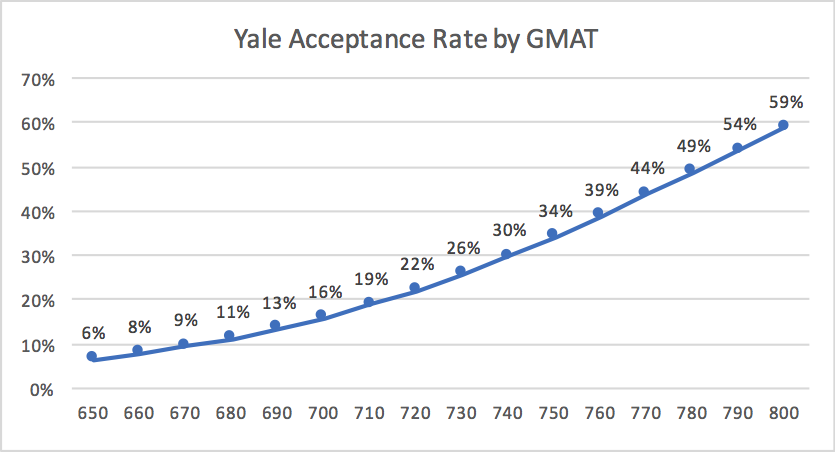
Yale MBA Acceptance Rate by GMAT Business School AdmissionsSimilar to all other schools, a high GMAT score will increase your chance of being admitted to Yale. Although the average GMAT score for the class of 2016 is 720, the average score for applicants is 7 points lower at 713. The GMAT range of the middle 80% of Yale MBA students is 680 to 760. However, the difference in acceptance rate for the bottom of that range is substantially lower than the top. An applicant with a 760 is more than three times more likely to be admitted than an applicant with a 680.

Yale MBA Acceptance Rate by GPA

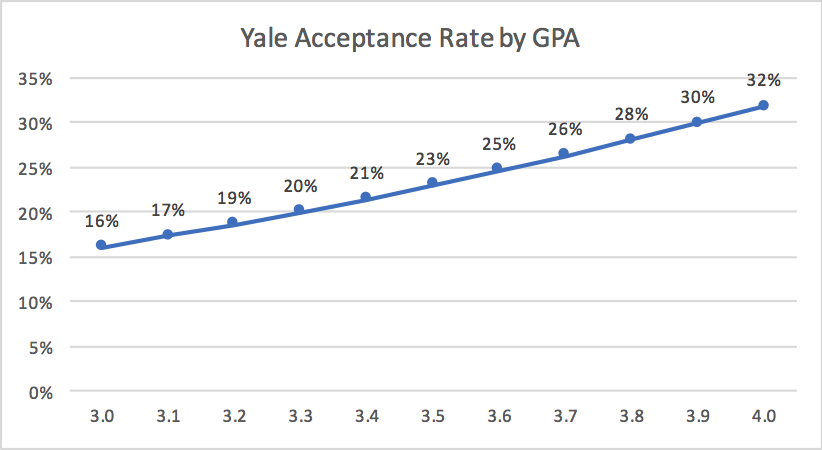
Yale MBA Acceptance Rate by GPA Business School AdmissionsA high GPA also raises the acceptance rate at Yale. The middle 80% students in the class of 2016 have a GPA between 3.17 and 3.87. An applicants with 3.87 is surprisingly only 50% more likely to be admitted than one with a 3.17. Even a perfect 4.0 only raises Yale MBA acceptance rate to 32%.

Yale MBA Acceptance Rate: GMAT vs. GPA

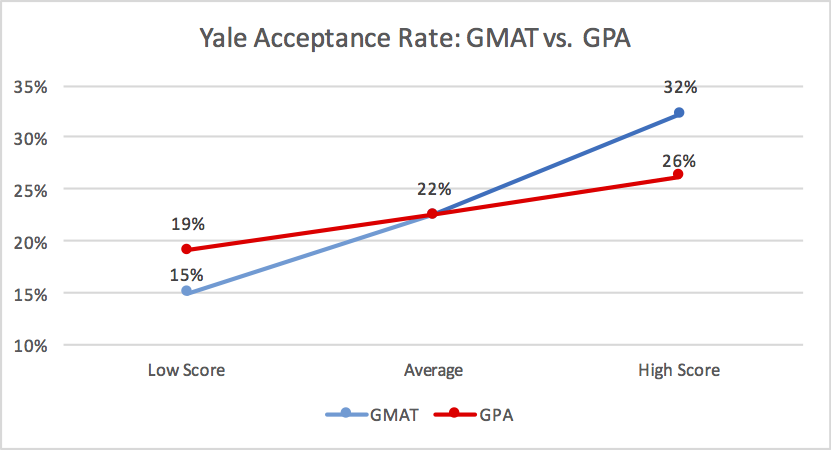
Yale MBA Acceptance Rate GMAT vs GPAThe chart above shows that GMAT is more important for admission to Yale than GPA. A high GPA will only increase acceptance rate by 4%, while a high GMAT results in a 10% higher chance of being admitted.* If you have a low GPA and a high GMAT, Yale is a great school to consider. For example, an applicant with a 3.0 and a 770 has a 34% chance of admission.

Yale MBA Acceptance Rate by Application Round

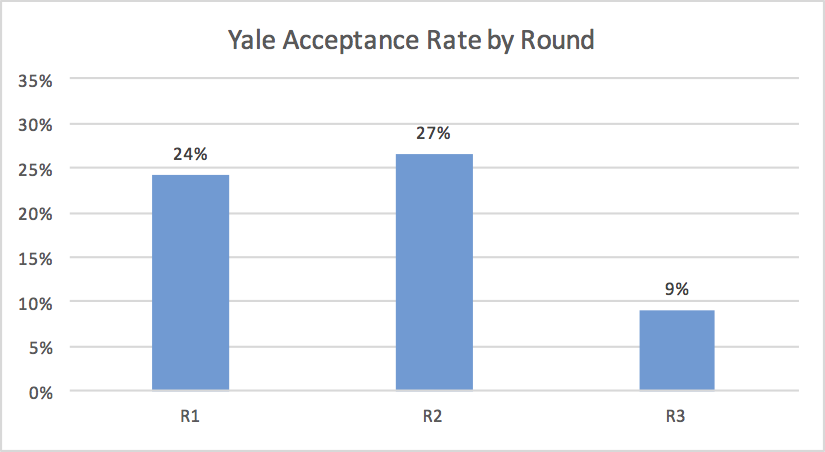
Yale MBA Acceptance Rate by Application Round Business School AdmissionsWhen applying to Yale, it does not matter whether you apply during the first or second round. However, applying in the third round is a huge disadvantage. Your chance of admission is less than half as likely compared to the first two rounds, so be proactive and submit your app early.

Other Admissions Factors

Indian applicants are at a significant disadvantage at Yale, with only a 6% acceptance rate. On the other hand, Yale seems to really like applicants with experience working for consumer packaged goods companies. Their acceptance rate is shockingly high, almost three times higher than average.

*A high score is defined as one standard deviation higher than average.

MBA Concentration Acceptance Rate Analysis

With the current semester just about over, next years application essay questions will be posted in the coming weeks for many schools. Round one applicants should start figuring out their story and crafting their essays. The most important essay for most schools is the question: Why get an MBA and why is [insert school name here] the right choice for you? In order to answer this question you need to have a plan for how an MBA is going to help you achieve your goals. The vast majority of MBA students are looking to switch careers. Why else pay $120,000 in tuition and give up two years of salary? If you wanted to stay in the same industry, you would probably just go for a promotion or switch companies.

I was curious if the industry an applicant is trying to transition into impacts their MBA acceptance rate. My theory was that there are a lot of people trying to transition into consulting, banking and technology, so there may be oversupply for those concentrations. Perhaps a candidate would stick out if they are pursuing a more unique career. I took the business school admissions data from GMAT Club and looked at the acceptance rate by stated concentration. First I decided to look at the top 20 schools in aggregate, to ensure the results were statistically significant. I was surprised by how much the acceptance rate varied depending on MBA concentration.

MBA Acceptance Rate by Concentration

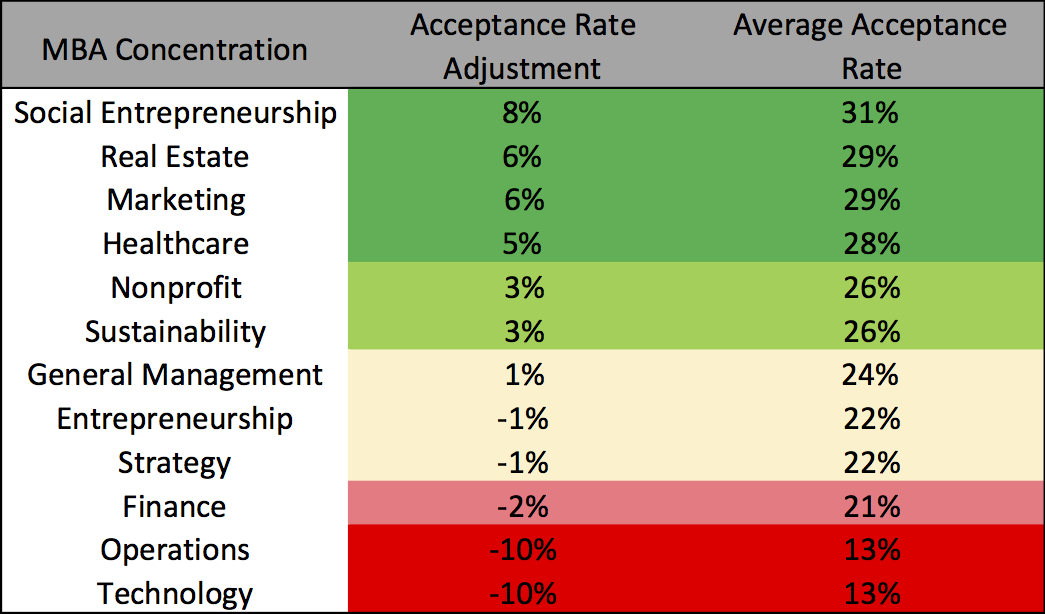
MBA Concentration Acceptance Rate Business SchoolThe average acceptance rate for top 20 schools is 23%. Many of the concentrations towards the top are fairly small with the exception of Marketing. As you can see, there is a huge range in the acceptance rates based on industry focus. With Social Entrepreneurship applicants 2.5 times more likely to be admitted than applicants interested in Technology or Operations. Most of the results don’t surprise me, business schools seem to be trying to help the world right now, so it is no shock that Social Entrepreneurship, Nonprofit and Sustainability are all in the top half. With the crisis in the Healthcare industry, the high acceptance rate for Healthcare applicants is also logical I am a little surprised that Real Estate is so high and Technology is so low. There is not a lot of focus on Real Estate that I have seen in business school, so I didn’t expect it to be the concentration with the second highest acceptance rate. On the other hand, Technology is very hot right now, so it is shocking the admissions rate is so low.

Since this data does not have gender included, it is possible that the acceptance rates are skewed by gender concentrations. More women tend to focus on Nonprofit, Social Entrepreneurship, Marketing and Healthcare, which could have bumped up the acceptance rate. Many schools are trying to increase their female enrollment, so women tend to have higher acceptance rates. At the other end of the spectrum, industries such as Operations and Technology are more dominated by men, which likely led to the low acceptance rates in those concentrations.

In the end, I wouldn’t recommend outright gaming the system. Don’t say you want to pursue Social Entrepreneurship rather than Technology if Tech is really what you are passionate about. It will likely show in your application. However if you are unsure of what you want to focus on, it would make sense to chose the concentration you are interested in that has the highest acceptance rate. There was a lot of variance by school. The chart below shows some of the highest and lowest acceptance rate concentrations by school. Take these findings with a grain of salt because the sample size is pretty small.

School Increase Acceptance Rate Lower Acceptance Rate
Stanford Social Entrepreneurship Finance, Entrepreneurship
Harvard Entrepreneurship Finance*
Wharton Healthcare* Finance, Entrepreneurship, Marketing
Booth Healthcare*, Marketing* Entrepreneurship, Finance, Operations*
Sloan Marketing, Social Entrepreneurship* Technology*, Operations*
Kellogg Entrepreneurship, Marketing, Social Entrepreneurship Operations*, Technology*
Haas Entrepreneurship, Healthcare Operations*, Technology*
Columbia Social Entrepreneurship Entrepreneurship, Marketing, Healthcare
Tuck Healthcare, Marketing Finance, Technology*
Darden Marketing Entrepreneurship, Finance
NYU Entrepreneurship, Finance, Marketing*
Ross Entrepreneurship, Marketing, Healthcare*, Social Entrepreneurship* Finance, Operations*, Technology*
Duke Healthcare, Marketing, Social Entrepreneurship* Finance, Operations*, Technology*
Yale Marketing*, Social Entrepreneurship* Entrepreneurship
Anderson Finance, Marketing Entrepreneurship, Technology
Cornell Finance Entrepreneurship, Operations
McCombs Entrepreneurship, Marketing Finance
Kenan-Flagler Finance, Healthcare*, Marketing*
Tepper Entrepreneurship, Operations, Marketing* Finance
Emory Marketing Finance

*This concentration had a very large increase or decrease.

Cornell MBA Interview Questions and Guide

Cornell MBA Interview Questions Johnson Business SchoolThis guide is designed to help Johnson MBA applicants to prepare for their interview, complete with a list of the most common Cornell MBA interview questions. The typical Johnson MBA interview is 30 to 50 minutes long. It can be given by either a second year student, alumni or an admissions committee member. It is even possible to get an interview with an adcom member while a second year student is observing for interview training purposes. Interviews can take place on campus, off-campus or over Skype. Expect the interview to be semi-blind, which means that they have seen your resume but probably nothing else. The Cornell MBA interview questions below are organized from most common question to least common, with the frequency it is asked in parenthesis.

Most Common Cornell MBA Interview Questions

1) Tell me about yourself or walk me through your resume. (80%)

2) Tell me about a challenging situation at work or a work conflict. (70%)

3) Why Johnson? (70%)

4) Why get an MBA? Why now? (60%)

5) How will you contribute to Johnson? (50%)

6) What are your post MBA plans or goals? (50%)

7) Describe a time when you managed or lead other people? (50%)

8) What are your biggest weakness? (40%)

9) Why did you make XYZ transition? (20%)

10) What is your leadership style? (20%)

11) Have you applied to any other schools? What do they have in common with Johnson? (20%)

12) Is there anything else you want me to know? (20%)

At the end you will have time to ask a few questions. For additional interview tips check out my MBA interview preparation guide. This guide was created using the Johnson interview reports from clear admit.

MBA Waitlist Acceptance Rate Rank

A more up-to-date analysis of MBA waitlist acceptance rate has been completed which include admissions data for the class of 2019.

At this point in the year many applicants have been placed on the waitlist for the school of their dreams. It is a frustrating experience that I personally have experienced. This articles shows the MBA waitlist acceptance rates for the top US MBA programs. The data for this analysis comes from GMATClub. These acceptance rates are meant to give a rough idea of the waitlist acceptance rate and should be taken with a grain of salt. The sample sizes vary by school; Olin, Emory and Stanford have the lowest sample sizes.

MBA Waitlist Acceptance Rate by School Rank

US News Rank School Waitlist Acceptance Rate
1 Stanford 9%
2 Harvard 2%
3 Wharton 6%
4 Booth 15%
5 Sloan 8%
6 Kellogg 6%
7 Haas 4%
8 Columbia 6%
9 Tuck 10%
10 Darden 16%
11 NYU 3%
11 Ross 11%
13 Duke 4%
13 Yale 3%
15 Anderson 18%
16 Cornell 11%
17 McCombs 8%
18 Kenan-Flagler 46%
19 Olin 30%
20 Tepper 13%
21 Emory 4%

MBA waitlist acceptance rates ranges widely from 46% to 2% depending on the school. It tends to vary quite a bit from year to year, so these acceptance rates should only be used as a guide. For example Dartmouth’s average waitlist acceptance rate is 10%, however for the class of 2016 it was only 2%. The top ten schools on average have a slightly lower waitlist acceptance rate coming in at 8% while the next ten schools average a noticeably higher acceptance rate of 14%.

MBA Waitlist Acceptance Rate Rank

Acceptance Rank School Waitlist Acceptance Rate
1 Kenan-Flagler 46%
2 Olin 30%
3 Anderson 18%
4 Darden 16%
5 Booth 15%
6 Tepper 13%
7 Ross 11%
8 Cornell 11%
9 Tuck 10%
10 Stanford 9%
11 Sloan 8%
12 McCombs 8%
13 Kellogg 6%
14 Wharton 6%
15 Columbia 6%
16 Emory 4%
17 Duke 4%
18 Haas 4%
19 Yale 3%
20 NYU 3%
21 Harvard 2%

The schools with the highest MBA waitlist acceptance rates are Kenan-Flagler, Olin, and Anderson. At the other end are Harvard, NYU and Yale with the lowest waitlist acceptance rates. Although NYU has the highest interview acceptance rate, it rarely accepts anyone off the waitlist.

Darden MBA Acceptance Rate Analysis

Darden, UVA’s business school, is the business school ranked 11th in the US. Darden is a prestigious school and only 25% of applicants are accepted. I built a predictive model to see which factors are most and least important for Darden admission, the results may surprise you.

Darden MBA Acceptance Rate by GMAT

Darden MBA Acceptance Rate by GMAT UVA MBA Admissions Business School

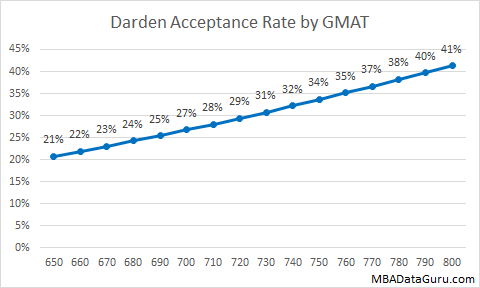
It is not shocking that increasing your GMAT will raise your Darden admission chance. The average GMAT score for accepted students at UVA’s business school is 706. If you were to increase your GMAT by 100 points from 650 to 750 when applying to Darden, you would raise your acceptance rate by an impressive 62%. Even at a GMAT score of 650, chance of acceptance is still over 20%.

Darden MBA Acceptance Rate by GPA

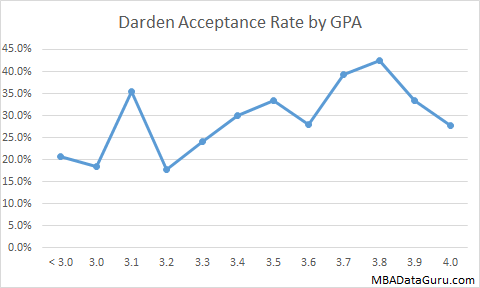
Darden MBA Acceptance Rate by GPA UVA MBA Admissions Business SchoolShockingly, GPA has little to no impact on your chance of admission to Darden. The average GPA of accepted students is 3.52. When I ran a regression model on factors that predict the chance of acceptance at Darden, GPA was one of the first variable eliminated. The graph above confirms my conclusion, a person with a 4.0 GPA has only a slightly higher chance of admission than a person with a 3.0. If you have a low GPA and a high GMAT, then Darden is a great school for you.

Darden MBA Acceptance Rate by Round

Darden MBA Acceptance Rate by Round UVA MBA Admissions Business School
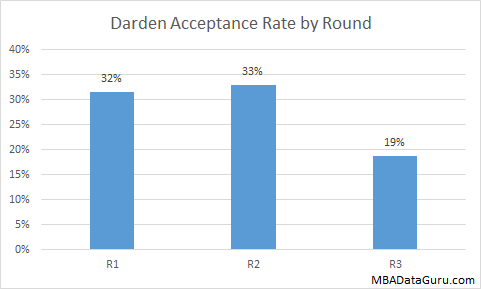
Recently I performed an analysis of MBA acceptance rates by application round. The Darden MBA acceptance rate was noticeably lower during round 3. When building the Darden predictive model I confirmed that the low round 3 acceptance rate was in fact statistically significant. Although round 3 applicants still have a fairly reasonable 19% acceptance rate, it is still significantly lower than the round 1 and 2 Darden admission rates. If you are on the fence about applying round 3 to Darden, you might as well wait for next year.

Other Darden MBA Acceptance Rate Factors

Similar to Wharton, Darden MBA applicants from India have roughly a 75% lower chance of admission. Computer science majors also have a similarly low chance of being accepted, coming in at 11%.