GMAT Preparation: How I Scored a 770

GMAT Preparation Studying MBA Application TestGMAT Preparation is a challenging experience. The average GMAT score at top schools has increased significantly over the past 5 years. The GMAT score is up at 19 out of the 25 top schools in that time period. It is critical for aspiring MBA students to study for the GMAT in an intelligent manner so they can maximize their chance of admission to their dream school. Here is how I was able to score a 770 on my first attempt at the GMAT.

Do Not Rush Your GMAT Preparation, I Studied for 6 Years

I know right now you think I am crazy for studying for 6 years, but it’s not what you think. I first started my GMAT preparation during the summer between my junior and senior year of undergrad. I had free time and GMAT scores are valid for 5 years. I studied for 10 to 15 hours and then life got in the way. I never ended up taking the test at that time. Since then, every year or two when I had some down time I would begin studying again, once again finishing about 10 to 15 hours of GMAT preparation before something would prevent me from finishing studying. Each time I came back to studying for the GMAT it was easier.

I finally got serious about studying for the GMAT in January 2013 because I knew I would be applying in the Fall. I studied from January until October when I eventually took the test. Studying over a long period of time has several benefits. Your brain can only absorb so much information per day. When you rush your learning by cramming last minute, you will forget almost as much as you learn, and it will not become second nature. The human brain commits information to memory during the rem cycle of sleep. If you are up late at night cramming last minute then you will not be getting enough sleep and benefit from all your studying. By studying slowly over time and getting enough sleep, you will absorb more information and your GMAT preparation will be more efficient.

I do not recommend studying over a 6 year timeframe for anyone. It is much more reasonable to plan for 6 months to a year of GMAT preparation. So if you are planning to apply for the class of 2017, now is the time to start studying.

Set a Date Test Date as Soon As Possible

When I began studying last year, my plan was to take the GMAT two months later. My goal was to study five to ten hours a week. Since I did not actually commit and schedule my test, I did not feel motivated to stick to my study plan, and the date I wanted to take the test slipped further and further. If I had a fixed date I needed to be ready by, then I would have done a better job of prioritizing my GMAT preparation. During January through May, I probably only studied two or three hours a week instead of the five to ten I wanted to. Spreading out my studying over nine months did end up benefiting me by allowing me to slowly absorb the material and get plenty of sleep, but it forced me to miss the round 1 application deadlines.

Diversify Your GMAT Preparation Techniques

GMAT preparation is not fun, but it is necessary in order to achieve a high score. Between work, social life and chores, I did not have a ton of time for GMAT preparation. I decided to try to optimize my limited time so I could study as efficiently as possible without letting the other areas of my life suffer. I found that a great way to multitask is to watch GMAT videos while doing chores or other low brain function tasks. Manhattan GMAT has some great GMAT videos posted on Vimeo that I used to study. There are also hundreds if not thousands of GMAT preparation videos on YouTube. I watched these videos every night while I cooked dinner, folded laundry, and cleaned my room. Over the course of 9 months of studying, I watched approximately 40 hours of GMAT videos without losing any time I needed for other tasks.

In addition to the videos, I also studied from traditional GMAT preparation text books. I found the official Guide by GMAC to be the best book. GMAT books are helpful for practicing problems. The books usually have problems in order of type of problem. On the test the questions will be in random order, so be sure to spend time practicing problems in random order rather than doing all algebra questions for an hour then all trigonometry questions for an hour.

Remember that the actual test is computer based, so be sure to practice doing some questions on your computer. There are a lot of great website such as GMAT Club and Beat the GMAT that offer resources for studying.

Practice Tests

GMAC offers two free practice tests that are very similar to the real GMAT. I don’t recommend wasting one early in your GMAT preparation because you only have two. Take a pen and paper test, Kaplan test or Manhattan GMAT test to roughly see where you are early on in your studying. Take your first real GMAC practice test about half way through your GMAT preparation to measure your progress. You can take the first practice test more than once. If you retake the first practice test, a lot of the questions will be different if you get certain questions right that you missed the first time. This give you a mostly different experience. I recommend retaking the first practice test once or twice. Take the second official GMAC practice test approximately two weeks before your actual test to see if you are close to the score you are hoping for.

The Human Brain Has Limited Capacity

I did all of my studying and practice tests after a full 10+ hour day of hard thinking at work. All of that thinking drains your brain’s capacity to perform on the GMAT and will slow you down. On my first official practice test I scored a 740. On my second official practice test I got a 730. Both of these tests were taken at 6 pm after working around 10 hours. On my actual test day, I took the test at 10 am without having worked all day. My brain was fresh which allowed me to move through the test faster and achiever a higher score of 770. I was in the 97th percent for quantitative and 98th percent for verbal. If you do decide to take your practice tests at night after working all day, you can be reasonably sure that you will perform at least as well as you score if not noticeably better.

GMAT Timing is Critical

Most GMAT questions can be answered pretty easily with enough time, but test takers have limited time to complete the test. Be sure to not only practice getting the questions right, but getting them right in the appropriate time period. If you can figure out within 30 seconds that you have a low chance of getting a question right, then make an educated guess and save the extra minute or so for a question you have a better chance of getting right.

The more answers you get right, the harder questions get. Some test takers go with an unconventional approach of randomly guessing on the first two questions. If you get them right then you have bought yourself 4 free minutes on the rest of the questions. If you get them wrong then the next several questions will be easier, so you can complete them faster and save time for the later more challenging questions, plus you still have the 4 free minutes for later in the test during the difficult questions.

Some people try the opposite approach, spend more time on the early questions so they can get them right. This is a bad approach because you will end up with harder questions faster and end up having less time for the hard questions later since you spent extra time on the early problems.

Good luck with your GMAT preparation. Studying is difficult and boring, but it pays off in the end. Having a high GMAT score significantly increases your chance of acceptance at top schools like Wharton.

Tuck Admissions Analysis

Tuck Admissions Analysis MBA Business SchoolThe final decision for the Tuck MBA January round applications is being released tomorrow. Tuck calls the students who have been accepted either the day of or the day before the decision is released. Today, mostly international acceptance calls were made, and I have not been called yet. I am based in the US so I am not super nervous yet, but I am finding it difficult to think of anything other than the Tuck decision. I was incredibly unproductive at work today because I spent the entire time hoping my phone would ring. To help ease my worries I created this elaborate Tuck admissions analysis to try to figure out my chances of getting in. Each of the following graphs are only acceptance rate vs. one variable. In reality there are probably interaction effects between different variables, so this is by no means especially accurate, but my final conclusion is that I have a 53% chance of being admitted. I was hoping the number would come out higher, but it is a lot better than the 20.8% acceptance rate overall at Tuck.

Tuck Admissions Analysis

Tuck Admissions Analysis GMAT Acceptance Rate MBA

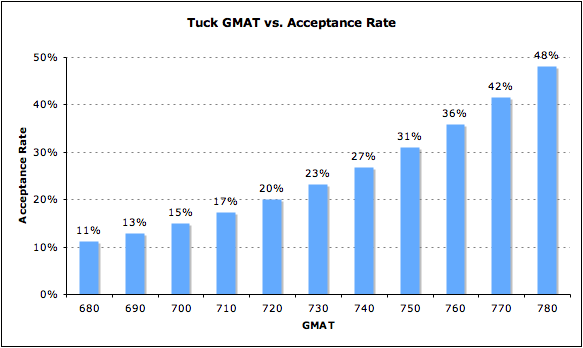
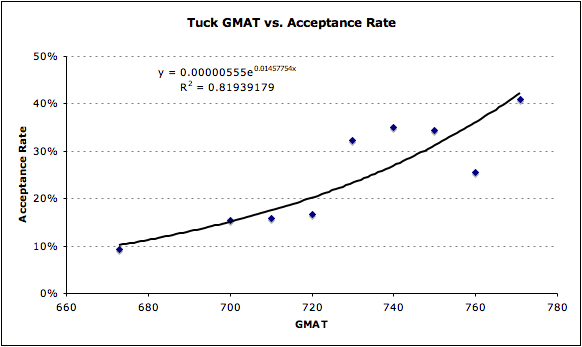
The first variable I looked at was GMAT. I did a scatter-plot by acceptance rate and found the best trendline for fitting the trendline. This line has an R squared of .82, which is a fairly strong correlation. I then created the smoothed out graph below, which probably does a better job of estimating the impact of GMAT on your application odds.

Tuck Admissions Analysis GMAT Acceptance Rate MBA

My 770 on the GMAT really helped to boost my Tuck admissions chances since it is significantly higher than the 718 average. However, I know my GPA is below the average Tuck GPA of 3.5. So next I looked at how GPA impacts acceptance rate.

Tuck Admissions Analysis MBA GPA Acceptance Business School

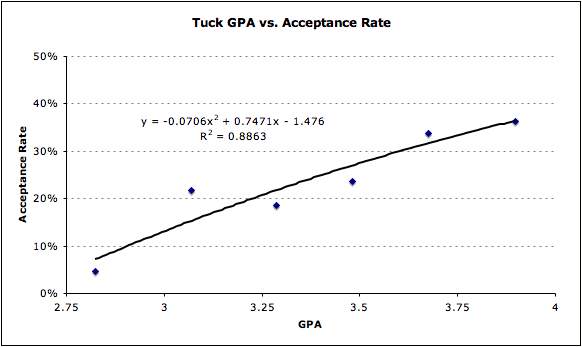
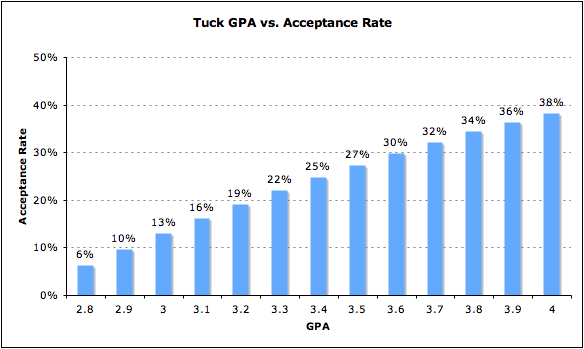
For Dartmouth, GPA is highly correlated with chance of acceptance, as one would expect. The GPA scatter-plot has a .89 R squared, which is very high. However, the line is not nearly as steep as it is for GMAT. Similar to GMAT, I smoothed out the curve to account for noise and came up with the graph below.

Tuck Admissions Analysis GPA Acceptance MBA Business School Dartmouth

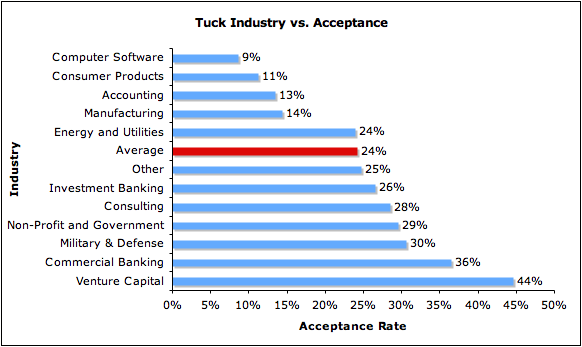
After GPA, I looked at how your industry impacts your chances of getting into Tuck. I only included an industry if it either had a high number of applicants or had a very high acceptance rate, like Venture Capital and Commercial Banking. I lumped all other industries into “other”. The trends for Dartmouth are similar to what I saw in my Wharton industry analysis. Manufacturing fared better with Tuck, but it is still significantly below average.

Tuck Admissions Analysis Industry Acceptance Rate Dartmouth MBA

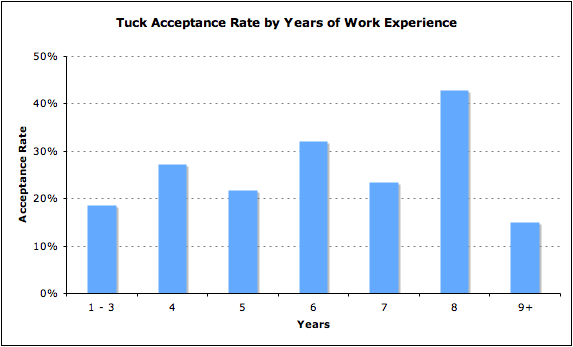
Finally, I looked at Dartmouth acceptance rate by years of work experience. The results of this graph do not seem to be as conclusive as other variables. The acceptance rate kind of jumps around. My interpretation is that in general the more years of work experience, the higher your chance of admissions is, until you reach 9+ years. Then the admissions committee starts to wonder why you are even applying for an MBA.

Tuck Admissions Analysis Dartmouth MBA Acceptance Rate

All in all, my predicted chance of getting into Dartmouth is pretty decent at 53%. My chance is theoretically a little better than a flip of a coin. I know that very few people who don’t do a applicant initiated interview are invited to a Tuck interview. An admissions committee member told me that roughly 55% of applicants self-initiate interviews, and I am going to guess that only 5% of total applicants are invited. If this is correct, then the fact that I already interviewed means that I have a pretty good chance of getting in. On top of that, I had one recommender who wrote an amazing recommendation for me. I sent it to NYU, Wharton and Tuck. I was admitted to NYU and I have been interviewed at Wharton and am waiting for my final decision. I was rejected from every school that he didn’t recommend me at. I am hoping the trend continues that I get into every school that my super recommender submitted to.

For those of you who are still waiting for the Tuck admissions decision, I hope that this article is able to distract you for a little while while you wait for the decision tomorrow. I wish everyone the best of luck.

The data used to create this Tuck admissions analysis is from GMAT Club. I used the data from the class of 2014, 2015 and the first two rounds of the class of 2016.

Stanford GMAT vs. GPA: Which is more important?

stanford gmat gpa MBA business school acceptance rateStanford is tied currently tied with Harvard and Wharton as the #1 MBA program in the world. Stanford’s acceptance rate is extremely low, at 6.8%. With such a low acceptance rate, it is important to understand how at Stanford GMAT and GPA affect your chance of admissions. Every school weighs the importance of GMAT and GPA differently. Today I will look at how Stanford compares the two metrics. For this analysis, I only included applicants who were accepted and are on the margin. We don’t learn much by seeing that Stanford accepted a student with a 3.98 GPA and a 790 GMAT, but we do learn a lot by analyzing the profile of applicants who were just barely accepted. Top MBA schools prefer candidates with high GPA and GMAT, but they are often willing to accept an applicant with low GPA if that applicant has a high GMAT. The same is true for applicants with low GMAT and high GPA.

Stanford GMAT vs. GPA

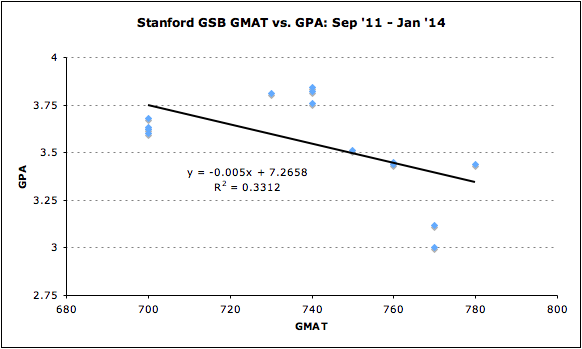
Stanford GMAT vs. GPA GSB MBA Admissions Acceptance

Unfortunately, Stanford data is a little thin because their acceptance rate is so low, but we get a reasonable idea of the GMAT vs. GPA tradeoff. At Stanford GMAT vs. GPA slope is -.005, which means that 100 GMAT points are roughly worth .5 GPA points. So a 680 GMAT with a 3.87 GPA would be viewed roughly similar to a 780 GMAT with a 3.37 GPA. This slope is less steep than most other schools, which means that, compared to other schools, Stanford prefers high GPA over high GMAT. The only school with a lower slope is Stern, which had a -.0043.

Check out how some of the other schools weigh GMAT vs. GPA:

Upenn / Wharton GMAT vs. GPA

Harvard GMAT vs. GPA

MIT / Sloan GMAT vs. GPA

Dartmouth / Tuck GMAT vs. GPA

NYU / Stern GMAT vs. GPA

The data for this post is from GMAT Club. I used the admissions data from the class of 2014, 2015, and R1 admits for 2016.

I have published a more recent Stanford business school acceptance rate analysis which has more accurate findings on GMAT and GPA at GBS.

Wharton GPA Impact on MBA Acceptance Rate

I posted an updated Wharton acceptance rate analysis which is more accurate than this article. It shows how GPA and GMAT affect your odds of admissions.

Wharton GPA MBA Admissions Acceptance Business School

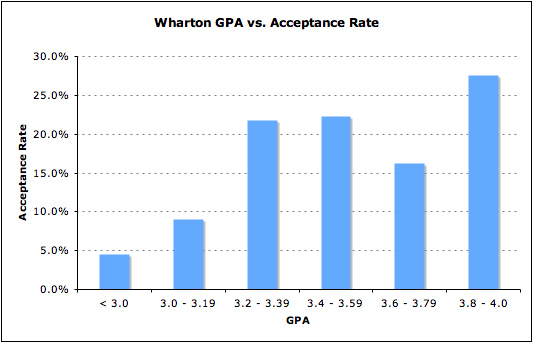
When applying to a top MBA program, GMAT and GPA are important parts of the application. As one would expect from a top MBA program, at Wharton GPA has a large impact on your chances of admission. The question is how much does your undergraduate GPA affect your chance of admission. I analyzed the acceptance data from the past two and half years at GMAT Club to see how much GPA impacts acceptance rate. Unlike Harvard where there is little benefit from GPA until 3.8 or higher, at Wharton the acceptance rate generally increases as the undergraduate GPA rises.

At Wharton GPA Increases Chance of Admission

Wharton GPA vs. Acceptance rate MBA Business School You can clearly see that acceptance rate is lowest below 3.0 and highest in the 3.8 to 4.0 range. There is a slight dip in the 3.6 to 3.79 GPA range. I took a closer look and it appears to be because more applicants in this GPA range worked in industries that Wharton does not value. There are more applicants in the 3.6 to 3.79 range that work in Government and Mutual Funds and fewer in Military and Venture Capital, which are industries that Wharton seems to prefer.

Higher GPA does appear to increase the chance of an applicant being admitted to Wharton, but the slope is not as steep as I would have expected. Unfortunately for some, GPA is stuck in stone. Applicants who hope to increase their chance of admissions need to focus on GMAT to increase their odds. Luckily, data suggests that very high GMAT scores significantly increase the odds that Wharton will accept an applicant. If an applicant studies hard for the GMAT, then a high GMAT score is highly likely achievable. There are many companies that offer GMAT preparation which will increase your chance of admission.

Wharton does not publish statistics on GPA for us to analyze. However, we can look at what the average GPA is in my data set. The mean GPA for accepts at Wharton in my dataset is 3.61 GPA with a middle 80% GPA in the range of 3.23 to 3.94. The mean Wharton GPA of 3.61 is lower than the mean Harvard GPA of 3.66.

Harvard GPA Impact on Acceptance Rate

Harvard business school is ranked first and it is incredibly difficult for applicants to get admitted. If you are applying, then you might wonder what is the minimum Harvard GPA requires in order to have a decent chance of acceptance. I analyzed the data from GMAT Club application data to discover the relationship between Harvard GPA and acceptance rate.

Harvard GPA MBA Acceptance Rate Business SchoolUpdate: I have posted a more up to date analysis of Harvard Business School acceptance rate which looks at how GPA, GMAT and application round impacts your chance of admission.

At Harvard GPA is Not Important Unless it is Very High or Very Low

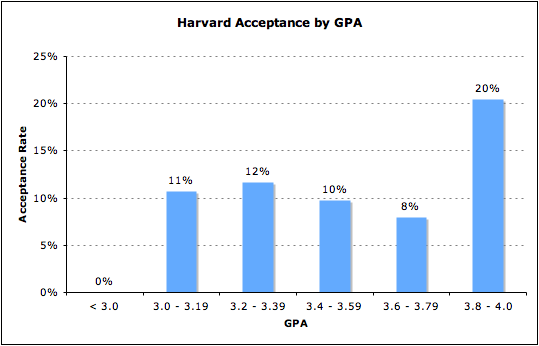
As you can see, the acceptance rate between 3.0 and 3.79 is relatively flat. GPA only seems to have any impact if you are above 3.8 or below 3.0. The acceptance rate for Harvard is higher in the 3.0 to 3.39 range than 3.4 to 3.79. This is likely due to low sample size in the lower GPA range. Although the acceptance rate is 0% below 3.0 in my dataset, I don’t think there is no chance of getting in, it is just very challenging.

At Harvard GPA only starts to help you when your GPA is 3.8 or higher. The average acceptance rate at Harvard is 12%, but it is 20% for applicants with a 3.8 or higher. I could not find any data published by Harvard on average GPA or GPA range. In my dataset, the average GPA of an applicant was 3.55, but the average GPA for someone who was accepted was 3.66. The middle 80% for Harvard GPA was 3.2 to 3.98, which means that 10% of those applicants that Harvard accepts have a GPA of 3.98 or higher.

In summary, if you are applying to Harvard, don’t stress out too much about your GPA as long as it is at least 3.0. Having a somewhat low GPA isn’t going to hurt your chances very much. Harvard only seems to care about how high your GPA is if you have a low GMAT score.

For this analysis, I used data from September 2011 through February 2014. There were 774 applicants in my data set.

The Most Common Tuck Interview Questions

Tuck Interview MBA Dartmouth Business School Admissions

Tuck interviews are typically 30 to 45 minutes. Typically, the interviewer is a second year student, but on occasion you will be interviewed by an admissions staff member. Unlike most schools, Tuck allows anyone who visits campus to interview. Since Tuck is in a very remote location in New Hampshire, Tuck wants to see that you are committed to the school and are willing to travel to campus. Tuck does extend interview invites to a few select candidates who did not self-initiate an interview, but it is very rare. A member of the admission committee told me that slightly over half the candidates self-initiate an interview.

I highly recommend you self-initiate an Tuck interview on campus, because if you don’t then you put yourself at a huge disadvantage.  While visiting campus, visit a class and go on a tour. It is a great way for you to gather material for your essays.

Here is a list of the most common questions asked during a Tuck interview. I also included the probability that each question is asked based on Clear Admit interview reports.

Tuck Interview Questions

  1. Why Tuck?  –  (100%)
  2. Walk me through your resume  –  (82%)
  3. Do you have any questions for me?  –  (76%)
  4. What are your short-term and long-term goals?  –  (71%)
  5. Why an MBA or why now?  –  (65%)
  6. Tell me about a challenge, conflict or difficult situation at work? How did you deal with it?  –  (59%)
  7. What is the accomplishment you are most proud of?  –  (29%)
  8. What kind of leader are you or how do you interact in a group?  –  (29%)
  9. What extracurricular activities do you plan to participate in at Tuck?  –  (29%)
  10. What are your three biggest strengths?  –  (29%)
  11. What is your biggest weakness, or three biggest weaknesses?  –  (29%)
  12. What would you contribute to Tuck?  –  (29%)
  13. Tell me about yourself  –  (18%)
  14. Are there any questions you wish I had asked you?  –  (18%)
  15. What are your other interests or passions?  –  (18%)
  16. If you attend Tuck, how would your classmates describe you?  –  (12%)

I interviewed back in December and most if not all of the questions I was asked are on this list. My Tuck interview was with a second year student. He was friendly and laid back. We chatted a little before and after the interview.

Check out my new MBA Interview Guide.

Harvard GMAT vs. GPA Comparison

I have posted a more up to date Harvard Business School acceptance rate analysis which is based on GPA, GMAT and application round.

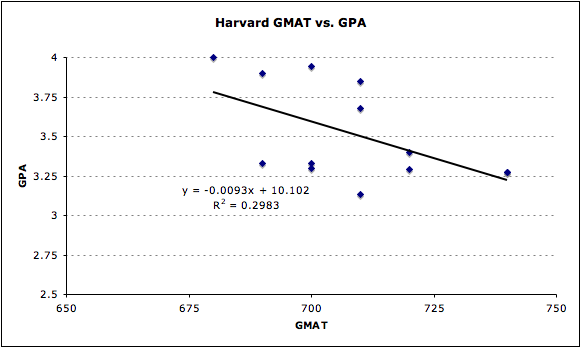
Word is that Harvard will take a chance on applicants who have low scores, but impressive accomplishments. Lets see if Harvard lives up to its reputation.

Harvard GMAT vs. GPA Admissions Accepted MBA Business School
As you can see the slope for Harvard is much steeper than for the other schools. The slope of -.0093 means that Harvard would look at an application with a 750 GMAT and 3.0 GPA similarly to a 650 and 3.93. This result is interesting, it shows that on the margin Harvard is weighs GMAT very strongly, however, the marginal Harvard GMAT scores are lower than other schools. Harvard is willing to take a chance on a low GMAT, but you better have a damn high GPA to make up for it.

Harvard GMAT vs. GPA All Accepts

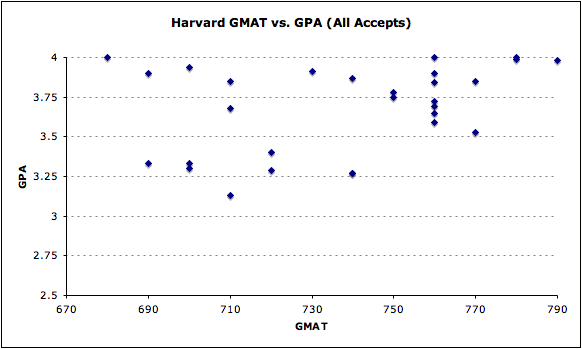
It is interesting to look at the total accepts instead of just the accepts on the margin. As you can see below, Harvard seems to be completely missing the population of students with low GPA and really high GMAT. I guess the admissions committee isn’t interested in students who slacked in undergrad and tried to make up for it with GMAT. I find that odd given Harvard’s reputation for grade inflation. They say that the hardest part of Harvard is getting in.

Harvard GMAT vs. GPA (all accepts)

The median Harvard GMAT score is 730. It is interesting that Harvard posts the median GMAT score instead of mean score like other schools. You can hide some very low GMAT scores by only posting a median. I would venture a guess that Wharton’s mean GMAT score, at 725, is higher than Harvard’s GMAT mean. After all, Harvard did accept a person with a 550 GMAT score last year. That has to be bringing down the average.

Check out how some of the other schools weigh GMAT vs. GPA:

Upenn / Wharton GMAT vs. GPA

MIT / Sloan GMAT vs. GPA

Dartmouth / Tuck GMAT vs. GPA

NYU / Stern GMAT vs. GPA

Methodology: The scatterplot represents the 50% of applicants who are accepted with the lowest GMAT and GPA. It isn’t helpful to look at the top 50% of applicants because those are not the marginal candidates who barely got in. I occasionally will remove very low outliers because those candidates may have been admitted due to very strong connections that most applicants don’t have. I never remove more than 5% of the total accepted students as outliers. The slope of the scatterplot demonstrates the point at which the school is indifferent to GMAT vs. GPA. The data for this analysis comes from GMAT Club.

Sloan Interview Preparation Guide

MIT Sloan Interview MBA Admission

At this point all of the Sloan interview invites have been sent out for this year. Unfortunately, I did not receive an invite from Sloan, but I am happy to say that due to all of my preparation, my Wharton interview went very well. Although the team based discussion is a new interview format, I was able to assume a leadership role without being aggressive or obnoxious about it. Since I had already started preparing for a Sloan interview incase I got an invite, I decided to post the Sloan interview preparation I was working on for myself. I hope this is helpful for those who will be interviewing with sloan over the next few weeks. Sloan interviews can take place on campus, in hub cities or even at the offices of alumni. Most Sloan interviews last 40 to 50 minutes, but some have been as short as 15 minutes. I have listed out the questions found in Clear Admit over the past 2 or 3 years in order from most common to least common. The number to the right indicates how many times it was asked.

Sloan Interview Questions:

  1. Why MBA? (5)
  2. Describe a time I had to resolve a conflict.  (5)
  3. Anything new to add to your resume since submitting application? (4)
  4. Why Sloan? (4)
  5. What do you me to get across to the admissions committee about you? (3)
  6. Questions? (3)
  7. Tell me of a time you received feedback and how did you respond? (3)
  8. Tell me about a time you helped a colleague who was struggling professionally. (3)
  9. Tell me of a time when you had to mentor someone. (3)
  10. Describe a time when one of your ideas was rejected and what you did. (3)
  11. Why get an MBA now? (2)
  12. Tell me about a time you had to persuade your colleagues. (2)
  13. Walk me through your resume. (2)
  14. Describe a time when you had to rally a team  (2)
  15. Describe a major initiative that you have worked on. (2)
  16. What would your recent team members say about you, if they were asked what its like to work with you?
  17. Tell me about a company in your industry that has caught your eye.
  18. Given your role at your company (work for a startup), what will it be like when you leave?
  19. Describe a time when you took a big risk.
  20. Elaborate on your leadership role in your extracurricular activity.
  21. Why did you change jobs from (company x) to (current company)?
  22. You have an offer from (current company) to return. Do you intend on taking it?
  23. Explain what your prior employer does, your contributions there and why you decided to move to your current job.
  24. Will you return to your employer after graduation?
  25. Describe a time when you had to say “no” to a boss.
  26. Tell me about your biggest achievement.
  27. Did you talk to someone about the Sloan program?

You will be in good shape if you prepare for the 10 to 15 most common questions. It may be helpful to look at the questions that have only been asked once, but I would not spend too much time prepping for them. For more info on preparing for a Sloan interview, check out my MBA interview preparation guide.

Few MIT Interview Invites for Round 2

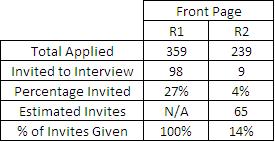
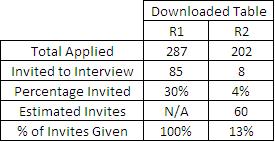
Similar to many of the applicants on the GMAT Club forum I have been impatiently waiting to hear from Sloan about an interview invite. It seemed to me that the number of invites have been very low so I decided to take a quick look at how low. I put together two charts, one based on the front page statistics and one based off of the table you can download with detailed stats.


MIT Sloan MBA Interview Invite

 MIT Sloan MBA Interview Invite


For some reason the two sets of numbers do not tie together but they tell the same story. Even though the Sloan interview invite period is more than half over, only 14% of the estimated interview invites have been sent out. My best guess is that the weather has been even worse than normal in Boston this year and has significantly delayed MIT. It is really hard for me to stay positive as the invite deadline quickly approaches, but given the numbers, I think we should all stay positive. It will be interesting to see if Sloan misses the invite deadline for R2 in addition to missing it for R1.

Wharton Interview Preparation Guide

wharton interview preparation guide MBA business schoolCheck out my updated Wharton MBA Interview Questions and preparation guide for the most up to date list of questions.

Now that I have been invited to a Wharton interview, I am spending as much time as I can prepping for interview. In the spirit of teamwork and cooperation, I’ll share with you the most common Wharton interview questions I found on Clear Admit. I only included questions from interviews that happened in the past two years, since the Wharton interview format changed. I don’t think that the older interviews are relevant anymore. If questions were asked to more than one person on a Clear Admit interview report then I put the number of times in parentheses.

Wharton Interview Questions:

1)    Describe your views of the Team Based Discussion. (7)

2)    Do you have any questions for me? (6)

3)    Do you have any updated to your application? (4)

4)    What extracurricular at Wharton? (4)

5)    Was your behavior in the Team Based Discussion representative of the way you typically act in a group setting? (4)

6)    Walk me through your resume. (4)

7)    Why MBA? (2)

8)    What could you have done differently as a team? (2)

9)    Why Wharton? (2)

10) Tell me about a time you had to persuade others. (2)

11) What are your post MBA goals? (2)

12) What specific quality or qualities do you hope to hone at Wharton?

13) Tell me about one time you had to overcome an obstacle working in a group and what you would do differently if you had to do it again?

14) Tell me about a time you failed and what you learned.

15) What are the 3 top qualities you think a leader should have?

16) What are 3 qualities you look for in a business school, especially our school

17) Why now?

18) What do you do in free time?

19) Tell me about a time you faced a leadership challenge.

20) Tell me about a time when you worked in a group in which everyone did not agree and how did your team resolve the situation?

21) What do you think worked well in the Team Based Discussion?

It seems that pretty much everyone is asked how they thought the team based discussion went and everyone is given the chance to ask questions at the end. Beyond that there are four other questions that are asked frequently, which you should prepare for. Good luck in your Wharton interview! Check out my MBA Interview Preparation Guide for more tips.