Advice for Improving your Resume

Resume Advice Tips MBA Admission Interview Business SchoolA few months back I interviewed several summer intern candidates at work. While reviewing these candidates’ resumes I saw a lot mistakes that you should never make on a resume, whether you are applying for a summer internship or a top ten MBA program. They did not do very well in the interviews and I was not surprised. Here are three easy steps you can take to quickly improve your resume before you apply for business school or your next job.

Do Not Use Too Much Jargon in your Resume

These candidates dropped terms such as electroencephalographic signal and fast Fourier transformation in the resume. Using complex jargon at best won’t help you and at worst will confuse the person reading your resume. If they can’t understand what you are saying then they won’t be impressed. You are an expert in your field, but not everyone is as knowledgeable about the topic. Try to make your resume as approachable as possible so you don’t alienate your interviewer. If your interviewer is not familiar with a term, it may make them feel stupid, and that isn’t going to help your chances of getting an offer.

Do Not Focus on the Process, Focus on the Result

Often when candidates describe their work experience, they focus on what they did, not the “so what?”. Business schools and hiring managers don’t care about the process you went through or the computer language you programmed in. Instead they want to find out what the impact of your project was. What would a hiring manager or business school rather see on a resume?

  • Expert VBA programmer
  • Automated data collection process using VBA, which reduced team workload by 100 hours per month

The second description not only shows that you know VBA, but it also demonstrates that you know how to use that skill to drive real value for your company. Whenever possible, try to quantify how much of an impact your project had for your company. Mention how many more customers your company will attract or how much you were able to increase profits or revenues.

Highlight your Ability to Work in a Team

Employers and business schools want to see that you can work in a team environment and interact well with others. Don’t just state that you are a team player, demonstrate that you know how to collaborate while discussing your accomplishments. Discuss a project where you collaborated with other departments and succeeded in accomplishing a goal. It doesn’t matter how smart you are if you don’t have the people skills required to interact in a work environment.

Check out my MBA Interview Preparation Guide to learn how to get ready for MBA interviews.
Stern Interview Acceptance Rate Analysis

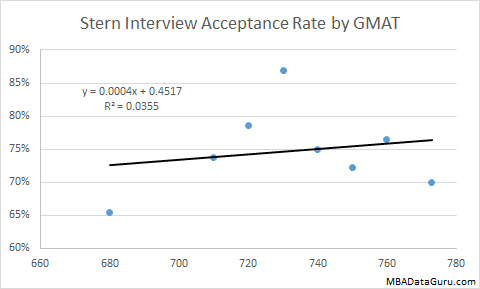
I know that the final decisions for applicants who were interviewed for New York University’s business school are expected soon. I decided to perform a Stern interview acceptance rate analysis to see if I could predict the chance of acceptance for applicants who were invited to interview. From my data sample 74% of applicants who were invited to interview were ultimately accepted.

Stern Interview Acceptance Rate by GMAT

Stern Interview Acceptance Rate by GMAT NYU MBA School AdmissionsNot only is the slope of the regression line very flat, but also the the R-squared is only 3%. These two pieces of information suggest that once a candidate is invited to interview, their GMAT has no impact on acceptance rate.

Stern Interview Acceptance Rate by GPA

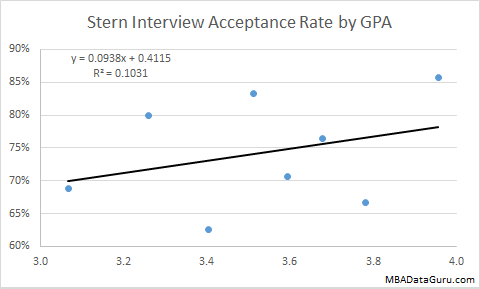
Stern Interview Acceptance Rate by GPA NYU Business School AdmissionThe slope of the GPA graph is a little steeper than the GMAT graph slope. The R-squared is also higher, coming in at 10%. Once again, this indicates that GPA has a little more impact on your chance of admission after being invited to interview compared to GMAT.

The low R-squared of the GPA and GMAT compared to admissions for interviewed applicants suggest that NYU treats all applicants as equal once they are invited to interview. If interviewed you are on equal footing compared to all other candidates invited to interview. This is different compared to Ross, which has a much higher correlation between GMAT / GPA and acceptance rate. The GMAT & GPA acceptance rate R-squared ranged from 30% to 75% for Ross, which is much higher than the 3% to 10% for Stern.

The data used for this post comes from GMAT Club.

Ross Interview Acceptance Rate Analysis

Earlier today I posted the Ross acceptance rate analysis which shows how GPA and GMAT scores affect your chance of admission at University of Michigan’s MBA program. I received a request to see if GMAT and GPA can still predict acceptance rate out of the applicants who were selected to interview. I would never want to disappoint a reader, so here is my Ross interview acceptance rate analysis. While reading this analysis, keep in mind that around 62% of interviewed applicants are accepted, which is higher than schools like Harvard and Wharton but lower than Stern.

Ross Interview Acceptance Rate by GMAT

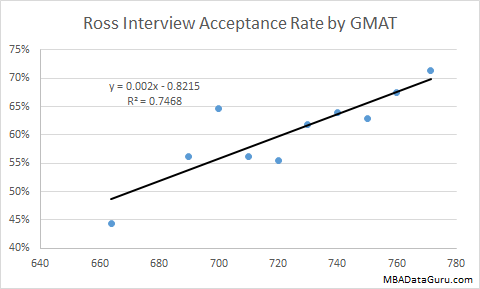
Ross Interview Acceptance Rate by GMAT Michigan MBA Business School AdmissionsIn the graph above you can see that there is a clear relationship between Ross acceptance rate even among the applicants selected to interview. The R-squared is 74% which is fairly high, so GMAT is an accurate predictor of admissions post interview. The slope of the line suggests that for every 10 points higher your GMAT is, you have a 2% higher chance of admissions. Unfortunately for those with a low GMAT score, you are not on an equal playing field even after being selected for an interview at Ross.

Ross Interview Acceptance Rate by GPA

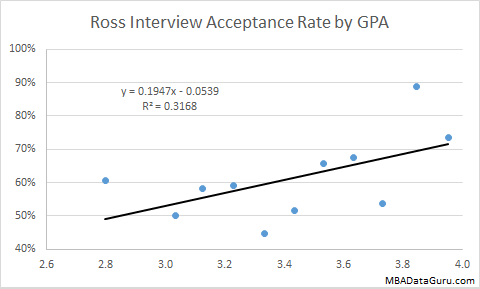
Ross Interview Acceptance Rate by GPA Michigan MBA Business School AdmissionsThere is also a relationship between Ross interview acceptance rate and GPA, but the correlation is much weaker. Just from looking at the graph you can see that the data is more spread out from the regression line. The R-squared of 32% is much lower than the R-squared for GMAT of 74%. All else equal, it would help your chance of admission if you have a high GPA, but it does not seem to matter as much as GMAT.

When I analyzed Harvard Business School acceptance rate, I found that GMAT and GPA could not predict acceptance rate from the pool of applicants selected to interview. Which means everyone who was interviewed were on a level playing field once invited to interview. That does not seem to be the case for Ross. In the end, even with a low GMAT or GPA, you still have a 50% of being accepted after your interview. All you can do is prepare for your Ross MBA interview as much as possible and hope for the best.

Ross Acceptance Rate Analysis

I plan to post the Ross admission calculator online as soon as I have time to build that portion of the website, probably over Christmas break. In the mean time I will share some of the insights I got from building the predictive model.

Ross Acceptance Rate by GMAT

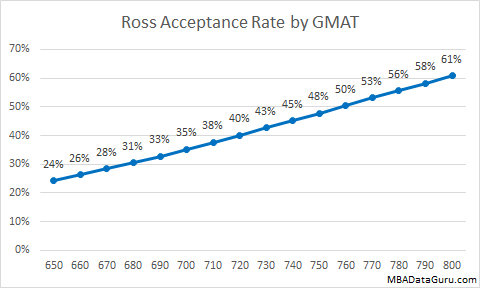
Obviously your chance of admission to Ross School of Business increases if you score higher on the GMAT. The good news is that Ross’s acceptance rate of 34% is significantly higher than almost all other business schools in the top 20. The Ross class of 2016 profile shows that the average GMAT and GPA are 702 and 3.4 respectively. The data used to create this analysis comes from GMAT Club. Of the applicants in my data set, 84% had GMAT of 700 or higher, which means that I am fairly confident about the relationship between GMAT and admissions in the 700’s but not as confident in the 600’s.

Ross Acceptance Rate by GMAT MBA Admissions Michigan School of Business To create the graph above, I used the average GPA from my data set which is 3.42 and then shifted the GMAT score in my model. The model takes into account the interaction of GMAT, GPA, years of work experience, undergraduate major and the industry you worked in.
Ross Acceptance Rate by GPA

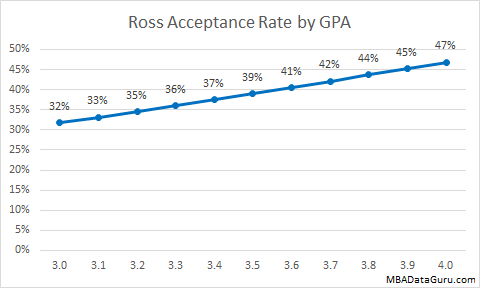
Next I looked at how GPA affects Ross acceptance rate. I’m sure it is not a surprised to hear that a higher GPA increases your chance of admissions at Michigan school of business. Ross Acceptance Rate by GPA MBA Admissions Michigan School of Business

Ross Acceptance Rate: GMAT vs. GPA

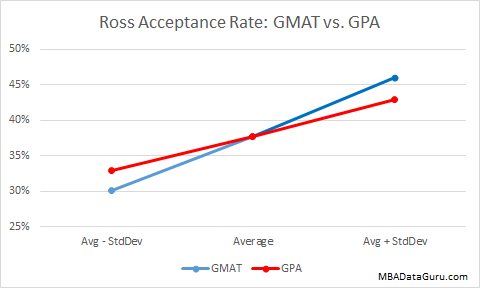
The real question is which is more important for raising your Ross acceptance rate, GPA or GMAT? In the graph below I compare how much the admissions rate changes if I alter the GMAT or GPA by a standard deviation. A standard deviation is a measure of variance in a population or sample. Since I can’t compare the absolute variance because GMAT and GPA are on different scales, I compare how the shift of one standard deviation impacts the Ross MBA acceptance rate.

Ross Acceptance Rate GMAT vs. GPA Admision Michigan School of BusinessAs you can see the slope is steeper for the GMAT line. This means that Ross prefers applicants with a high GMAT over applicants with a high GPA. One standard deviation higher in GMAT increases acceptance rate by 22% while a standard deviation in GPA only increases chances of admission by 14%.

Other Ross Acceptance Rate Insights

similar to Harvard and Wharton, at Michigan the acceptance rate is noticeably lower for Indian applicants vs. non-Indian applicants, 17% vs. 41% respectively. Engineering majors have a lower chance of admission while liberal arts majors have a higher chance. Many schools are trying to increase the number of women in their program. The higher acceptance rate for liberal arts majors may reflect Ross trying to attract more women, however my data set is missing gender information. More years of work experience increases the chance of admission by around 2.5% per year. Also military applicants have a higher chance of admissions.

For those of you who have already been invited to interview at Ross, your acceptance rate is higher at around 62%. Check out my Ross Interview Acceptance Rate Analysis to see what your chance of getting admitted is.

Good luck with your applications!

Harvard Business School Acceptance Rate Analysis

How can anyone ensure that they will be accepted to Harvard Business School? Unfortunately there are no assurances at the number one ranked business school which has an acceptance rate of 12%. This analysis will show you what factors impact Harvard Business school acceptance rate, such as GMAT and GPA.

Harvard Business School Acceptance Rate by GMAT

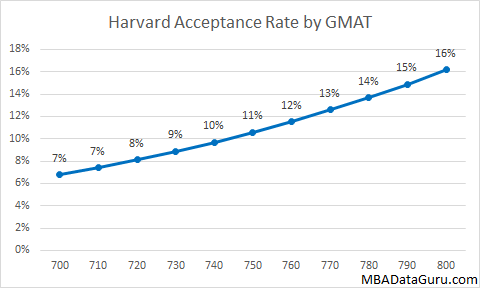
Similar to all other business schools, Harvard does care about your GMAT score. As you can see in the graph below, a higher GMAT results in a better chance of admission. If you want a double digit chance of admission you had better score a 740 or higher. Even at 800 the HBS acceptance rate is surprisingly only predicted to be 16%.

Harvard Business School Acceptance Rate by GMAT MBA HBS Admissions

Harvard Business School Acceptance Rate by GPA

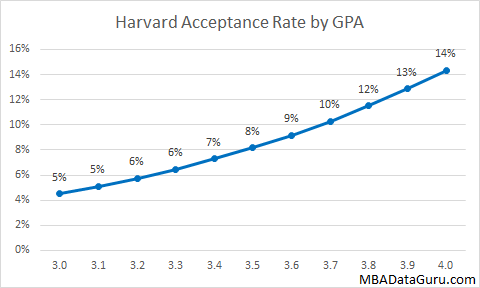
Next we look at how GPA affects Harvard Business School acceptance rate. Obviously a higher GPA results in a better chance of admission at HBS. Acceptance rate doesn’t break into the double digits until you hit 3.7. This reminds me of why I didn’t even bother applying to Harvard with my 3.33 GPA. Damn you engineering, why did you ruin my grades?Harvard Business School Acceptance Rate by GPA HBS MBA Admission

Harvard Business School Acceptance: GMAT vs. GPA

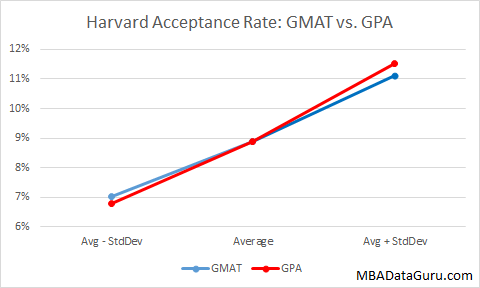
The real question is which is more important for raising your chance of admission to HBS, GPA or GMAT? In the graph below I compare how much the admissions rate changes if I alter the GMAT or GPA by one standard deviation. A standard deviation is a measure of variance in a population or sample. Since I can’t compare the absolute variance because GMAT and GPA are on different scales, I compare how the shift of one standard deviation impacts the Harvard MBA acceptance rate.

Harvard Business School Acceptance Rate GMAT vs GPA MBA HBS AdmissionsUnlike at Stern and Wharton, Harvard values GPA over GMAT. Harvard acceptance rate increases by 30% when GPA increases by one standard deviation but only by 25% when GMAT increases by a standard deviation. This indicates that GPA is more important than GMAT at HBS, and they are willing to roll the dice on a candidate with low GMAT like the guy who was accepted last year with a 550.

Other HBS Acceptance Rate Insights

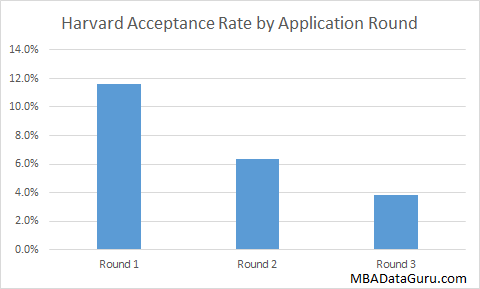
The round you apply in does have an impact on your chance of being accepted at HBS. Applying in a later round significantly reduces your chance of admission at Harvard. The data for round 3 is not statistically significant due to low sample size, but I wouldn’t risk applying in round 3 unless you have a godly application. Perhaps after this recruiting year is over I’ll have enough data to confirm and update the model.

Harvard Acceptance Rate by Round HBS MBA AdmissionsIf you want to maximize your chances of getting into Harvard, then be sure to apply during round 1. Additional work experience does increase your odds of getting into Harvard by a small amount, roughly .5% per year. I’m sure a lot of peoples’ next question is what about the 2+2 program? I do know about the 2+2 program Harvard has but I can’t tell which candidates are applying through the 2+2 program vs. not. However I can tell you that of the 59 people in my sample who are 24 years old or younger , none were admitted. So although it is possible to get in if you are younger, it certainly is more challenging.

Next I’ll mention a few factors that are out of your control in the short term but should be known so you can plan accordingly. Similar to Wharton, applicants who are applying from India have a lower chance of admissions, only 1.5% of applicants from India are accepted. Applicants who majored in finance also have a significantly lower chance of being admitted, only 2%. And finally applicants who have worked in venture capital or the military have a much higher admissions rate, 16% and 17% respectively.

Update: I took a quick look if I could predict acceptance rate accurately for people who were already selected for an interview. They only factors that had any predictive power were round, age and major. Average acceptance rate is 49%, with older candidates doing a little better about 7% higher acceptance rate for someone a year older than average. Round 2 applicants had a 37% acceptance rate, while round one had a 57% chance. And finally, applicants who majored in finance had a 16% chance of admittance. In the end, it is very difficult to predict admissions for candidates once they have been invited to interview, which suggests that to Harvard the interview actually matters.

Good luck with your Harvard applications!

For undergrads, check out the Harvard acceptance rate analysis at College Admit Me.

Stern Acceptance Rate Analysis

I just finished building the Stern acceptance rate prediction model. I will post the admissions calculator as soon as I have time to finish learning PHP and then build that portion of the website. I’ll probably have time to work on it over Christmas break, but right now I am too busy applying for interviews for summer internships. In the mean time I will share some of the insights I got from building the model.

Stern Acceptance Rate by GMAT

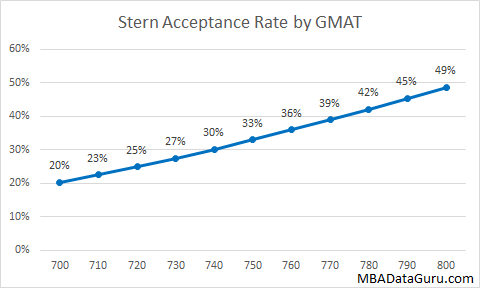
The first thing that jumped out at me was that the acceptance rates I came up with are noticeably higher than the published acceptance rate of 15%. I believe that this is because the average candidate who applies and posts their data on GMAT Club, where I get my data, is more competitive than the average candidate. The average GMAT Club applicant to Stern has a GPA or 3.45 and GMAT of 709, which is not too far from the scores listed on the class profile for Sterns class of 2016 of 3.52 and 721.

Stern Acceptance Rate by GMAT MBA Admissions Business School NYUIf you are applying to Stern, it is pretty obvious that having a higher GMAT is important and will significantly raise your chances of being admitted. To create the graph above, I used my model with the average GPA of 3.45.

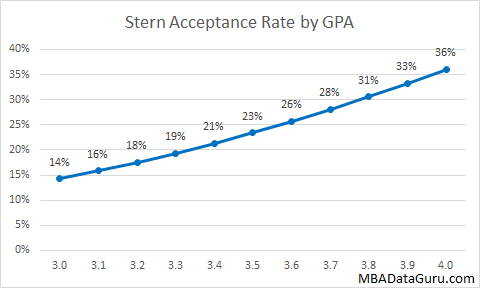
Stern Acceptance Rate by GPA

Next I looked at how GPA affects Stern acceptance rate. Once again there is a clear relationship between GPA and admission rate for NYU. In the graph below I used the average GPA score of 709 in my admissions model.Stern Acceptance Rate by GPA NYU Admissions Business School

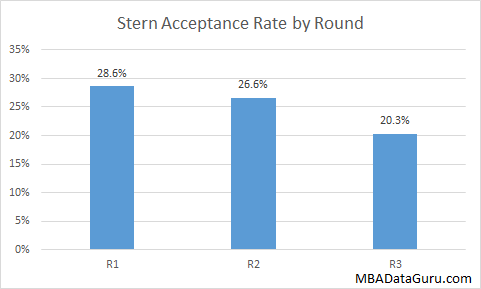
Stern Acceptance Rate by Round

Many candidates want to know if it matters in which round you apply. I took a look at the raw acceptance rate by round for NYU. As you can see the acceptance rate for round 2 is slightly lower and for round 3 it is noticeably lower.

Stern Acceptance Rate by Round MBA NYU Admissions Business SchoolThe acceptance rates above are raw numbers, not the predicted values from my admissions model. Why you ask? Because when I took into account all of the other factors, the round you apply in is not statistically significant. The reason the acceptance rate is lower in round 2 and 3 is not because the schools are more selective but because on average lower quality candidates apply in those rounds. If you are a qualified candidate, do not worry about applying to Stern in round 3, you still have a good chance of getting in.

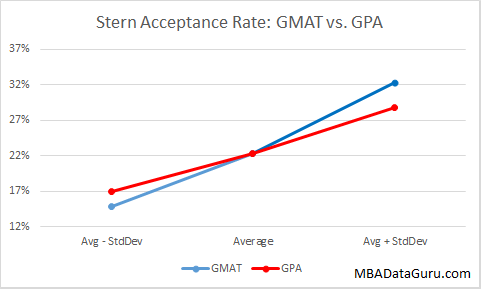
Stern Prefers GMAT over GPA

In the past I tried to figure out if Stern prefers a high GMAT or GPA and didn’t come up with anything conclusive. Now that I have built the Stern admissions model I can see how a similar change in GMAT or GPA impact acceptance rate at Stern. In the graph below I compare how much the admissions rate changes if I alter the GMAT or GPA by a standard deviation. If you are applying to business school then you should probably know what a standard deviation is, however if you don’t it is a standard measure of variance in a population or sample. Since I can’t compare an absolute variance because GMAT and GPA are on different scales, I compare how the shift of one standard deviation impacts the Stern acceptance rate.

Stern Acceptance Rate GPA vs GMAT MBA NYU Admissions Business SchoolIn the graph above, you can see that increasing the GPA by one standard deviation (.28) increase acceptance rate by 29%, but raising the GMAT score by one standard deviation (39) leads to a 45% higher chance of admissions. It is clear that Stern prefers candidates with high GMAT score over ones with a high GPA. This is good news for candidates with a low GPA because with enough hard work, you can increase your odds significantly by raising your GMAT.

Other NYU Admissions Insights

I also found that NYU prefers candidates with an average age of 27 to 28, the further you are from this average age, the lower your chance of getting in. Stern really likes candidates that come from consulting. Applicants from consulting had a acceptance rate of 42% vs. 21% for non-consultants. Having more work experience also increased your odds of admissions. Acceptance rate increased by about 2% for each year of work experience. However, once you pass 28, the age deviation factor is significantly stronger than the work experience factor so you shouldn’t wait until after 28 to apply.

I noticed that candidates that majored in business or engineering had a lower chance of admission. Business majors with average scores had a 8% chance of admission compared to 24% for non-business majors. Engineers had a 13% chance of getting in compared to a 26% chance for non-engineers. These differences are statistically significant even after taking into account all other factors. That being said, I majored in engineering and I got into Stern. I also know many other business and engineering majors who are currently attending Stern with me.

Wharton Acceptance Rate Analysis for Indian Applicants

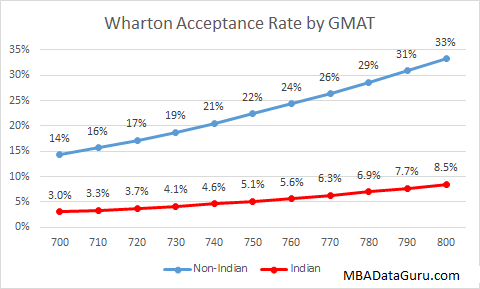
Last week I posted an article discussing the Indian application disadvantage at Wharton. I received a request to go into more detail about how GMAT impacts the Wharton acceptance rate for Indian applicants. Given that only 5% of applicants identified as Indian and the acceptance rate is low, I don’t have enough data to look at that relationship in isolation. However, I have built a model that can predict what that relationship would be for Indian applicants based off of data from other Wharton applicants.

Wharton Acceptance Rate by GMAT

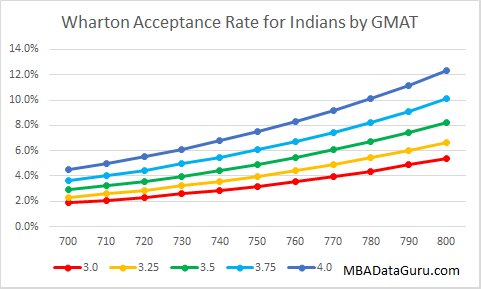
As you can see, my model predicts that there is a relationship between GMAT and the Wharton acceptance rate. This acceptance rates in the graph assumes a GPA of 3.54, which is the average for Wharton applicants. As you would expect, the higher the GMAT score, the higher the chance of getting in. Unfortunately, even with an 800, the forecast acceptance rate is still less than 10% for Indian applicants. Wharton Acceptance Rate GMAT India MBA Application

Wharton Acceptance Rate by GPA

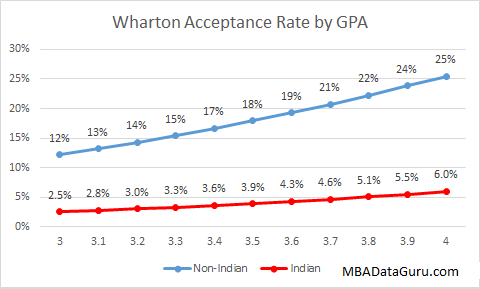
I decided to also look at the relation ship between GPA and acceptance rate as well. Similar to GMAT, higher GPAs increase your chance of acceptance. For the graph below I used the average Wharton GMAT score of 728 to calculate the acceptance rate. Even for candidates with a 4.0 GPA, they only have an acceptance rate of 6%.

Wharton Acceptance Rate GPA India MBA Application

After that I made a graph displaying the relationship between GMAT and GPA on acceptance rate for Indian applicants. With a 4.0 GPA and 800 GMAT, the acceptance rate increased to 12%, but that is still very low for such a qualified candidate.

Wharton_GMAT_vs_GPA_12-4-14

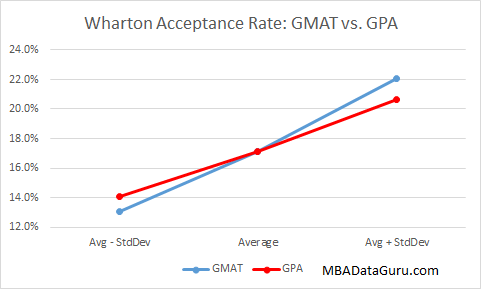
The final question to answer is which is more important to Wharton, GMAT or GPA. I already had suspicions that Wharton cared more about GMAT than GPA, and this analysis confirmed it. I looked at the average candidate (both Indian and non-Indian) then compared the average acceptance rate to the acceptance rate one standard deviation above and below for both GMAT and GPA.

Wharton Acceptance Rate GPA vs GMAT MBA AdmissionsAs you can see the slope for the line is steeper for the GMAT than for GPA. What this means is that a candidate who score one standard deviation above average for GMAT will be rewarded more than a candidate who has a GPA one standard deviation above average. Similarly a candidate will be punished more for having a low GMAT. This suggests that GMAT is more important to Wharton than GPA.

The data used to make this post came from GMAT Club and included applicants from 2012 through 2014.

Significant Indian Application Disadvantage at Wharton MBA Program

Recently I discovered an Indian application disadvantage at Wharton’s MBA program while reviewing their admissions data. I have been busy over the past few months at business school and haven’t been able to post. I am attending NYU Stern school of business and loving it. I have a little bit of free time over Thanksgiving break so I decided to make a little progress towards building my MBA admission calculator. I started by analyzing Wharton’s admission data because I have far more data available for Wharton compared to other schools. This makes it easier to find statistical significance in the model. For example, there are 1,093 Wharton applicants verses 498 NYU applicants. I built a beta version of a model to predict admissions into Wharton, but plan to spend a lot more time working on it before I release it on this website.

The Indian Application Disadvantage at Wharton

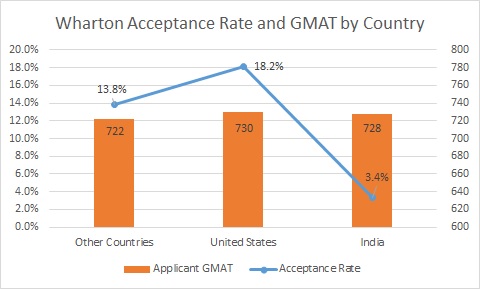
In building the logistic regression, I found that the only three variables had statistic significance, including GPA, GMAT and whether the applicant was from India. I was shocked to find a significant Indian application disadvantage, the acceptance rate for Indians was 3.4% compared to 18.2% for Americans and 13.8% for non-Indian Internationals.

Indian Application Disadvantage Wharton MBA GMAT

Despite similar GMAT scores, Indian applicants had significantly lower acceptance rate at Wharton.

The difference between American and non-Indian acceptance rates was not statistically significant. However, the Indian acceptance rate difference was significant, with a confidence interval of 0% to 8%. This means we can be about 95% sure that the Indian acceptance rate is equal to or lower than 8%. For this analysis I excluded all entries that were missing both GMAT and GPA. If I had included these applicants who didn’t share their scores, then the Indian acceptance rate would have dropped to 2.8%.

I don’t know why the acceptance rate for Indian applicants is lower despite similar GPAs and GMAT scores. It could be due to trouble writing application essays or some other explanation, but I think this matter needs to be looked at closer.

Protein Folding and Gamification

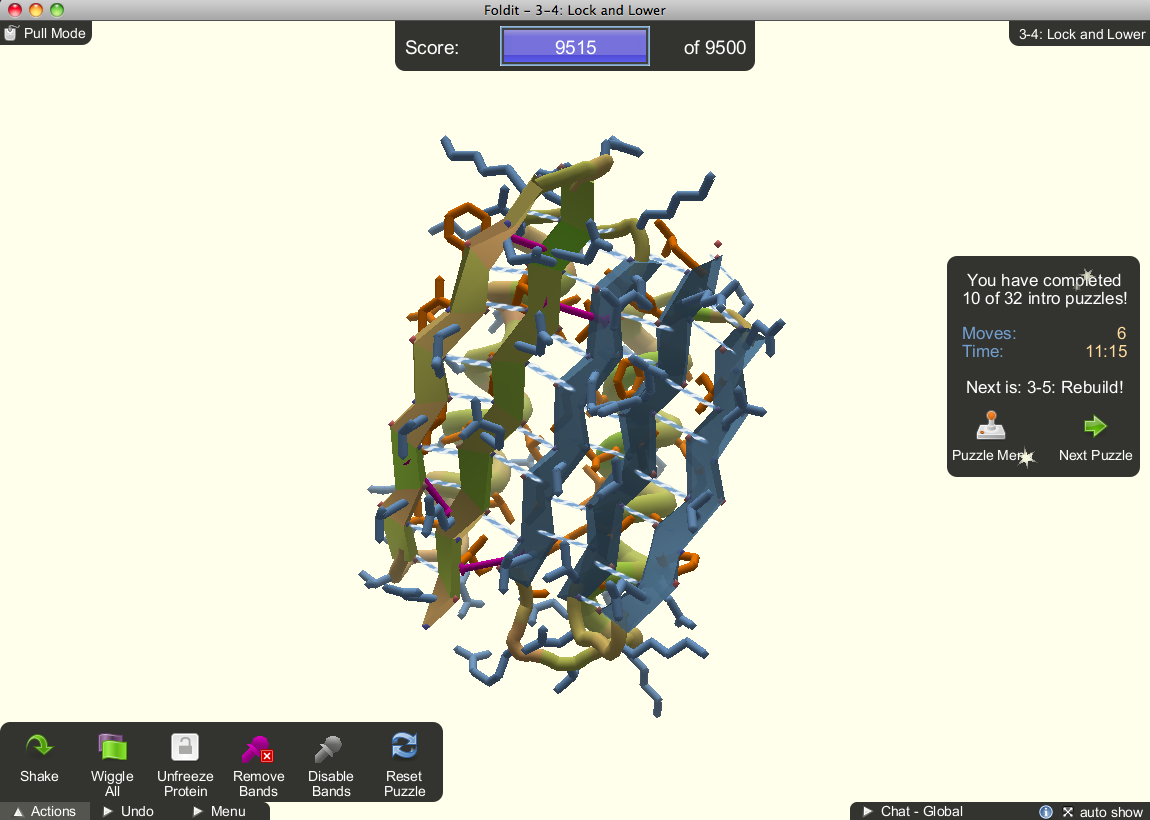
Right now I am taking a class through Coursera taught by a Wharton professor Kevin Werbach called Gamification. Gamification is the process of adding game like elements to non-game activities. Gamification makes those non-game activities more fun and engaging. In one lecture, professor Werbach talkes about a gamified research tool called Foldit. This tool is used to help solve protein folding problems.

Foldit Gamification Business Protein Folding

What is Protein Folding

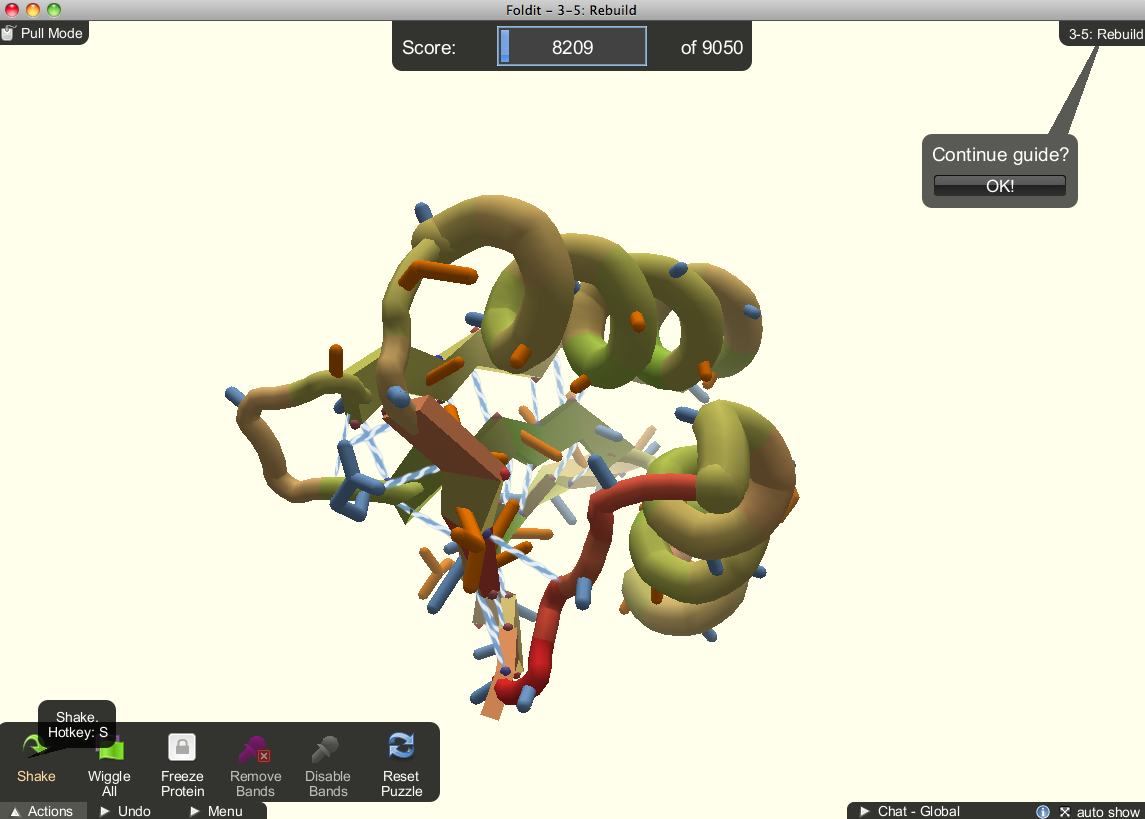
Proteins folding can be used to help understand how the body works and assist in finding cures for diseases such as HIV and cancer. Solving protein folding is an incredibly complicated problem and requires expensive supercomputers. Interestingly, human intuition is actually better at solving these complex problems than supercomputers. Researchers at the University of Washington decided to tap into the power of the human mind to solve these problems. The researchers turned protein folding into a game. Players score points for finding the best way to fold a protein.

In three weeks the gamers were able to solve problems that researchers had been working on for ten years. They helped to find targets for drugs to neutralize the AIDs virus.

Foldit Game HIV Cancer Protein Folding

My Experience Protein Folding

I downloaded and played Foldin. It is an extremely unique game. I actually really enjoy it. It gets difficult quickly. I finished the first 10 levels without major problems but am getting stuck on the 11th. In order to beat a level, you need to reach a target score. If you are really close to the target but can’t quite get there, it is really frustrating to start over. I don’t think I have solved any diseases yet because I am still on the 32 introductory levels that teach you the game.

Stanford GPA Impact on Acceptance

stanford gpa MBA business school acceptance rate

Stanford is the most select MBA program in the country. If you hope to be accepted, then you need to put together a very strong application. It is important to understand how at Stanford GPA will impact your chance of admission before deciding if you want to apply.

Unfortunately, once you finish your undergraduate degree, you GPA is set in stone. At this point the only metric you can improve is your GMAT. However, knowing where you stand with GPA can help you to set your GMAT goal so that you still have a competitive chance of being admitted by Stanford.

Stanford GPA by Acceptance Rate

Stanford GPA MBA Acceptance Rate Business School

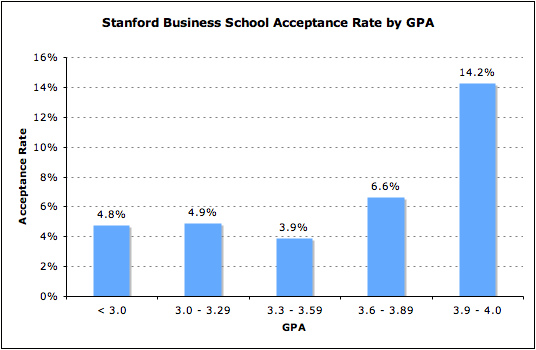
As you can see, at Stanford GPA has little impact on acceptance rate until it increases over 3.6. Above 3.6, acceptance rate increases by almost 50% compared to below 3.6. Applicants who have a GPA that is higher than 3.9 have a 200% higher chance of being admitted compared to students below 3.6. Although the below 3.0 applicants do not seem to suffer from a lower acceptance rate than applicants with a 3.0 to 3.6, the data for that population is very thin and is likely to have significant error. It is reasonable to assume that it will be difficult to be admitted at Stanford with a GPA below 3.0.

If you are luck enough to be invited by Stanford for an interview. It is important to work hard during interview preparation to maximize your chance of admission. Top MBA programs put a lot of weight on interpersonal skills, so you don’t want to slack off when it comes to the interview.

To create this Stanford GPA analysis, I used data from GMAT Club. The data included applicants for the class of 2014, 2015 and round 1 of 2016.

More recent analysis on the impact of GPA on Stanford admission rate shows that GPA is not an important factor, but GMAT is.