Yale MBA Acceptance Rate Analysis

Yale School of Management, also known as YSOM, is a prestigious school located in New Haven, Connecticut. It is difficult to gain admission to Yale’s MBA program, similar to their undergraduate school. The YSOM class of 2016 has impressive statistics, with a median GMAT of 720 and median GPA of 3.56. Only 22% of applicants who apply to Yale will be accepted.

Yale MBA Acceptance Rate by GMAT
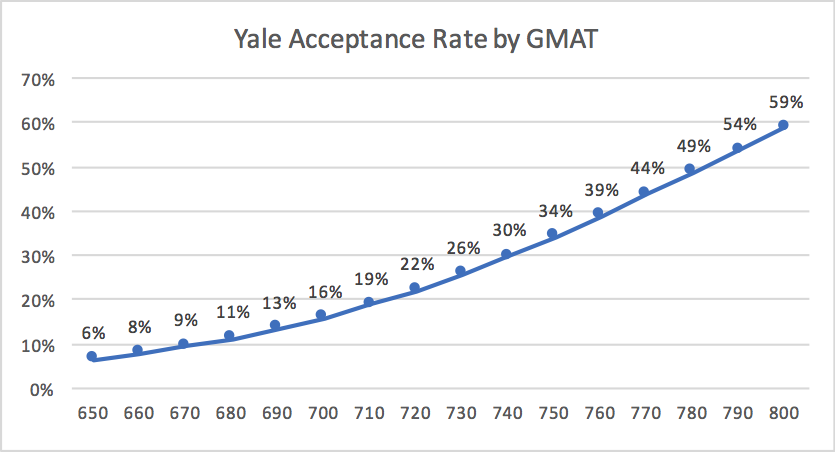
Yale MBA Acceptance Rate by GMAT Business School AdmissionsSimilar to all other schools, a high GMAT score will increase your chance of being admitted to Yale. Although the average GMAT score for the class of 2016 is 720, the average score for applicants is 7 points lower at 713. The GMAT range of the middle 80% of Yale MBA students is 680 to 760. However, the difference in acceptance rate for the bottom of that range is substantially lower than the top. An applicant with a 760 is more than three times more likely to be admitted than an applicant with a 680.

Yale MBA Acceptance Rate by GPA
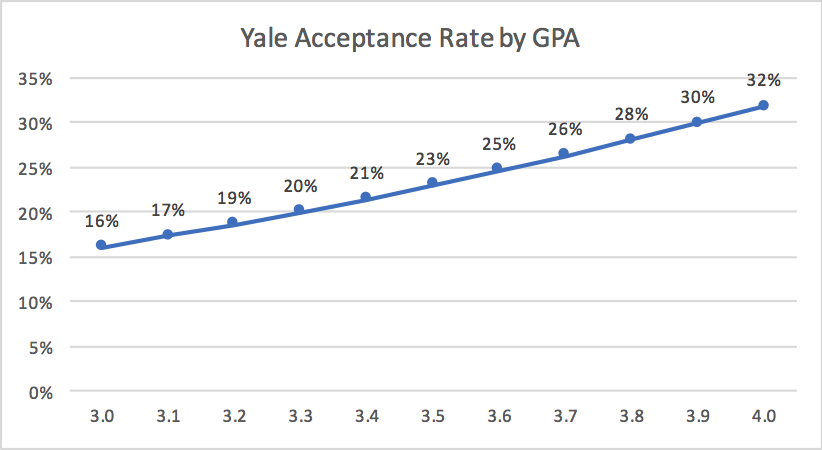
Yale MBA Acceptance Rate by GPA Business School AdmissionsA high GPA also raises the acceptance rate at Yale. The middle 80% students in the class of 2016 have a GPA between 3.17 and 3.87. An applicants with 3.87 is surprisingly only 50% more likely to be admitted than one with a 3.17. Even a perfect 4.0 only raises Yale MBA acceptance rate to 32%.

Yale MBA Acceptance Rate: GMAT vs. GPA
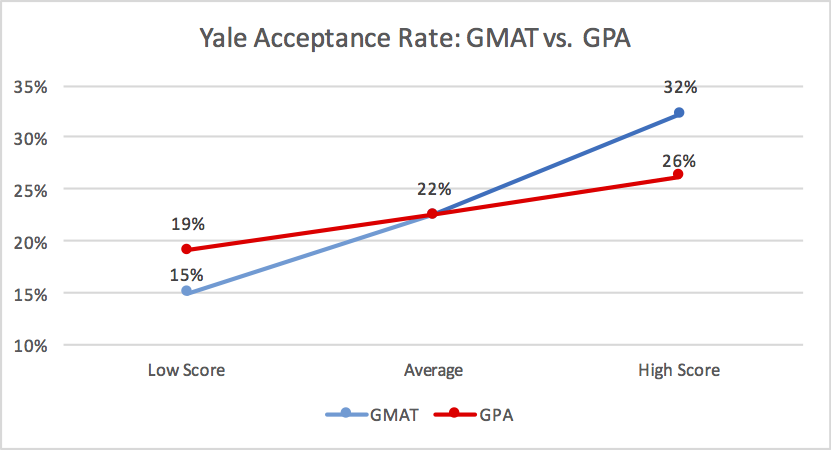
Yale MBA Acceptance Rate GMAT vs GPAThe chart above shows that GMAT is more important for admission to Yale than GPA. A high GPA will only increase acceptance rate by 4%, while a high GMAT results in a 10% higher chance of being admitted.* If you have a low GPA and a high GMAT, Yale is a great school to consider. For example, an applicant with a 3.0 and a 770 has a 34% chance of admission.

Yale MBA Acceptance Rate by Application Round
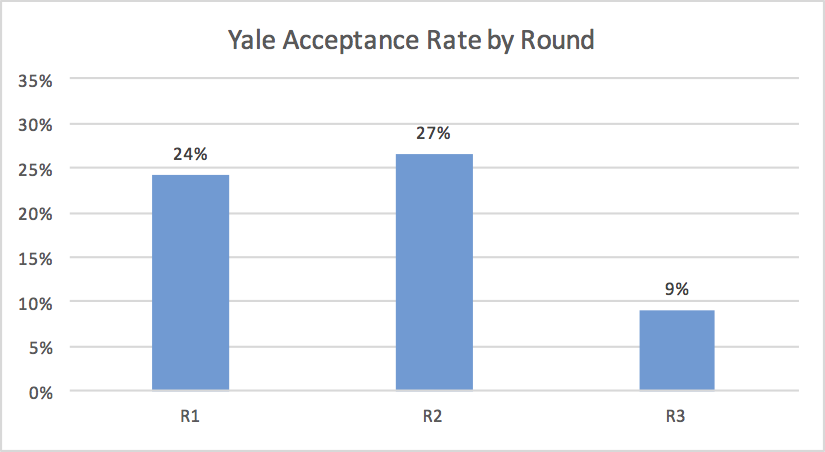
Yale MBA Acceptance Rate by Application Round Business School AdmissionsWhen applying to Yale, it does not matter whether you apply during the first or second round. However, applying in the third round is a huge disadvantage. Your chance of admission is less than half as likely compared to the first two rounds, so be proactive and submit your app early.

Other Admissions Factors

Indian applicants are at a significant disadvantage at Yale, with only a 6% acceptance rate. On the other hand, Yale seems to really like applicants with experience working for consumer packaged goods companies. Their acceptance rate is shockingly high, almost three times higher than average.

*A high score is defined as one standard deviation higher than average.
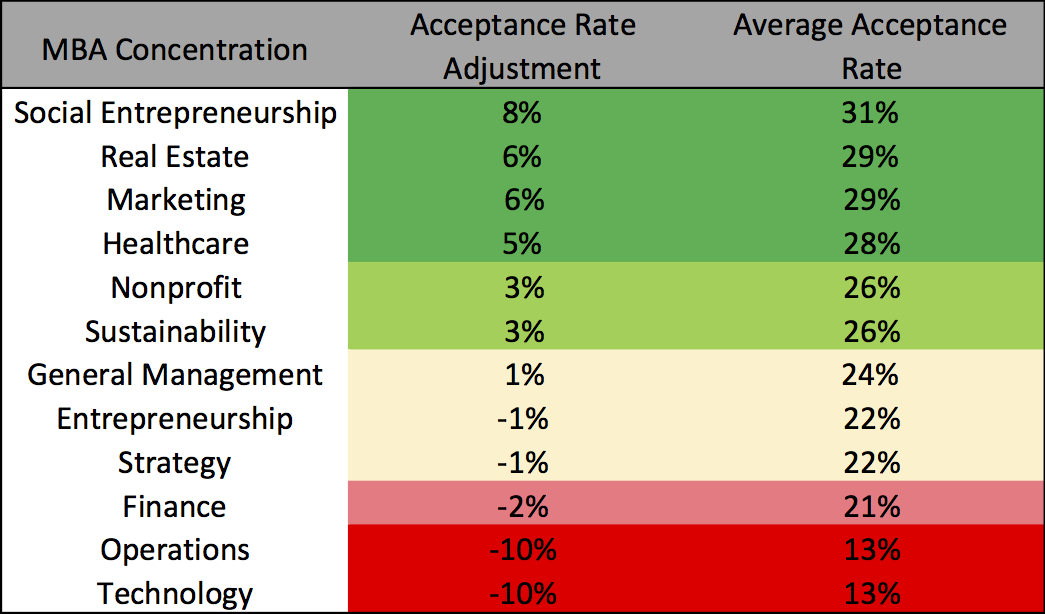
MBA Concentration Acceptance Rate Analysis

With the current semester just about over, next years application essay questions will be posted in the coming weeks for many schools. Round one applicants should start figuring out their story and crafting their essays. The most important essay for most schools is the question: Why get an MBA and why is [insert school name here] the right choice for you? In order to answer this question you need to have a plan for how an MBA is going to help you achieve your goals. The vast majority of MBA students are looking to switch careers. Why else pay $120,000 in tuition and give up two years of salary? If you wanted to stay in the same industry, you would probably just go for a promotion or switch companies.

I was curious if the industry an applicant is trying to transition into impacts their MBA acceptance rate. My theory was that there are a lot of people trying to transition into consulting, banking and technology, so there may be oversupply for those concentrations. Perhaps a candidate would stick out if they are pursuing a more unique career. I took the business school admissions data from GMAT Club and looked at the acceptance rate by stated concentration. First I decided to look at the top 20 schools in aggregate, to ensure the results were statistically significant. I was surprised by how much the acceptance rate varied depending on MBA concentration.

MBA Acceptance Rate by Concentration

MBA Concentration Acceptance Rate Business SchoolThe average acceptance rate for top 20 schools is 23%. Many of the concentrations towards the top are fairly small with the exception of Marketing. As you can see, there is a huge range in the acceptance rates based on industry focus. With Social Entrepreneurship applicants 2.5 times more likely to be admitted than applicants interested in Technology or Operations. Most of the results don’t surprise me, business schools seem to be trying to help the world right now, so it is no shock that Social Entrepreneurship, Nonprofit and Sustainability are all in the top half. With the crisis in the Healthcare industry, the high acceptance rate for Healthcare applicants is also logical I am a little surprised that Real Estate is so high and Technology is so low. There is not a lot of focus on Real Estate that I have seen in business school, so I didn’t expect it to be the concentration with the second highest acceptance rate. On the other hand, Technology is very hot right now, so it is shocking the admissions rate is so low.

Since this data does not have gender included, it is possible that the acceptance rates are skewed by gender concentrations. More women tend to focus on Nonprofit, Social Entrepreneurship, Marketing and Healthcare, which could have bumped up the acceptance rate. Many schools are trying to increase their female enrollment, so women tend to have higher acceptance rates. At the other end of the spectrum, industries such as Operations and Technology are more dominated by men, which likely led to the low acceptance rates in those concentrations.

In the end, I wouldn’t recommend outright gaming the system. Don’t say you want to pursue Social Entrepreneurship rather than Technology if Tech is really what you are passionate about. It will likely show in your application. However if you are unsure of what you want to focus on, it would make sense to chose the concentration you are interested in that has the highest acceptance rate. There was a lot of variance by school. The chart below shows some of the highest and lowest acceptance rate concentrations by school. Take these findings with a grain of salt because the sample size is pretty small.

School Increase Acceptance Rate Lower Acceptance Rate
Stanford Social Entrepreneurship Finance, Entrepreneurship
Harvard Entrepreneurship Finance*
Wharton Healthcare* Finance, Entrepreneurship, Marketing
Booth Healthcare*, Marketing* Entrepreneurship, Finance, Operations*
Sloan Marketing, Social Entrepreneurship* Technology*, Operations*
Kellogg Entrepreneurship, Marketing, Social Entrepreneurship Operations*, Technology*
Haas Entrepreneurship, Healthcare Operations*, Technology*
Columbia Social Entrepreneurship Entrepreneurship, Marketing, Healthcare
Tuck Healthcare, Marketing Finance, Technology*
Darden Marketing Entrepreneurship, Finance
NYU Entrepreneurship, Finance, Marketing*
Ross Entrepreneurship, Marketing, Healthcare*, Social Entrepreneurship* Finance, Operations*, Technology*
Duke Healthcare, Marketing, Social Entrepreneurship* Finance, Operations*, Technology*
Yale Marketing*, Social Entrepreneurship* Entrepreneurship
Anderson Finance, Marketing Entrepreneurship, Technology
Cornell Finance Entrepreneurship, Operations
McCombs Entrepreneurship, Marketing Finance
Kenan-Flagler Finance, Healthcare*, Marketing*
Tepper Entrepreneurship, Operations, Marketing* Finance
Emory Marketing Finance

*This concentration had a very large increase or decrease.

Cornell MBA Interview Questions and Guide

Cornell MBA Interview Questions Johnson Business SchoolThis guide is designed to help Johnson MBA applicants to prepare for their interview, complete with a list of the most common Cornell MBA interview questions. The typical Johnson MBA interview is 30 to 50 minutes long. It can be given by either a second year student, alumni or an admissions committee member. It is even possible to get an interview with an adcom member while a second year student is observing for interview training purposes. Interviews can take place on campus, off-campus or over Skype. Expect the interview to be semi-blind, which means that they have seen your resume but probably nothing else. The Cornell MBA interview questions below are organized from most common question to least common, with the frequency it is asked in parenthesis.

Most Common Cornell MBA Interview Questions

1) Tell me about yourself or walk me through your resume. (80%)

2) Tell me about a challenging situation at work or a work conflict. (70%)

3) Why Johnson? (70%)

4) Why get an MBA? Why now? (60%)

5) How will you contribute to Johnson? (50%)

6) What are your post MBA plans or goals? (50%)

7) Describe a time when you managed or lead other people? (50%)

8) What are your biggest weakness? (40%)

9) Why did you make XYZ transition? (20%)

10) What is your leadership style? (20%)

11) Have you applied to any other schools? What do they have in common with Johnson? (20%)

12) Is there anything else you want me to know? (20%)

At the end you will have time to ask a few questions. For additional interview tips check out my MBA interview preparation guide. This guide was created using the Johnson interview reports from clear admit.

MBA Waitlist Acceptance Rate Rank

A more up-to-date analysis of MBA waitlist acceptance rate has been completed which include admissions data for the class of 2019.

At this point in the year many applicants have been placed on the waitlist for the school of their dreams. It is a frustrating experience that I personally have experienced. This articles shows the MBA waitlist acceptance rates for the top US MBA programs. The data for this analysis comes from GMATClub. These acceptance rates are meant to give a rough idea of the waitlist acceptance rate and should be taken with a grain of salt. The sample sizes vary by school; Olin, Emory and Stanford have the lowest sample sizes.

MBA Waitlist Acceptance Rate by School Rank

US News Rank School Waitlist Acceptance Rate
1 Stanford 9%
2 Harvard 2%
3 Wharton 6%
4 Booth 15%
5 Sloan 8%
6 Kellogg 6%
7 Haas 4%
8 Columbia 6%
9 Tuck 10%
10 Darden 16%
11 NYU 3%
11 Ross 11%
13 Duke 4%
13 Yale 3%
15 Anderson 18%
16 Cornell 11%
17 McCombs 8%
18 Kenan-Flagler 46%
19 Olin 30%
20 Tepper 13%
21 Emory 4%

MBA waitlist acceptance rates ranges widely from 46% to 2% depending on the school. It tends to vary quite a bit from year to year, so these acceptance rates should only be used as a guide. For example Dartmouth’s average waitlist acceptance rate is 10%, however for the class of 2016 it was only 2%. The top ten schools on average have a slightly lower waitlist acceptance rate coming in at 8% while the next ten schools average a noticeably higher acceptance rate of 14%.

MBA Waitlist Acceptance Rate Rank

Acceptance Rank School Waitlist Acceptance Rate
1 Kenan-Flagler 46%
2 Olin 30%
3 Anderson 18%
4 Darden 16%
5 Booth 15%
6 Tepper 13%
7 Ross 11%
8 Cornell 11%
9 Tuck 10%
10 Stanford 9%
11 Sloan 8%
12 McCombs 8%
13 Kellogg 6%
14 Wharton 6%
15 Columbia 6%
16 Emory 4%
17 Duke 4%
18 Haas 4%
19 Yale 3%
20 NYU 3%
21 Harvard 2%

The schools with the highest MBA waitlist acceptance rates are Kenan-Flagler, Olin, and Anderson. At the other end are Harvard, NYU and Yale with the lowest waitlist acceptance rates. Although NYU has the highest interview acceptance rate, it rarely accepts anyone off the waitlist.

Darden MBA Acceptance Rate Analysis

Darden, UVA’s business school, is the business school ranked 11th in the US. Darden is a prestigious school and only 25% of applicants are accepted. I built a predictive model to see which factors are most and least important for Darden admission, the results may surprise you.

Darden MBA Acceptance Rate by GMAT

Darden MBA Acceptance Rate by GMAT UVA MBA Admissions Business School

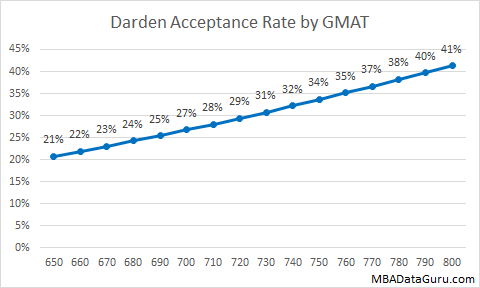
It is not shocking that increasing your GMAT will raise your Darden admission chance. The average GMAT score for accepted students at UVA’s business school is 706. If you were to increase your GMAT by 100 points from 650 to 750 when applying to Darden, you would raise your acceptance rate by an impressive 62%. Even at a GMAT score of 650, chance of acceptance is still over 20%.

Darden MBA Acceptance Rate by GPA

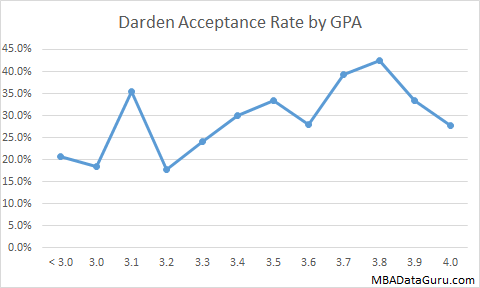
Darden MBA Acceptance Rate by GPA UVA MBA Admissions Business SchoolShockingly, GPA has little to no impact on your chance of admission to Darden. The average GPA of accepted students is 3.52. When I ran a regression model on factors that predict the chance of acceptance at Darden, GPA was one of the first variable eliminated. The graph above confirms my conclusion, a person with a 4.0 GPA has only a slightly higher chance of admission than a person with a 3.0. If you have a low GPA and a high GMAT, then Darden is a great school for you.

Darden MBA Acceptance Rate by Round

Darden MBA Acceptance Rate by Round UVA MBA Admissions Business School
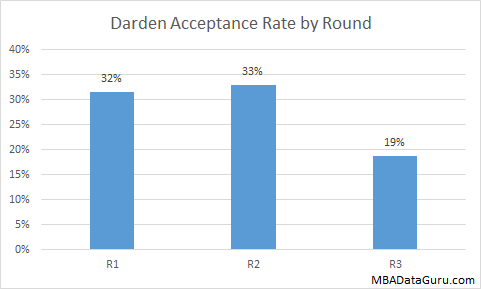
Recently I performed an analysis of MBA acceptance rates by application round. The Darden MBA acceptance rate was noticeably lower during round 3. When building the Darden predictive model I confirmed that the low round 3 acceptance rate was in fact statistically significant. Although round 3 applicants still have a fairly reasonable 19% acceptance rate, it is still significantly lower than the round 1 and 2 Darden admission rates. If you are on the fence about applying round 3 to Darden, you might as well wait for next year.

Other Darden MBA Acceptance Rate Factors

Similar to Wharton, Darden MBA applicants from India have roughly a 75% lower chance of admission. Computer science majors also have a similarly low chance of being accepted, coming in at 11%.

MBA Acceptance Rate by Application Round

An updated MBA acceptance rate by round analysis article can be found here which includes application data from the class 2017 and 2018.

Some business schools have roughly the same acceptance rate during all rounds while others see a significant drop off in later rounds. With applications for round 3 due in the next month or two, this analysis may help you decide which schools to focus on and which to avoid. Here is a list of the top 20 schools’ MBA acceptance rates by application round. The data for this analysis came from GMAT Club, which may be a biased sample. People on GMAT Club tend to have higher GMAT scores than the general applicant pool, so the acceptance rate can be significantly higher for some schools. The acceptance rates are meant to give you an idea of the relationship between rounds, not the absolute acceptance rate. These numbers are raw and not adjusted for other variables such as GMAT and GPA.

MBA Acceptance Rate by Round

The first table is MBA acceptance rates by round ordered by school ranking. The acceptance rates that have a star next to them means that the sample size is very small and might not be very accurate.

US News Rank School Round 1 Round 2 Round 3 Round 4
1 Stanford 8% 5% 2%
1 Wharton 19% 16% 0%*
1 Harvard 12% 6% 4%
4 Booth 29% 25% 15%
5 MIT 16% 11%
6 Kellogg 26% 23% 20%*
7 Haas 17% 17% 6%
8 Columbia 23% 20%
9 Tuck 28% 29% 22% 9%
10 NYU 29% 27% 21%
11 Ross 41% 42% 38%*
11 Darden 32% 33% 16%
13 Yale 24% 27% 9%
14 Duke 31% 33% 21%
15 McCombs 38% 36% 28%
16 Anderson 26% 34% 9%
17 Johnson 39% 36% 37%
18 Tepper 24% 38% 43%
19 Kenan-Flagler 36% 40% 60%
20 Emory 26% 40% 37%

Schools with Significantly Lower Round 3 Acceptance Rate

Many of the top 20 MBA programs have significantly lower acceptance rates in round 3 to the point where it is better to wait until next year to apply. Harvard, Stanford and Wharton, the number one ranked schools, have a large decrease in acceptance rate for round 3. Only 2% to 3% of applications for these schools are in round 3 because everyone knows that acceptance rates are so low. Haas, Yale, Duke, UVA and UCLA also see a significant drops in round 3 admissions compared to earlier rounds. Dartmouth has a respectable round 3 acceptance rate of 22%, but a very low 9% chance of admission for round 4.

Schools with Similar or Higher Round 3 Acceptance Rate

While many schools have a lower acceptance rate for round 3, there are several schools that don’t have a drop off in response. Ross, Cornell, and Emory all have similar admission odds for the third round, while Tepper and UNC actually have a higher acceptance rate for round 3.

Round 3 MBA Acceptance Rate Ranking

This is the the same table as the first one but ranked by round 3 acceptance rate from highest to lowest. Some schools have a round 4 that I did not include, because the sample size was too small. I combined round 4 applications with round 3 except for Tuck because Dartmouth actually had a large number of round 4 applicants.

Round 3 Rank School Round 1 Round 2 Round 3 Round 4
1 Kenan-Flagler 36% 40% 60%
2 Tepper 24% 38% 43%
3 Ross 41% 42% 38%*
4 Johnson 39% 36% 37%
4 Emory 26% 40% 37%
6 McCombs 38% 36% 28%
7 Tuck 28% 29% 22% 9%
8 NYU 29% 27% 21%
8 Duke 31% 33% 21%
10 Kellogg 26% 23% 20%*
11 Darden 32% 33% 16%
12 Booth 29% 25% 15%
13 Yale 24% 27% 9%
13 Anderson 26% 34% 9%
15 Haas 17% 17% 6%
16 Harvard 12% 6% 4%
17 Stanford 8% 5% 2%
18 Wharton 19% 16% 0%*
19 MIT 16% 11%
19 Columbia 23% 20%

The most surprising number is  UNC Kenan-Flagler’s round 3 acceptance rate of 60%, which is significantly higher than that of round 1 and 2. I looked at the GMAT and GPA for each round to see if they would explain the high admissions in round 3, however they were both slightly lower than other rounds. I can’t explain why UNC round 3 acceptance rate is so high, but it is a great school to apply to in the third round.

Kenan-Flagler UNC MBA Acceptance Rate by Round GMAT GPA Admissions Statistics

By request, below is the GMAT, GPA and age for Harvard and Booth by round. Round 3 data does not have a ton of data, so take this with a grain of salt.

School Variable R1 R2 R3
Booth GMAT 735 739 728
Booth GPA 3.61 3.62 3.58
Booth Age 27 28 29
Harvard GMAT 735 728 720
Harvard GPA 3.61 3.57 3.54
Harvard Age 27 27 27

* Sample size is 30 or fewer applications.

Tuck Acceptance Rate Analysis

Tuck School of Business is a top MBA program with a competitive admissions process. The Tuck acceptance rate is low, at 20%. Unlike most other top MBA programs, Tuck is a self initiated interview. Anyone who visits campus can schedule an interview. In this article I will discuss which factors impact Tuck acceptance rate.

Tuck Acceptance Rate by GMAT

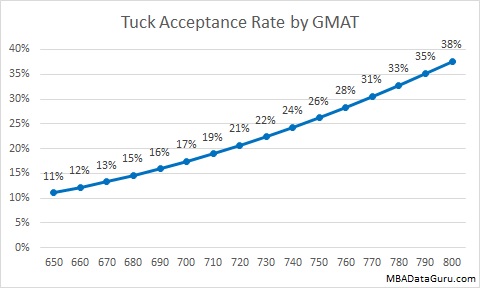
Tuck Acceptance Rate by GMAT Dartmouth MBA AdmissionsGMAT score has a large influence on Tuck acceptance rate. The average Tuck GMAT score is fairly high at 716. Adding a hundred points to your GMAT more than doubles your chance of admission. Even with a low GMAT of 650, acceptance rate at Dartmouth is still more than 10%, unlike Harvard where you need a 740 to have a 10% chance of admission.

Tuck Acceptance Rate by GPA

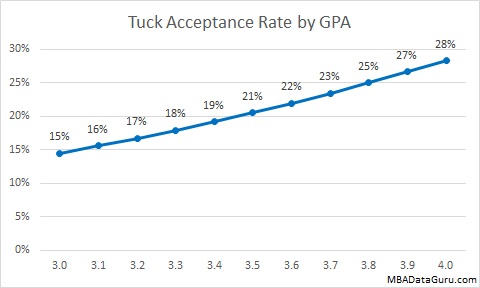
Tuck Acceptance Rate by GPA Dartmouth MBA AdmissionsThe average Tuck GPA is a solid 3.5. It is clear that applicants with a higher GPA have a better chance of being accepted. Once graduated, GPA is set in stone, so you might as well focus on increasing your GMAT which can still be increased.

Tuck GMAT vs. GPA

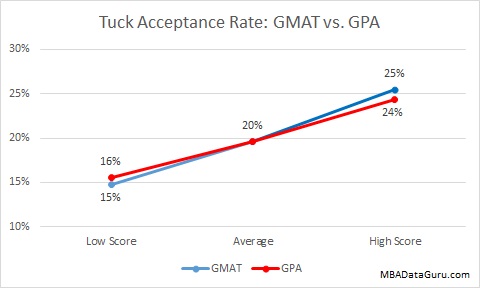
Tuck Acceptance Rate GMAT vs GPA Dartmouth MBA AdmissionsNext we look at whether Tuck prefers a high GMAT or a high GPA. The graph above shows that applicants with a high GMAT have a slightly better chance of being admitted than an applicant with a high GPA. The difference is so small that it is not very important.

Tuck Acceptance Rate by Application Round

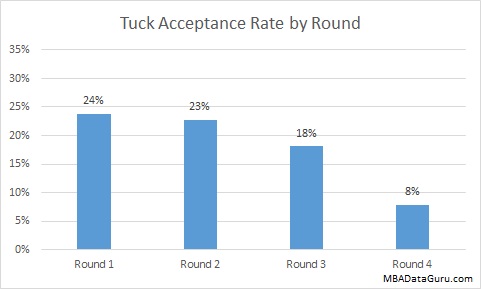
Tuck Acceptance Rate by Round Dartmouth MBA AdmissionsAs you can see in the graph above, the round you apply to Tuck does influence acceptance rate significantly. Round 1 and 2 have a similar admission rates of around 24%. Round 3 acceptance rate starts to drop off noticeably to 18% but not much below the 20% average acceptance rate. The Tuck acceptance rate for round 4 is extremely low, at 8%. Unless you have an incredible application or are desperate to leave your current job for business school, I recommend avoiding round 4 and waiting for the next year.

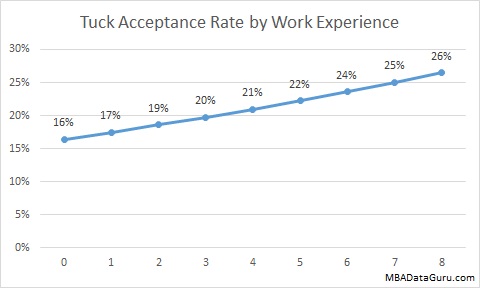
Tuck Acceptance Rate by Years of Work Experience

Tuck Acceptance Rate by Years Work Experience Dartmouth MBA AdmissionsTuck values applicants that have a longer work experience. Each year of work experience raises your chance of admission by a little more than 1%.

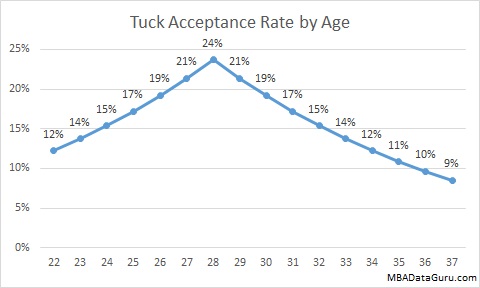
Tuck Acceptance Rate by Age

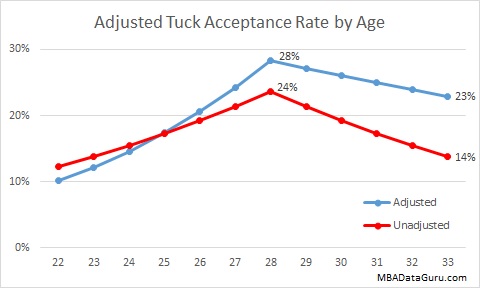
Tuck Acceptance Rate by Age Dartmouth MBA AdmissionsSimilar to other schools such as Columbia, Duke, Cornell and Booth, Tuck prefers applicants who are around 28 years old. I believe that this is because they have enough work experience to draw on during school but are not too old to be placed at companies during recruiting. In the above graphs I look at age and years of work experience separately, however in reality they are closely related.

Adjusted Tuck Acceptance Rate by Age Dartmouth MBA AdmissionsIn the graph above I adjusted the original acceptance rate by age graph and added in the impact of work experience. For simplicity I assume that everyone graduates at 22 and works full time from graduation until they apply for business school. When these two factors are combined, you see that older applicants have a large advantage compared to younger applicants.

Other Tuck Admissions Factors

There are a few other factors that affect your chance of admission to Tuck. International applicants (excluding India) have a significantly higher chance of admission, at 28% acceptance rate. Applicants that worked in Venture Capital are especially prized at Tuck, with an impressive 47% chance of admission.

If you are thinking of applying to Tuck, be sure to check out my Tuck Interview Question Guide so you know what questions to expect. The data for this analysis came from GMAT Club.

Stern Interview Preparation

NYU Stern Interview MBA Business SchoolStern Interviewed me back in December 2013. I am happy to say that I was accepted. I used Clear Admit to prepare, and it was very helpful. I felt ready and don’t remember being caught off guard by any questions. I have created a list of the most common questions you can expect during a Stern interview because I want to help all of my potential future classmates. Most Stern interviews are around 30 minutes and conducted by an admissions staff member who has read your full application. My first question was about a unique activity that I participate in that I mentioned in the application. When you arrive, you will receive a folder with information about clubs/programs you mentioned you would be interested in. You will also be given a Stern shirt so you can show your pride if you are admitted. My Stern interview was right before winter break so I didn’t hear back for almost 3 weeks, but often candidates get their decision in as little as a few days. Don’t forget to bring a copy of your transcripts, your application cannot proceed without them. I forgot mine and had to overnight them when I got back home.

The Most Common Stern Interview Questions

  1. (63%) Why do you want to attend Stern?
  2. (63%) How did you come to work for XYZ company? Or why did you transition for XYZ company to ABC company?
  3. (53%) What is your back up plan if you don’t get a job in your desired post-MBA role?
  4. (42%) What programs would you get involved with at Stern?
  5. (37%) Describe a conflict you had at work (or challenging situation or time you failed) and how you overcame it.
  6. (37%) What is your proudest professional achievement?
  7. (37%) What companies do you want to work at post MBA? (Have a list of 5 companies and reasons for each one)
  8. (37%) How is your post MBA goal different from your current role?
  9. (32%) Where would you like to intern between your first and second year?
  10. (26%) How would your (friends, manager or colleague) describe you?
  11. (21%) What is the weakest aspect of your resume?
  12. (21%) If you are admitted to all of the schools you applied to, how will you decide which school to attend?
  13. (21%) Why do you want to get an MBA?
  14. (16%) How do you plan to market yourself to your target industry?
  15. (16%) Tell me about yourself or walk me through your resume.
  16. (16%) If 25 years from now you were asked to return to Stern to speak, how would you want to be introduced?
  17. (11%) What is your role within a team?
  18. (11%) What will you contribute to the class?
  19. What other schools are you applying to?
  20. What other schools did you apply to? How would you decide where to attend?
  21. What frustrates me the most at my current role?
  22. What role would I prefer to take (if any) in a student organization?
  23. Tell me about what you’ve learned working at your current company?
  24. What’s the best constructive criticism your boss has given you?
  25. What do you hope to learn from your future classmates?
  26. How did you choose to attend ABC for undergrad? What is your best memory of your time there?
  27. How did you first hear about Stern and in what ways did you learn about the school?
  28. What most surprises you about Stern?
  29. Is international experience important to me in my business school experience? Why?
  30. Tell me what you like to do in your free time.
  31. What do you like about New York? What neighborhoods would you consider living in?
  32. What would you change/enhance on the Stern website?
  33. What makes Stern’s culture different from other schools?
  34. During the first few weeks at Stern, how will you distinguish yourself from the other students?
  35. Why do your MBA in New York City? (about the city.. not the school)
  36. What do you bring to the class?

Any question that doesn’t have a percentage next to it I only saw once in interview reports. The one Stern interview question that rubs me the wrong way is the question about  your back up plan. As a member of the class of 2016, I wonder is it so common that Stern students fail to get the job they want post MBA that Stern need to ask almost every student this question?

If you are invited for a Stern interview, please let me know if this guide was helpful for you. Also, check out my guide on how to prepare for an MBA interview.

Other interview preparation articles:

MIT / Sloan Interview Preparation

Upenn / Wharton Interview Preparation

Tuck Interview Preparation

HBS Interview Preparation

Wharton MBA Interview Questions and Preparation

Wharton mba interview question and preparationWharton is tied for the number one business school in the world. If you are fortunate to be invited to interview for a spot in Wharton’s MBA program then you are very lucky. Unfortunately, only 47% of applicants interviewed for the Wharton MBA program will be accepted into the school. Given the lower than 50-50 chance of acceptance, you should prepare as much as possible for your Wharton interview. This guide will walk you what to expect during your team based discussion (TBD), your individual Wharton MBA interview as well as what are the most common questions asked during the interview.

What to Expect in Wharton MBA Interview

There are two components to a Wharton interview. First you will participate in the TBD, then you will have a one on one interview, typically with a second year MBA student who watched you during the TBD. I recommend showing up to your interview at least 30 minutes early. This will give you a chance to meet as many of the applicants as possible. Hopefully you will meet several of the applicants who will be in your team based discussion, which will make working with them easier.

The TBD will last roughly 35 minutes and there will be 4 or 5 other applicants in the interview with you. There will also be 2 second year MBA students observing you. One of the two observers will be your one on one interviewer. Each prospective student will be given 1 minute to introduce them-self and their idea for the prompt. Take notes during the prompt and probably throughout the entire discussion. Make sure you know everyone’s name or you will look like an idiot, so write everyone’s name down. After the introductions are over you have another 30 minutes to solve the problem.

If your idea is selected then great, if not then don’t worry, just play along with the group. This isn’t an idea contest, it is an opportunity to see how your interact in a group. You need to show that you can work well in a group. If you act like a jerk and try to force your idea down everyone’s throat then you will not get into Wharton.

If possible try to show leadership traits. This can be by proposing an agenda for the discussion. This could be assigning roles such as time keeper and note taker. Be sure to talk but not too much. And do not interrupt other applicants.

Wharton MBA Interview Questions

The personal interview will last 10 to 15 minutes and will be conducted by one of the two MBA2’s who observed your TBD. You will typically be asked 4 questions, but it can range from 2 to 6. Here is a list of Wharton interview questions as well as the probability that you will be asked it during the one on one interview. The Wharton MBA interview questions were collected from Clear Admit.

  1. (83%) How do you think the discussion went?
  2. (42%) Walk me through your resume / tell me about yourself.
  3. (42%) Did your behavior in the TBD reflect how you normally are?
  4. (25%) Why Wharton?
  5. (25%) Do you have any updates to your application?
  6. (25%) What clubs would you participate in here at Wharton?
  7. (17%) What is something that your group could have done better?
  8. (17%) Who I would want and NOT want on my team?

I found the the who you would not want on your team question especially difficult because I wasn’t expecting it. Even though it is a rare question, make sure you have an answer. Good luck in your Wharton MBA interview and be sure to check out my guide to preparing for MBA interviews.

HBS Interview Questions and Preparation

HBS Interview Questions and preparation Harvard MBAYou have just received your HBS interview invitation and now you realize that you need to prepare for one of the most important interviews of your life. After all the Harvard acceptance rate for those interviewed is still only 50%. This guide will tell you what to expect during the interview and what are the most frequently asked questions during a Harvard MBA interview. Be sure to spend ample time preparing, because you know that everyone else invited by Harvard to interview will be also.

What to Expect in the HBS Interview

The interview will be 30 minutes long and will be conducted by two admissions committee members. It can take place on-campus, off-campus hub, or even sometimes over skype. There are many Harvard MBA interview questions that pop up pretty frequently, but Harvard has a lot more variation in the questions they ask than other schools. Harvard is going to dig deeper and ask follow up questions, similar to a McKinsey behavioral interview. You can expect anywhere from 5 to 18 questions during the interview. On average Harvard will ask you 11 interview questions.

Harvard will ask a lot of detailed questions about your resume and essays. Expect the adcoms to have read your full application. They seem to ask a lot of questions about choices and transitions that you have made. They will ask not only why you made that transition but how you made the transition.

List of HBS Interview Questions

Here is a list of the most common Harvard MBA interview questions. It is compiled from Clear Admit interview reports. I calculated the probability of a person receiving each question in an interview so you know which questions to prepare for most. Sometimes they will ask a slight variation to the questions below.

  1. (70%) What are your weaknesses? What is negative feedback you have received? What do you struggle with?
  2. (60%) Why did you choose ABC employer or transition to ABC employer? How did you get XYZ job?
  3. (55%) Is there anything you wish we had asked?
  4. (50%) What are your long term goals / plans? What do you want to do post MBA?
  5. (45%) Tell me about yourself.
  6. (45%) Why did you pick your college?
  7. (45%) What are your strengths?
  8. (35%) Why get an MBA?
  9. (30%) Describe your industry and role? What do you make of XYZ new competitor in your industry?
  10. (30%) What do you do in your job? What does a typical day at your current job look like?
  11. (25%) What is your dream job (or internship)?
  12. (20%) Tell me about a challenge you have faced.
  13. (20%) Tell about a company outside of your area of interest that you appreciate?
  14. (15%) What do you like to do for fun? What do you do outside work?
  15. (15%) Was moving to the United States (or other country) hard? Did you experience a cultural shock?
  16. (15%) Why Harvard? How have you gotten to know us?
  17. (10%) Why did you pick your major? What was the process?
  18. (10%) How did you get these promotions?
  19. (10%) Tell me some more about your siblings or family.
  20. (10%) What would you do differently if you were CEO of your company?
  21. (10%) What’s an issue in the news you always follow?
  22. (10%) Did you visit an HBS class? What did you think?

Interestingly they don’t frequently ask why Harvard as much as other schools. Perhaps because Harvard is one of the most prestigious and hard to get into school in the world. You should prepare for at least the first 9 HBS interview questions on the list because you have a very high chance of being asked one of these questions. Be sure to read my guide on how to prepare for an MBA interview.

For students applying to Harvard undergrad, check out the Harvard acceptance rate analysis at College Admit Me.