Monthly Archives: March 2017

Military MBA Acceptance Rate Analysis

Military MBA Acceptance Rate Analysis - GMAT GPA AgeTransitioning from the military to MBA is a fairly popular path to follow. A little over 4% of MBA applications come from military veterans. When looking at the data comparing military applicants to traditional MBA applicants, a few trends become clear:

  • Military / Veteran applicants tend to be a year or two older.
  • Scores for military applicants are a little lower on average, about 15 points on the GMAT and about .15 for GPA
  • Military applicants on average have another year or two of work experience
  • Military MBA acceptance rate is about 50% higher than the acceptance rate for traditional applicants
  • Some schools have a very large advantage for military applicants while others have little to no advantage

For the purposes of this article, I define traditional applicants as individuals that have worked in finance, marketing, accounting, retail, STEM and healthcare. They make up around 86% percent of MBA applicants. I excluded applicants that had a background in education, entertainment, sports, hospitality, tourism, human resources, journalism, publishing, government and non-profit.

Military applicants on average have the highest acceptance rate despite having the lowest average scores. My hypothesis is that they tend to have more significant leadership experience than other applicants and tend to do well in job placement. They also know how to operate well under pressure. These traits are desirable for MBA programs.

Military MBA Acceptance Rate by Tier

For the purposes of this analysis, I broke the schools into tiers since not all schools have enough data on military applicants to look at individually.

  • Tier 1 is defined as the schools ranked 1 through 7: Harvard, Wharton, Booth, Stanford, Sloan, Kellogg and Haas.
  • Tier 2 is defined as schools ranked 8 through 14: Tuck, Yale, Columbia, Ross, Stern, Fuqua and Darden.
  • Tier 3 is defined as schools ranked 15 through 25: Anderson, Johnson, McCombs, Kenan-​Flagler, Tepper, Goizueta, McDonough, Kelley, Olin, Marshall, Carey and Owen.
Tier
Applicant Group
Accepted
GMAT
GPA
Age
1
Traditional
14%
727
3.53
27.3
1
Military & Defense
23%
719
3.39
28.4
2
Traditional
25%
718
3.45
27.3
2
Military & Defense
39%
705
3.28
28.9
3
Traditional
37%
709
3.43
27.1
3
Military & Defense
55%
685
3.23
28.8

As you can see, military applicants have a substantial advantage at tier 1, 2 and 3 schools. The tier with largest lift is actually tier 1, which has a 62% higher acceptance rate for military applicants compared to traditional applicants. Military applicants had a 58% higher acceptance rate for Tier 2 schools and 49% for tier 3. Military applicants had the smallest score gap for tier 1 schools and the largest gap for tier 3 where military applicants had a GMAT that is 24 points lower.

Military MBA Acceptance Rate Lift

School
Military Acceptance Rate Lift
Harvard University (HBS)
117%
University of Michigan—​Ann Arbor (Ross)
94%
Duke University (Fuqua)
90%
University of Pennsylvania (Wharton)
75%
Massachusetts Institute of Technology (Sloan)
71%
Northwestern University (Kellogg)
57%
Columbia University (CBS)
39%
Dartmouth College (Tuck)
36%
University of Texas—​Austin (McCombs)
30%
University of Virginia (Darden)
19%
University of Chicago (Booth)
11%

The chart above shows how much higher the acceptance rate for military applicants is compared to traditional applicants. Harvard had the highest lift, where military applicants are more than twice as likely to get accepted. At the other end of the spectrum is Booth, where military applicants only have a 11% advantage over traditional applicants. My advice for military applicants is to apply to Ross and Duke. They are really strong schools with a greater than 50% chance of admission. I only included schools where there is enough data.

I looked at the acceptance rates for the other schools but there wasn’t enough data to publish an actual number. So I grouped them into categories.

  • Schools with a large lift ( greater than 70%): Haas, Emory, Tepper, and Kelley
  • Schools with a medium lift (30% to 60%): Stern, Anderson, Johnson, and Marshall.
  • Schools with little to no lift (lower than 30%): Stanford, Georgetown, Olin, Owen, Carey, UNC, and Yale.

I plan to do a similar analysis for other non-traditional applicants in the near future.
Best Schools for Young MBA Applicants

Deciding when to start applying to business school can be a challenge. Salary increases dramatically after an MBA, but schools tend to prefer applicants with more work experience. I looked at the top 25 US MBA programs’ admission data to find the best schools for young MBA applicants in terms of chance of being admitted. I analyzed the MBA acceptance rate by age to see which schools had the smallest disadvantage for younger applicants relative to traditionally aged MBA applicants.

How Many MBA Applicants are Young?

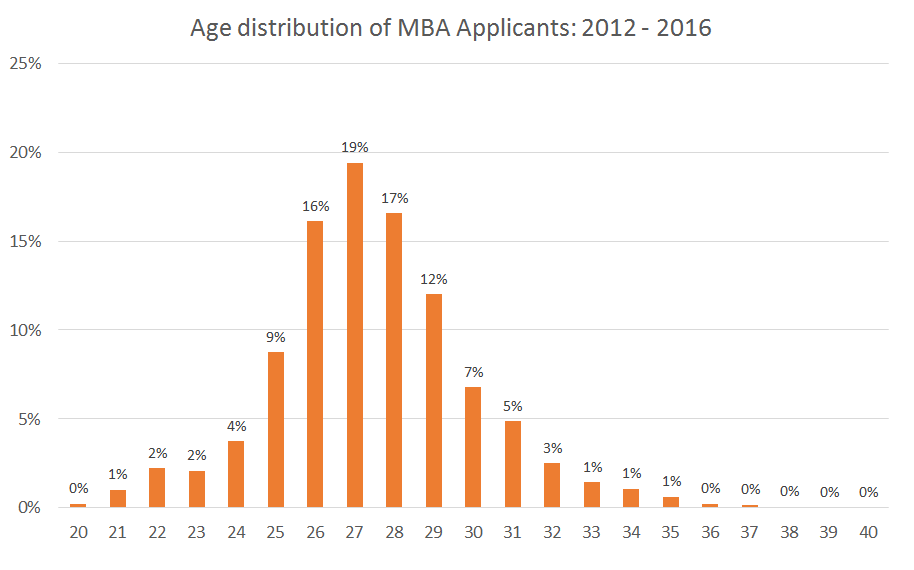
I defined an applicant as young if they are 25 or younger. I compared the young MBA applicants to those who are the more typical age range of 26 to 29. Over the past 5 years, the number of young applicants has increased significantly from 13% of the applicant pool to 21% over the past 5 years. Despite the increase in supply of young applicants, there has not been a drop in acceptance rate for younger candidates.

MBA Applicant Age Distribution

MBA Applicant Age Distribution

The rise in applications from younger applicants could be driven by some schools adopting programs specifically targeted at undergraduates. Harvard has the 2+2 program that allows undergraduates to apply to HBS while they are still in school. Those who are accepted must spend at least 2 years working full time before starting their MBA. NYU Stern also has a program targeted towards undergraduates called the Berkley Scholars. It is a very selective program where 5 to 6 undergraduates will get a full ride and a stipend for living expenses. Unlike Harvard’s 2+2 program, Berkley Scholars start their MBA immediately. The Berkley Scholars tend to do very well. From the class of 2016, two of the scholars joined McKinsey and one went to BCG.

Best Schools for Young MBA Applicants

Almost every school in the top 25 penalizes young applicants in admissions. On average young applicants have only 2.5 years of work experience which, is 2 years lower than traditionally aged applicants that are 26 to 29. Most of the best schools for young MBA applicants still moderately penalize younger applicants. Stanford is the only school that actually gives young applicants an advantage when they apply. My hypothesis is that it is related to their affinity for startups. If a young person has a great idea for a startup, will 2 more years working as a low level analyst really improve the odds of it working out? In the table below, the “Disadvantage for <25” column shows how much lower the odds are for a young applicant to be admitted. For example at MIT an applicant that is 26 to 29 has a 16% acceptance rate. The disadvantage factor is -10%, so the young MBA acceptance rate is 14.4%. I have included the average GMAT and GPA for reference.

School
Disadvantage
for <25
GMAT
(<25)
GMAT
(26 – 29)
GPA
(<25)
GPA
(26 – 29)
Stanford University (GSB)
52%
733
731
3.57
3.59
Washington University in St. Louis (Olin)
3%
719
712
3.52
3.46
Massachusetts Institute of Technology (Sloan)
-10%
720
729
3.56
3.52
Carnegie Mellon University (Tepper)
-16%
714
714
3.43
3.39
Georgetown University (McDonough)
-20%
699
699
3.43
3.35
University of North Carolina—​Chapel Hill (Kenan-​Flagler)
-26%
709
712
3.42
3.37
Cornell University (Johnson)
-28%
712
715
3.32
3.36
Columbia University (CBS)
-29%
722
726
3.55
3.49
Vanderbilt University (Owen)
-30%
698
692
3.49
3.34
University of Virginia (Darden)
-35%
723
718
3.44
3.39

Worst Schools for Young MBA Applicants

These schools are at the complete other end of the spectrum. These MBA programs severely penalize young applicants. It is interesting to see Berkeley, the other top California school, treats young applicants completely contrary to Stanford. Young applicants have a 72% lower chance of being admitted then applicants 26 to 29, despite the young applicants having higher GMAT and GPA. I was a little shocked to see Harvard featured so prominently on the list of worst schools for young MBA applicants given that they have the 2+2 program to attract young talent.

School
Dissadvantage for <25
GMAT
(<25)
GMAT
(26 – 29)
GPA
(<25)
GPA
(26 – 29)
University of California—​Berkeley (Haas)
-72%
722
721
3.56
3.51
University of Michigan—​Ann Arbor (Ross)
-64%
721
720
3.33
3.41
Harvard University (HBS)
-63%
731
732
3.59
3.58
Arizona State University (Carey)
-52%
690
687
3.46
3.41
University of Pennsylvania (Wharton)
-52%
734
731
3.56
3.55
Duke University (Fuqua)
-50%
716
717
3.46
3.42
University of Texas—​Austin (McCombs)
-49%
717
708
3.38
3.44
Dartmouth College (Tuck)
-48%
716
727
3.51
3.46
Indiana University (Kelley)
-47%
694
698
3.43
3.39
Yale University (YSOM)
-46%
713
724
3.49
3.47
University of California—​Los Angeles (Anderson)
-45%
720
718
3.48
3.47
University of Chicago (Booth)
-44%
726
731
3.56
3.52
Emory University (Goizueta)
-44%
714
705
3.46
3.37
Northwestern University (Kellogg)
-42%
730
724
3.5
3.49
New York University (Stern)
-41%
711
718
3.47
3.43
University of Southern California (Marshall)
-40%
703
707
3.52
3.42

MBA Acceptance Rate by Age Group

For reference, here are the raw MBA acceptance rates by age group for each school. I also looked at older applicants and plan to do a follow-up article focusing on applicants that are 30 years old and older.

Rank
School
<= 25
26 – 29
30+
1
Harvard University (HBS)
4%
12%
12%
1
University of Pennsylvania (Wharton)
10%
22%
15%
3
University of Chicago (Booth)
16%
28%
18%
4
Stanford University (GSB)
8%
5%
5%
4
Northwestern University (Kellogg)
14%
24%
26%
4
Massachusetts Institute of Technology (Sloan)
14%
16%
11%
7
University of California—​Berkeley (Haas)
4%
16%
8%
8
Dartmouth College (Tuck)
14%
27%
17%
9
Columbia University (CBS)
15%
21%
13%
9
Yale University (YSOM)
13%
24%
16%
11
University of Michigan—​Ann Arbor (Ross)
14%
40%
36%
12
New York University (Stern)
15%
26%
14%
12
Duke University (Fuqua)
13%
26%
24%
14
University of Virginia (Darden)
23%
36%
19%
15
University of California—​Los Angeles (Anderson)
14%
24%
22%
16
Cornell University (Johnson)
28%
40%
41%
17
University of Texas—​Austin (McCombs)
19%
37%
29%
18
University of North Carolina—​Chapel Hill (Kenan-​Flagler)
30%
41%
42%
19
Carnegie Mellon University (Tepper)
34%
40%
38%
20
Emory University (Goizueta)
22%
39%
42%
21
Georgetown University (McDonough)
39%
49%
46%
21
Indiana University (Kelley)
22%
42%
56%
21
Washington University in St. Louis (Olin)
34%
33%
38%
24
University of Southern California (Marshall)
24%
40%
35%
25
Arizona State University (Carey)
19%
39%
62%
25
Vanderbilt University (Owen)
35%
50%
63%

Are you curious what round to apply during? Check out my article on MBA Acceptance Rate by round.

MBA Acceptance Rate by Round (class of 2018 data included)

The third round of MBA applications is notorious for having a lower acceptance rate. With the third round application deadlines approaching quickly for most business schools, you may be wondering if the stereotype about the third round is fact or fiction. I updated my analysis of MBA acceptance rate by round with the last 2 years of data and I expanded it to include Olin, Georgetown, USC, Arizona State and Vanderbilt.

This analysis was done using self-reported data from GMAT Club. Data from the class of 2014 through the class of 2018 was used because otherwise there would not be enough data for round 3 and 4 to accurately capture the acceptance rate.

MBA Acceptance Rate by Round Key Takeaways

  • At almost all top 15 schools applicants have a moderate to significant disadvantage when applying during the 3rd and 4th round
  • Applicants to schools ranked 16 to 25 had little to no disadvantage when applying in the 3rd and 4th round
  • On average, top 15 schools had a much larger drop in applicant GMAT from round 1 to round 3 (16 points) than the rest of the top 25 (4 points), but GPA decline was identical (.07)
  • Schools with the largest drop in acceptance rate from round 1 to 3 also had the largest drop in GMAT (20 points)
  • Schools with moderate drop in acceptance rate from round 1 to 3 had a smaller drop in GMAT (10 points)
  • Schools that have no disadvantage when applying 3rd round had almost no drop in GMAT (3 points)

Schools where round doesn’t matter

Although 60% of the top 25 schools are noticeably impacted by which round you apply, several schools don’t appear to care when you apply. Stanford GSB and NYU Stern are the only two schools in the top 15 that are not influenced by which round an applicant applies. Cornell, UNC, Tepper, Emory, Kelley, USC, ASU and Vanderbilt all appear to be unaffected by which round a candidate applies.

Schools where round has moderate impact

Many schools in the across the entire top 25 are moderately impacted by application round. This include top 15 schools such as Kellogg, Tuck, CBS (rolling admission), Ross and Duke. McCombs, Georgetown and Olin are all only minimally impacted by application round.

Schools where round has high impact

Only schools in the top 15 seem to be highly impacted by applying 3rd round. HBS, Wharton, Haas and Darden are most impacted by round. Booth, Sloan, Yale and UCLA are also significantly affected by application round.

MBA Acceptance Rate by Round

Rank
School
R1
R2
R3
R4
1
Harvard University (HBS)
13%
8%
4%
1
University of Pennsylvania (Wharton)
20%
20%
0%
3
University of Chicago (Booth)
26%
23%
13%
4
Stanford University (GSB)
6%
6%
6%
4
Northwestern University (Kellogg)
22%
20%
13%
4
Massachusetts Institute of Technology (Sloan)
18%
10%
Low data
7
University of California—​Berkeley (Haas)
14%
14%
6%
Low data
8
Dartmouth College (Tuck)
26%
24%
20%
7%
9
Columbia University (CBS)
20%
16%
9
Yale University (YSOM)
21%
21%
11%
11
University of Michigan—​Ann Arbor (Ross)
26%
31%
24%
12
New York University (Stern)
19%
22%
22%
Low data
12
Duke University (Fuqua)
24%
23%
15%
14
University of Virginia (Darden)
29%
28%
13%
15
University of California—​Los Angeles (Anderson)
19%
22%
9%
16
Cornell University (Johnson)
33%
33%
31%
33%*
17
University of Texas—​Austin (McCombs)
32%
28%
24%
Low data
18
University of North Carolina—​Chapel Hill (Kenan-​Flagler)
26%
33%
44%
38%
19
Carnegie Mellon University (Tepper)
25%
36%
34%
Low data
20
Emory University (Goizueta)
27%
35%
32%
25%*
21
Georgetown University (McDonough)
41%
47%
32%
21
Indiana University (Kelley)
22%
39%
34%
21
Washington University in St. Louis (Olin)
31%
31%
27%
28%
24
University of Southern California (Marshall)
26%
32%
23%*
25
Arizona State University (Carey)
37%
20%
37%
Low data
25
Vanderbilt University (Owen)
41%
41%
49%
45%*

Check out the upcoming deadlines for round 3 and 4.

*Very few data points are available, so confidence on the accuracy is also low.

US News MBA Ranking 2017: The Redemption of Stern

NYU Stern MBA Business School Class of 2016

Photo credit: Anmar El-Khalil during graduation week 2016

Last year when the MBA rankings came out for US News and World Report, NYU was shocked and horrified. The school that was ranked 10 when we were admitted had dropped to 20. We all invested approximately $300K* in getting an MBA and now the perceived value of our degree had dropped significantly. In reality, many of us from the class of 2016 already had jobs so it would have little to no effect on us, but it was still a slap in the face. Either way, it felt awful and was a terrible way to end our MBA experience.

That Sprint we held monthly town hall meeting to discuss the action the administration was taking to correct the rankings problem. Some people felt defeated and bitter and others were energized to correct this grave injustice. We poked fun at ourselves at Stern Follies #Top20MBA. No matter how people behaved in reaction, underneath we were all really hurt by what had happened.

So the real question is why did NYU drop 9 places to 20. US News and World Report admits that they were missing one data piece from Stern and that they pulled a random value out of their @#$ to fill in for that number rather than ask us for it. Rankings are serious business and can seriously impact application volume and matriculation for schools, so US News should not take it lightly. The protocol for data submission starts with the school submitting roughly 300 pieces of data. Next, US News confirms that they received all the data that they need before calculating the rankings. Next they generate the rankings, and finally they publish them.

US News knew that they were missing 1 data point from Stern for the rankings, yet they never informed us of it. US News is supposed to verify that they have received all data points before starting the ranking process. Someone at US News had to spend time “estimating” the one piece of data that was missing yet it never occurred to them that they might just drop us an email to inform us of the missing value. They ended up coming up with an estimate that was wildly off by around 2000 basis points.

As a reasonable person, I have a hard time believing that US News did not do this maliciously. Rankings that stay the same each year are boring and don’t get attention. However, when there are big moves it attracts attention. I believe that US News knew exactly what they were doing when they decided to publish the rankings with their fabricated data point because they knew it would it would attract headlines and generate revenue for their company.

This year NYU Stern submitted all of the data points and bounced back to number 12. I don’t think that US News ever had anything against Stern but they also didn’t care if they hurt people in their quest for more pageviews. It feels good to be back in the general rankings range that I started my MBA, but I can’t help but have a bad taste in my mouth.

Stern is truly an amazing school and I owe much of my success to it. Not only does it have top notch professors, but the students are both talented but also down to earth. Some MBA programs are cutthroat, but NYU is not one of them. Everyone is extremely collaborative and works well in a team environment. We help each other rather than compete.

The head of Stern recruiting at a consulting firm once told me a story about recruiting at Stern. He told a partner that they had to be more harsh with the interviews in the afternoon than the morning at Stern. The partner had not attended Stern, so he didn’t understand why. So this consulting manager informed him that NYU students puts the school and each other ahead of themselves and they will help each other prep for the interviews even if it hurts themselves. In my experience at Stern, we lived up to that expectation. Everyone was collaborative and helpful. No one was cutthroat. It is an amazing place to get your MBA.

*$120K in tuition and $180K in salary opportunity cost.

MBA Round 3 Application Deadline

It is mid March and the application season for the class of 2019 is winding down. If you plan to apply for this year, you should check the MBA Round 3 Application Deadline for the school of your dreams because it is fast approaching or already past. Also, check out the MBA acceptance rate for round 3 at the schools you are considering.

MBA Round 3 Application Deadline

School
Application Round
Application Deadline
Decision Notification
Harvard
3
4/3/2017*
5/10/2017
Stanford
3
4/5/2017
5/18/2017
Booth
3
4/4/2017
5/18/2017
Wharton
3
3/28/2017
5/9/2017
Kellogg
3
4/5/2017
5/10/2017
MIT Sloan
3
4/10/2017
5/17/2017
Haas
3
4/6/2017
5/11/2017
Columbia
3
4/12/2017**
Interview notification 6 weeks later
Tuck
4
4/5/2017
5/12/2017
Yale
3
4/19/2017
5/18/2017
UVA
3
4/6/2017
5/8/2017
NYU
4
3/15/2017
6/1/2017
Ross
3
3/20/2017
5/12/2017
Duke
3
3/20/2017
4/17/2017
Cornell
4
3/15/2017***
4/5/2017
McCombs
3
4/4/2017
5/11/2017
UNC
4
3/10/2017****
4/24/2017****
UCLA
3
4/12/2017
5/24/2017
Emory
4
3/10/2017
4/28/2017
Olin
3
4/3/2017
5/5/2017
CMU
4
4/23/2017
5/24/2017

Now that you know when you need to apply for round 3 or 4, you may be wondering what your chance of getting accepted for the final round. Typically acceptance rate is lower for round 3 or 4 for most business schools. I will publish an updated acceptance rate by round article in the next couple days, which can help you decide if it make more sense for you to apply now or wait until round 1 in the fall.

*2+2 program notification is 5/17/2017
**Rolling admission until 4/12/2017
***After March 15th, applications will be received and reviewed on a space available basis
****If space is still available in the class, we will accept applications after the Round 4 deadline. Decisions on applications submitted after the Round 4 deadline will be released on a rolling basis.

Olin also has a round 4 and 5 in June and July.